NC House passes crypto ATM bill to curb scams. Will the Senate take it up?
AI-generated summary reviewed by our newsroom.
- House Bill 920 passed the rules committee, a step before the full House.
- Measure would impose transaction limits, fee caps and fraud-protection rules.
- Bill limits new users to $2,000/day for the first 30 days, then $5,000/day.
A bill aimed at regulating cryptocurrency kiosks, often called crypto ATMs, advanced in the North Carolina House on Tuesday.
The measure comes as the machines — which allow users to convert cash into digital currencies such as Bitcoin and Ethereum — have spread across the Triangle and the country while drawing increasing scrutiny for their role in fraud and scam schemes.
North Carolina currently has no regulations governing crypto ATMs despite several other states having taken action, with Indiana having completely banned the kiosks.
House Bill 920, the Virtual Currency Kiosk Consumer Protection Act, seeks to change that.
The legislation was introduced last week as a substitute to another bill and has moved quickly through House committees, where it has been further amended.
It passed the rules committee Tuesday and moved to the House floor, where it passed unanimously.
The bill now goes to the Senate.
“The bill protects North Carolinians from cryptocurrency kiosk scams. Cryptocurrency fraud is rapidly growing in America,” said Rep. Neal Jackson, a Robbins Republican and one of the bill’s primary sponsors, during a finance committee hearing on Tuesday.
Jackson cited FBI data showing more than 13,400 cryptocurrency kiosk-related complaints nationwide in 2025, resulting in $389 million in reported losses. That represented a 23% increase in complaints and a 58% increase in losses compared with the previous year, he said.
The FBI data also shows more than half of the complaints were made by those over the age of 50, who lost over $302 million in 2025. In North Carolina in 2025, there were 491 complaints with over $12 million in losses. And that’s just what’s reported.
Pressure for regulation had been building. That’s included from the AARP North Carolina, which in May went out to various businesses, including gas stations and restaurants that host these machines, asking them to hang a sign near the crypto ATMs with fraud warnings.
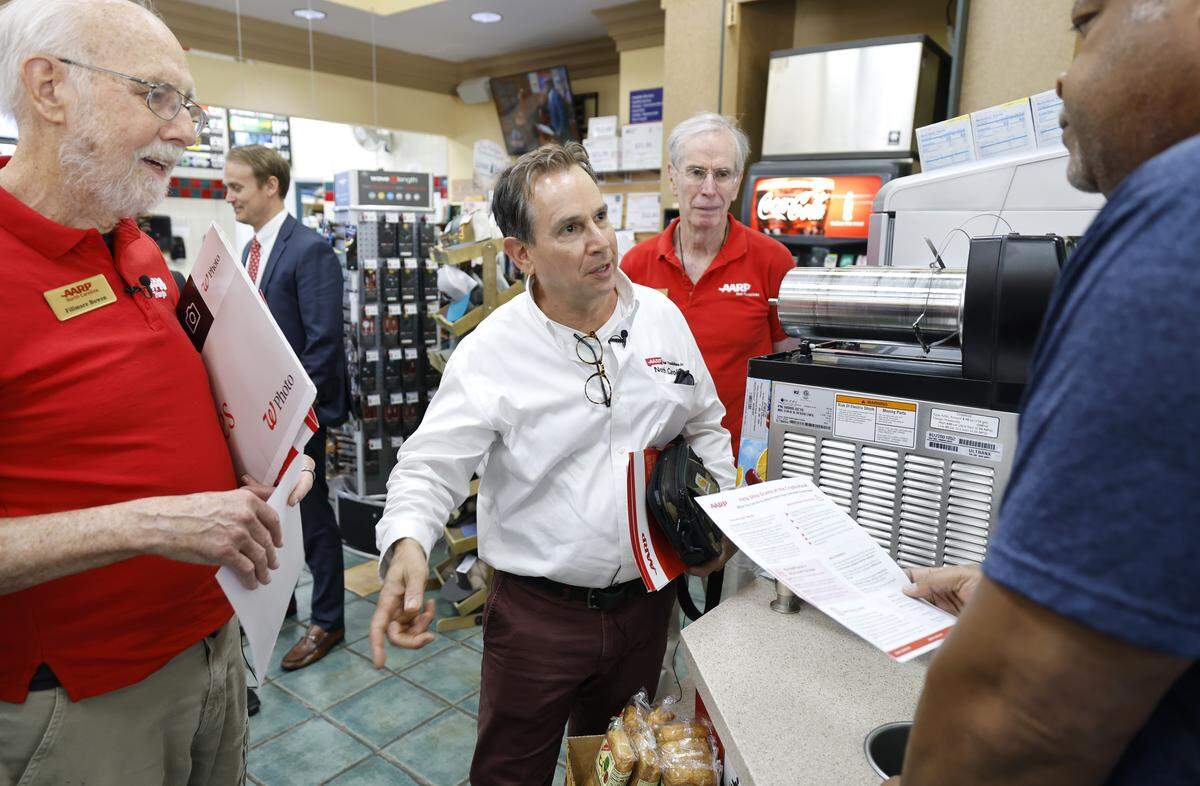
At the time, Chris Brandenburg, manager of federal and state advocacy for AARP North Carolina, told The News & Observer the organization had been having conversations with House and Senate lawmakers “who seem to understand the gravity of this issue.”
As for what legislation could look like, Brandenburg said in a “perfect world” it would include a full ban. If not, he said, alternatives could include safeguards such as transaction limits, recovery methods for victims of scams, and requirements for warning signage around the machines.
During the AARP NC event, one victim of a crypto ATM scam shared her experience. Dolores Miller, a 71-year-old Silver Spring, Maryland, resident, lost about $10,000 she and her husband had stored in a safe at home for their retirement. A scammer called her posing as a law enforcement officer and told her there was a warrant out for her arrest and that she needed to post bond — in cash, through a Bitcoin ATM.

“I was in a very heightened emotional state,” Miller told The N&O, adding that a security guard at the grocery store never intervened, despite her coming and going, crying, and having an anxiety attack.
“I just think if people who work in places where they have these machines, if they get some education as to what machines are used for, maybe it would have been like, ‘Wait a minute,’” she said.
What the bill does
The bill would license kiosk operators under North Carolina’s Money Transmitters Act — a state law that governs businesses engaged in transmission of money — and place them under the supervision of the state’s office of the Commissioner of Banks.
It would require operators to provide fraud warnings for customers to complete transactions, designate and employ compliance and consumer protection officers and implement anti-fraud measures. Operators would also need to submit reports of the location of each virtual currency kiosk within the state.
Businesses that host the machines can earn money through revenue-sharing agreements or leasing arrangements with kiosk operators like Bitcoin Depot and Coinstar.
The legislation would impose transaction limits. New customers would be limited to $2,000 in transactions per day during their first 30 days of using a kiosk. After that period, customers could conduct up to $5,000 in daily transactions. That was previously $7,500 but was amended during the finance committee.
New customers’ first transactions would be held 48 hours before the crypto is sent. New customers who are scammed would be able to get a full refund if the fraud was reported within 30 days and the state Commissioner of Banks confirms the transaction was fraudulent. Existing customers who are scammed would get their fees refunded but not the full transaction amount. Anyone would be able to cancel a transaction for a full refund before it completes.
The bill bans the use of QR codes to log in to kiosks. That’s because in crypto ATM scams, scammers often provide victims a QR code that sends their money straight to the scammer’s wallet instead of their own.
Fee cap debate
The bill would cap service fees at 14% of the value of the transaction. Currently, no state limit exists on the fees crypto ATM companies can charge.
That fee cap came up as a point of contention.
Rep. Tim Longest, a Raleigh Democrat, introduced an amendment during the finance committee hearing to lower the cap to 3%. The amendment — and the bill — was initially approved via voice vote by the committee.
But the bill was brought back before lawmakers after Longest’s amendment was found to conflict with a separate amendment from Rep. Brian Echevarria, a Harrisburg Republican, to lower the $7,500 daily limit to $5,000.
After a roll call vote, the proposal to lower the cap failed.
“We have to decide if we want to regulate a current industry that’s not regulated at all, or do we want to put it out of business, and I believe this amendment would put the industry out of business,” Jackson said, urging committee members to vote against the lower cap.
The 3% cap, said Longest, still permits a “reasonable profit,” without allowing companies to take a large chunk of each transaction.
Later, during the rules committee, Longest said that “in crafting regulations, I think it’s important that we ensure that consumers are adequately protected by those regulations, and I do not believe that under the language of the bill currently before you, those regulations are sufficient to protect consumers. “
Longest also unsuccessfully sought to lower daily transaction limits to $1,000 for new customers and $2,500 for existing ones. Those had been the limits in an earlier proposed version of the bill. During the House session, Longest again introduced an amendment to lower the cap and to lower the new customer daily transaction. That failed, too.
The bill would take effect Dec. 1 if it becomes law.
This story was originally published June 9, 2026 at 3:23 PM.