
Durham explores DAP’s future as community demands preservation of old ballpark
AI-generated summary reviewed by our newsroom.
- Durham study offers three redevelopment concepts for 5.44-acre DAP site
- Community survey of 2,611 favors public access, preservation and green space
- City Council directs staff to study preservation options and flexible funding
The future of the historic Durham Athletic Park, a nearly century-old landmark downtown, is set for a dramatic transformation.
The city of Durham received the findings of a study that outlines three ambitious, multi-million dollar ideas for the 5.44-acre site, ranging from a preservation effort to a complete landscape transformation.
The study, conducted by architecture firm Perkins + Will North Carolina Inc, confirmed overwhelming support from the community for redeveloping the city-owned facility that was once the set of the 1988 film “Bull Durham.” Residents want to see the old ballpark become a vibrant civic and cultural destination that emphasizes green space, youth activities, festivals and free public programs.
At a meeting Thursday, the Durham City Council discussed the costs of redevelopment, estimated between $40 million and $85 million, and the community’s desire to modernize the historic park while preserving its legacy.
“Updating the DAP to give it the ability to host both sporting and non-sporting events will provide activities and reasons for people from all over Durham and beyond to visit,” said Susan Amey, a representative with Durham Next, a nonprofit focused on projects in Durham.
“That will also provide the greatest foot traffic to support surrounding hospitality and entertainment businesses, creating the most economic impact for Durham and additional tax revenue,” Amey said.
The park’s history and demands for access
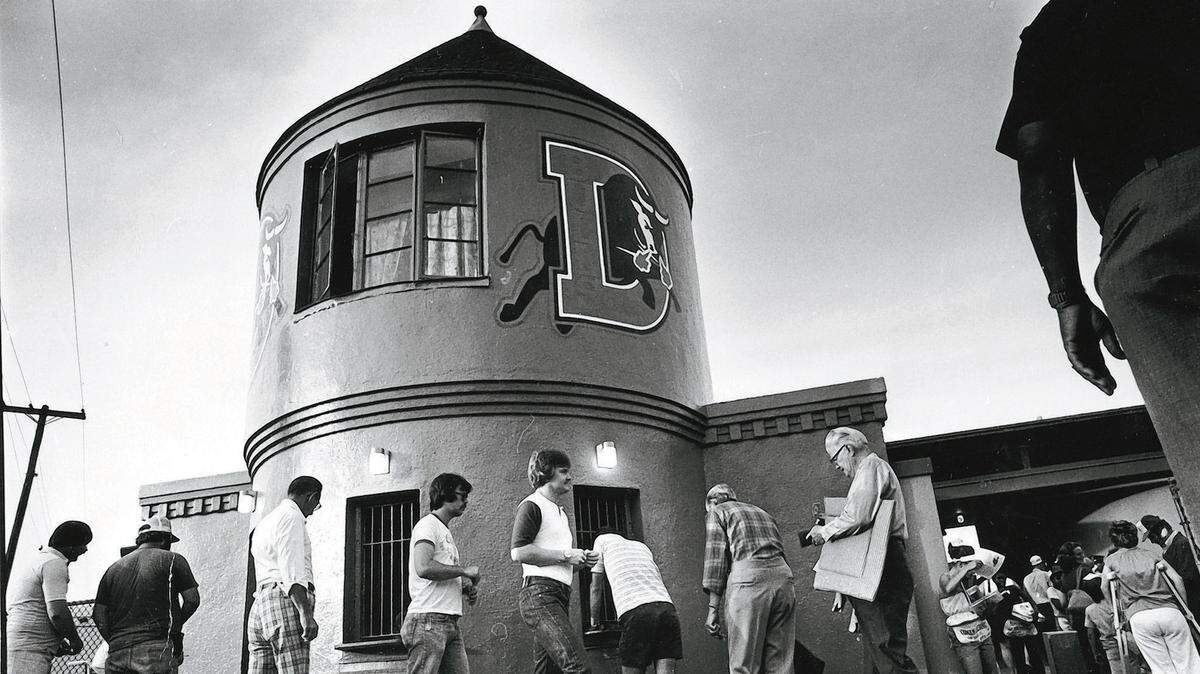
The Durham Athletic Park, or DAP, was built in 1926 and rebuilt in 1939 at 500 W. Corporation St. The DAP was home to the Durham Bulls baseball team from 1926 to 1994 before the Durham Bulls Athletic Park opened in 1995. It also has hosted games by N.C. Central University’s baseball games.
In the 85 years since the DAP was built, “it’s seen a lot of history,” Bob Ashley, a member of the Museum of Durham History, told the City Council. That includes the first official integrated baseball game in 1950 in Durham.
“All that history is worth remembering, worth preserving,” he said. “The park stands as a reminder of that. To anyone living here, visiting here, preserving the park will be a visible reminder of all of that and more to come.”
While downtown Durham has been transformed in the last three decades, the athletic park sits mostly unused, except for special events or rentals. Jackie Field, the city’s community programs division manager, said the park is only active about 124 days a year. Of those days, 91% are dedicated to baseball. The Durham Bulls currently manage the old ballpark but with focus limited to baseball use, there is little room for other uses.
“The Durham Athletic Park remains a significant opportunity to provide a center for recreation and culture,” said Nicole Thompson, the president of Downtown Durham, Inc., adding that the city has seen over 1,400 residential units, seven multifamily developments with 86 businesses in the area since 2018.
DAP study results and priorities
The study, which concluded on Feb. 28, explored future community-focused uses that preserve the park and improve its connection to the community and nearby greenways.
The survey saw 2,611 people respond to the online survey, with nearly half of the respondents women, 21% identified as people of color, 20% from low-income households, and 14% identified as having a disability.
“The community feedback made it clear people want the DAP to remain public, inclusive and free to access,” Field said. “There was strong opposition to new housing or large scale development. ... People want more open space, more diverse amenities and more inclusive programming, especially for youth and teens.”
Key community priorities included:
- Historical preservation: 44% of respondents stressed the importance of preserving the DAP’s features like the historical architecture and baseball history with ideas for reuse and upgrades.
- Access and equity: 28% of respondents wanted inclusive, multi-generational, low-cost or free events with improved access for people of all ages and abilities; 29% wanted extended hours of operation and easier rental processes
- Open and green space: 28% of respondents wanted more activities like recreation, picnics, leisurely sports
Julia Lasure, a coordinator for Preservation Durham, said the city should not consider replacing the ballpark with something new.
“The recent feasibility study treats historic preservation as a secondary, competing goal rather than an essential one,” she said. “We want to make sure that we highlight that preservation should not be framed as a trade-off with public use or open space.”
The three concepts & costs
The study created three concepts for the DAP’s future use. City staff said the concepts were not final and may evolve during the design phase.
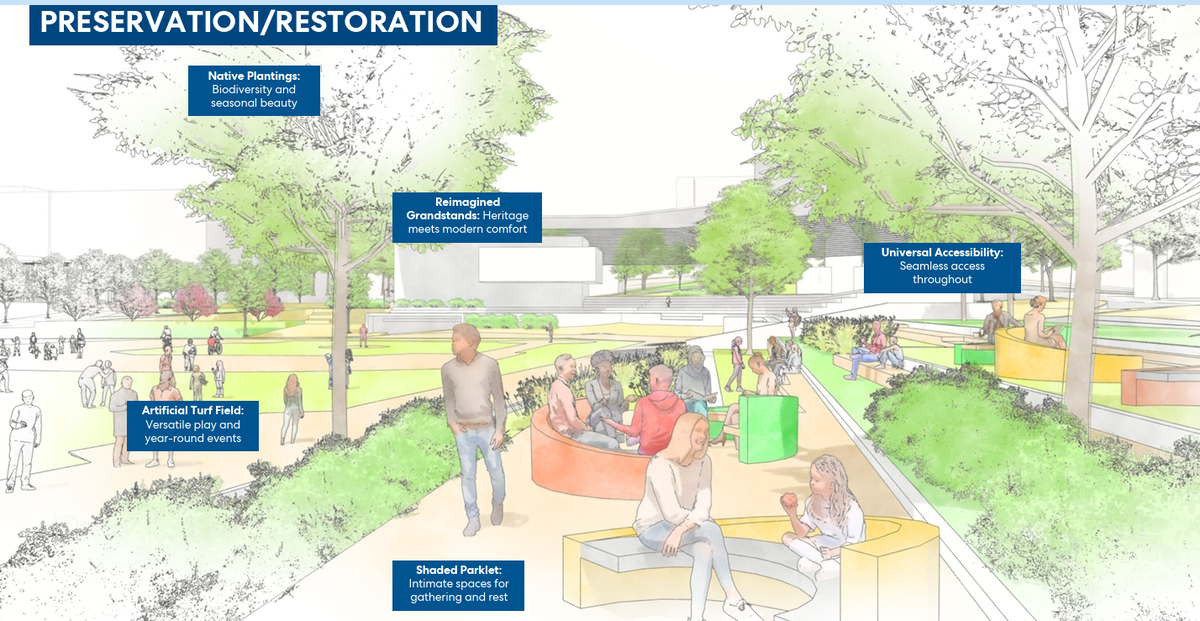
- Preservation/Restoration: Focuses on keeping the park’s key historical features intact, including the 1939 brick wall, the ticket booth, the grandstands. Estimated cost: $48 million to $68 million.
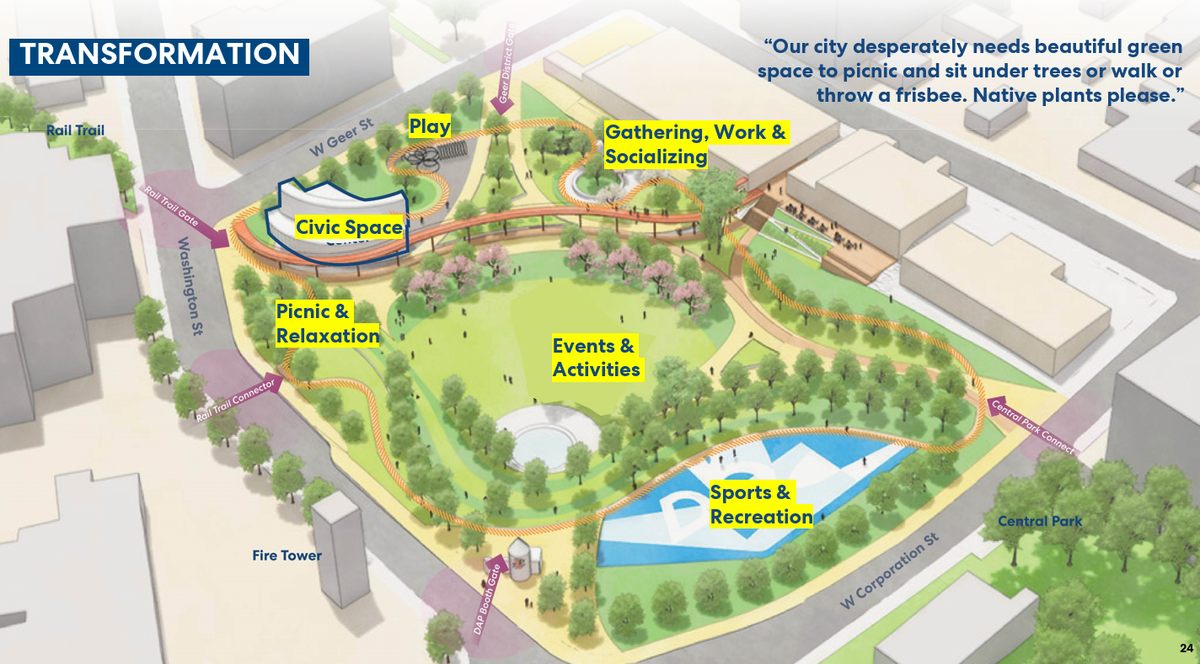
- Transformation: Reshapes the site while honoring its baseball legacy with a new central lawn, zones to play, rest and for public use. This would also have a new anchor connecting to the Durham Rail Trail and Geer Street. Estimated cost: $40 million to $60 million.
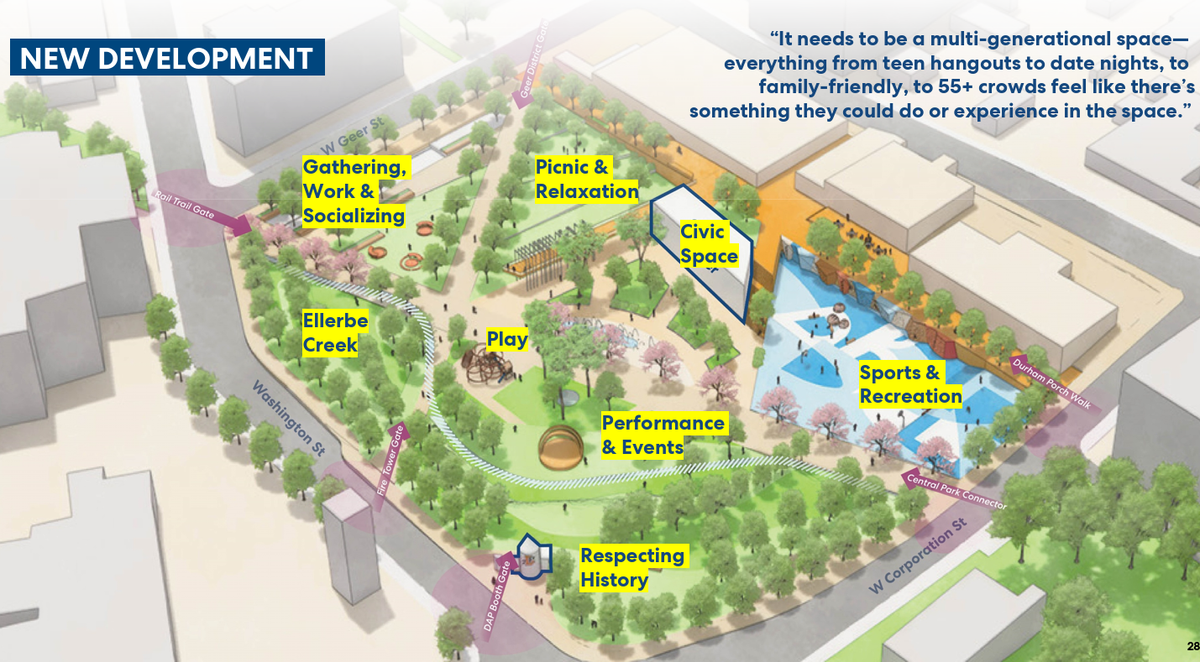
- New development: The most transformative with an added “Homebase Plaza,” a new space that anchors the park and supports cultural events, gatherings and daily use. Estimated cost: $62 million to $85 million.
The City Council members expressed support for preserving the DAP but debated the site's core use. There was also support to have “maximum flexibility” to allow the ballpark to be changed from one use to the next, such as from sports to concerts and festivals and removes the current fences around the park.
At the end of the presentation, the City Council and City Manager Bo Ferguson directed staff to explore preservation efforts in detail, including proposals from the city’s Sports Commission. Later, city staff will share findings with the City Council with funding options.
“I hope we can be more agile and a bit more flexible in how we fund things,” said Mayor Leo Williams. “I’d love to explore interest and what that would look like rather than just the high cost of finding a general contractor.”