Against Duke and FSU, No. 8 UNC didn’t need a lot of 3’s to win. Why that’s important.
For the second consecutive game, No. 8 North Carolina held a Top 25 opponent to under 35 percent shooting.
First it was No. 1 Duke on Wednesday, which finished shooting 34.7 percent without Zion Williamson. UNC won 88-72.
Then it was No. 16 Florida State on Saturday, which shot 31 percent from the floor. UNC won 77-59.
UNC (22-5, 12-2 ACC) has now won 10 of its last 11 games. And after wins over No. 1 Duke on the road and No. 16 Florida State at home, the Tar Heels will almost certainly rise in the NCAA’s new NET rankings, which will help the Selection Committee determine where teams are seeded in the NCAA tournament. Before the Florida State game, North Carolina was ranked No. 9 in the NET rankings.
The Tar Heels, which had been red hot from 3-point range in recent games, have made only nine of their last 40 three-point attempts. However, UNC is finding other ways to win when the 3-point shots are not falling.

Freshman wing Nassir Little crashed the offensive glass and had a team-high 18 points and 8 rebounds. Graduate senior Cam Johnson was successful with his mid-range shot. He also had 18 points and 10 rebounds.
But it was the Tar Heels’ defense that was most impressive.
It was the first time this season that the Tar Heels have held two consecutive opponents to under 35 percent shooting. As a result, their Ken Pom defensive efficiency ranking rose from 13th to 10th in the country.
“We feel very good about the W,” UNC coach Roy Williams said. “We know we can play better, but Florida State, they know they can play better as well. They didn’t shoot the ball anything like I’ve seen them shoot in some of those games they’ve played.”
Before their game against the Tar Heels, the Seminoles had been riding an eight-game winning streak. In a 77-64 road win against Clemson on Tuesday, Florida State shot 48 percent and were 7 of 18 from 3.
In an 88-66 win over Wake Forest two weeks ago, Florida State shot 56.5 percent from the floor, and made 10 of 26 3-pointers.
But against the Tar Heels, the Seminoles struggled. They shot 8 of 28 from inside the 3-point line.
When a Seminoles’ ball handler drove to the rim, the Tar Heels packed the lane. They forced the Seminoles to take outside shots. Florida State had 59 field goal attempts, and more than half — 31 —were 3-point attempts, which was uncharacteristic of Leonard Hamilton’s team. On average, 37.9 percent of FSU’s field goal attempts are 3-point shots, which is slightly below the nation average of 38.7 percent.
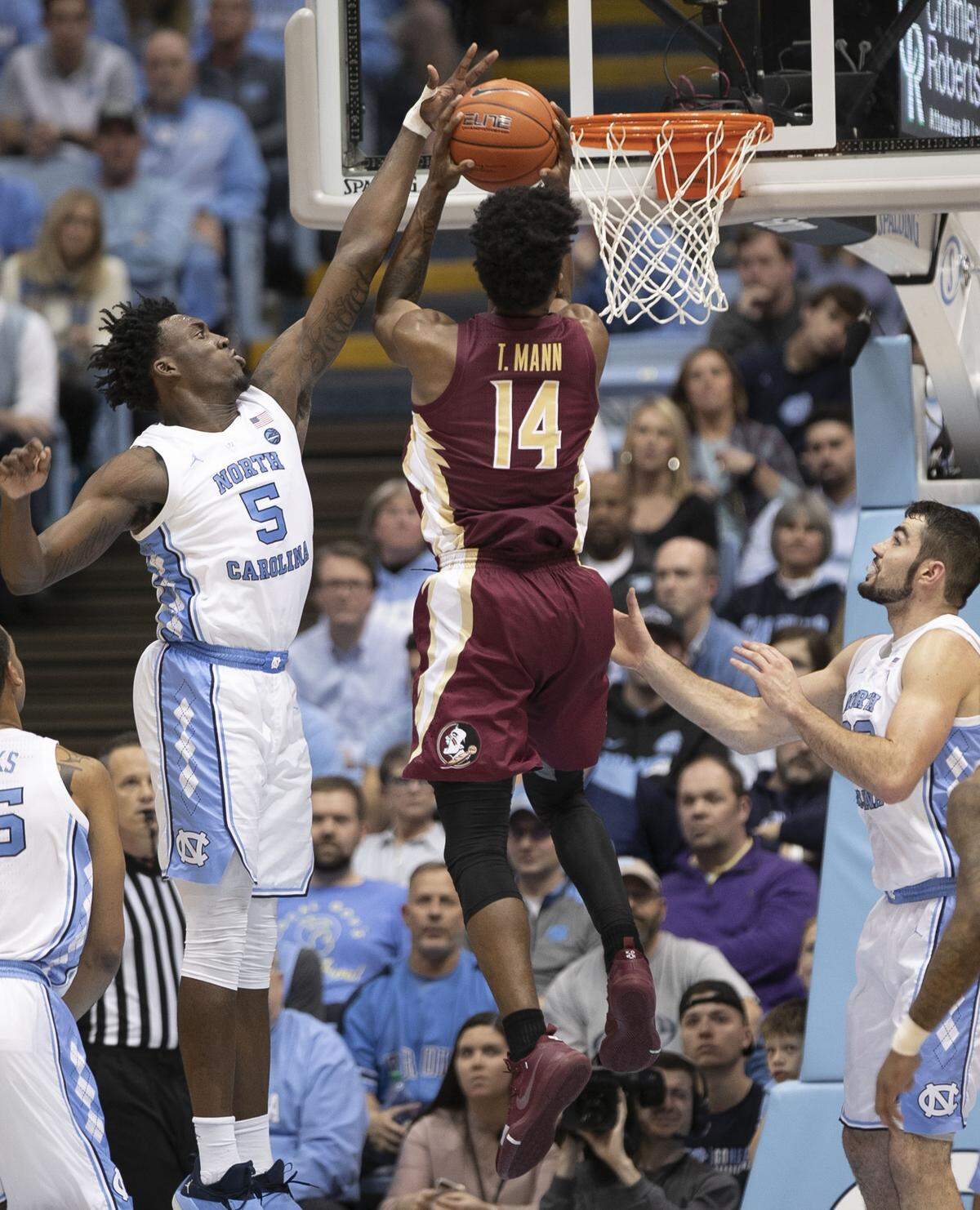
UNC did a good job defending FSU’s big men. FSU has the 12th tallest team in the country, according to kenpom.com. Their starting center, senior Christ Koumadje, is 7-4, 268 pounds. And Mfiondu Kabengele, a 6-10, 250-pound forward is a key player off the bench.
UNC’s two starting forwards are 6-9, 230-pound Garrison Brooks, and 6-8, 240-pound Luke Maye. Yet, FSU only scored 12 points in the paint.
“A lot of their defensive schemes took us out of things we normally do to get around the basket for our big guys,” Hamilton said. “I thought we just weren’t on point today.”
UNC went on a 16-1 run over a six minute stretch midway through the second half to take a 19-point lead. In that stretch, FSU missed nine consecutive field goal attempts. Seven field goal attempts were 3-pointers.
The biggest thing was keeping FSU off the offensive boards and allowing second chance points. The Seminoles had four offensive rebounds and seven second chance points in the first half. It helped keep the game within three points at halftime.
But FSU had only two offensive rebounds in the second half and only two second chance points. After winning the rebounding margin 25-20 in the first half, the Tar Heels doubled down, outrebounding the Seminoles for the game 47-32.
Rebounding has always been a staple for Roy Williams-coached teams. It’s what he emphasizes most in practice.
“We tried to box them out and keep them off the offensive boards,” Williams said. “I think we ended up 15-9 points on offensive rebounds. I would like for it to be a little more.”
As the season has progressed, the Tar Heels have steadily gotten better on defense. In December, the Tar Heels were ranked 30th in defensive efficiency. Now they are ranked 10th in the country. While UNC’s championship teams have all been great offensive teams, they’ve also been great defensively.
In 2005, UNC finished with the country’s fifth-most efficient defense. In 2009, UNC had the 18th-most efficient defense. And in 2017, UNC finished with the country’s 11th-most efficient defense.

“Beating two teams like that is really giving us a lot of confidence as a team,” said Maye, who had 15 points and 11 rebounds, “and let’s us know that we’re really turning into the team that we wanted to be at the beginning of the season. We’ve got a lot to improve on but I think we’re getting to a good point come March.”
This story was originally published February 24, 2019 at 1:21 AM.