
Moms want Congress to prevent the kind of truck crashes that killed their daughters
There comes a time in her presentation on truck safety that Marianne Karth talks about the unreliability of statistics and why we really don’t know how many people are killed each year when cars and SUVs get crushed under trucks.
Karth, who lives in Raleigh, cites her family’s experience: In 2013, she was driving on Interstate 20 in Georgia with her son in the front seat of their Ford Crown Victoria and her two daughters in the back, when they were hit from behind by a tractor-trailer truck.
The force of the collision spun the car around so that it slid backwards, its trunk going under the back of another truck’s trailer which smashed through the rear window into the back seat. Karth’s daughter AnnaLeah died instantly, just shy of her 18th birthday. Mary, 13, died a few days later.

Federal statistics that year listed just one fatality from an underride collision in Georgia. Karth knows there were at least two. She describes how some of Mary’s hair was stuck to the truck where it had hit her head, and how a nurse cut off Mary’s long braids in the emergency room.
And then you realize Karth is holding the braids.
“I actually had my braids when I was a little girl, and they got saved, so I don’t think this is morbid,” Karth says, anticipating some discomfort in her audience. “I think this is special.”
Karth combines her gut-wrenching personal story with data, studies, photos and crash test videos to argue that the government should require strong guards on the front, rear and sides of trucks to prevent these kinds of underride collisions. For the last three years, she has teamed up with Lois Durso of Marco Island, Florida, whose 26-year-old daughter was killed in an underride collision near Chicago in 2004.
TV, radio, conferences and lobbying
Karth and Durso have gone on TV and radio, written and visited members of Congress and spoken at conferences and other gatherings across the country. At the N.C. Traffic Safety Conference and Expo in Raleigh last summer, their talk was titled, “Turning Tragedy into Advocacy: Two moms on a mission to make truck crashes more survivable.”
The main focus of that mission has been the Stop Underrides Act, which would require front, rear and side guards on tractor-trailers and on large single-unit trucks to prevent smaller vehicles from going underneath them. Sen. Kirsten Gillibrand, a Democrat from New York, offered to introduce the bill in late 2017 after a milk truck jackknifed across Interstate 81 north of Syracuse and two cars went under the trailer, killing all four people in the cars. Another prime sponsor was Sen. Marco Rubio, a Republican from Durso’s home state of Florida.
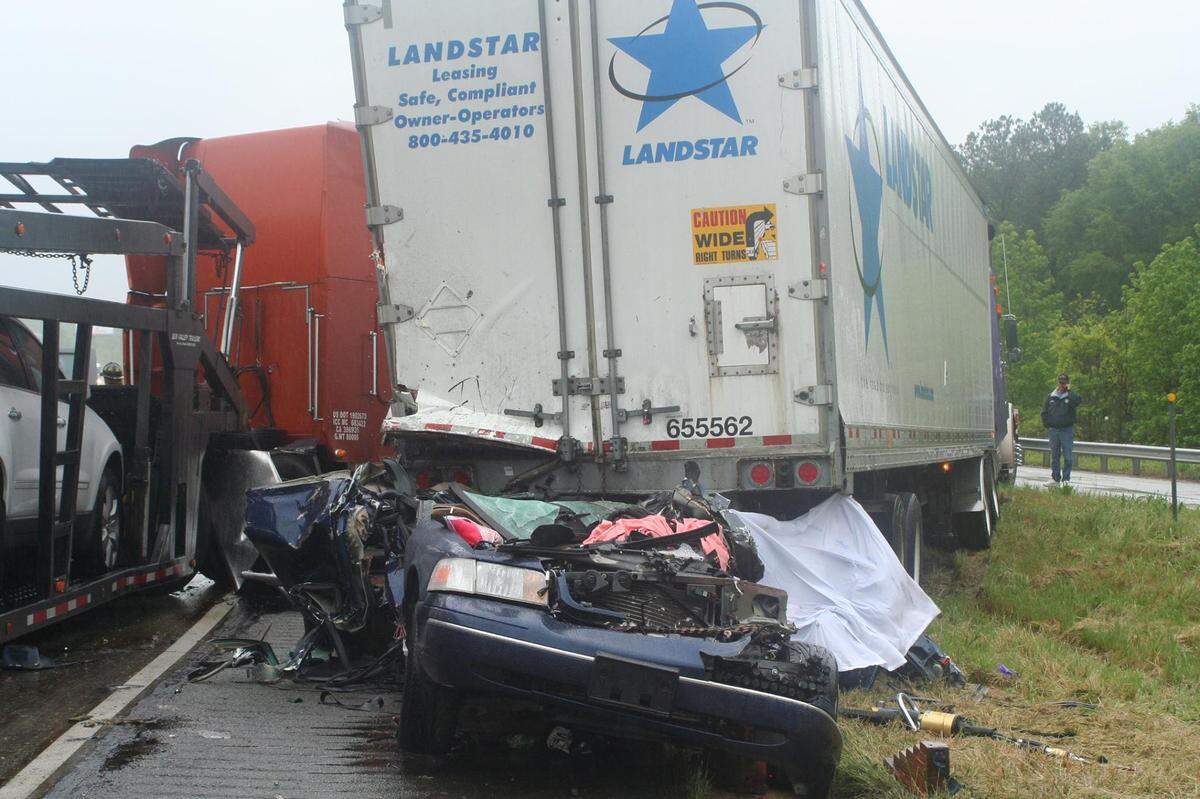
Politicians are respectful and express sympathy for the moms and what their families have gone through. But the bill has languished, in the face of opposition from the trucking industry and claims from lawmakers and regulators that not enough is known about the extent of the problem. A mandate that would cost the industry millions would likely be contested in court, and legislators want to ensure the bill is built on a strong foundation to withstand a challenge.
“I understand your concerns about truck underrides and I agree that more can and must be done to enhance safety on the roads to prevent these terrible tragedies,” Sen. Thom Tillis wrote to Karth last month, citing a Government Accounting Office review of the issue. “In their report, GAO stated that improved data collection, inspections and research is needed before understanding what specific measures of the Stop Underrides Act would in fact enhance safety.”
But Karth says the problem of underride collisions has been studied for decades and that the industry and regulators at the U.S. Department of Transportation have largely ignored that research.
“I am convinced that it will take an Act of Congress to get DOT and the trucking industry to DO THEIR JOB,” Karth replied in an email to Kyle Sanders, a staff member for Tillis, who along with North Carolina’s other senator, Richard Burr, gets special attention from her. “I’d like you to make it very clear to Senator Tillis that the ball’s in his court to be a hero and take action to save lives.”
In 2014, the National Transportation Safety Board recommended the federal government require side underride protection systems on new truck trailers capable of carrying large loads. The National Highway Transportation Safety Administration, the agency that would develop the regulations, said in a written statement last month that it “has initiated research into side underride guards that should help inform next steps,” and hopes to finish the research this year.
Underride crashes are an old problem
An estimated 219 people on average were killed each year in underride crashes in the United States in the decade ending in 2017, according to the GAO report. But those kinds of deaths are likely under-reported, the GAO concluded, because law enforcement agencies don’t have a standard definition for an underride and some crash report forms don’t even have a place for reporting them (the standard form in North Carolina does).
Underride crashes are especially dangerous, because the first contact a car or SUV has with the truck is often at the windows. The seatbelts, airbags and crumple zones that manufacturers have built into vehicles to protect people aren’t given a chance to work, says Aaron Kiefer, an accident reconstruction engineer in Cary.
“None of that is helpful if the windshield of the car is what encounters the trailer first,” Kiefer said. “You have hundreds of millions of dollars of development and work that have gone into protecting motorists, but it’s circumvented in this oversight of trailer design.”
Karth and Durso have plenty of photos and videos of what happens to cars in an underride crash. They include videos of a car’s top being partly sheared off by a trailer in crash tests done by the Insurance Institute for Highway Safety, or IIHS, an independent nonprofit research group.

The car in that test was going 35 mph. Durso says her daughter, Roya Christine Sadigh, was riding with her fiance in a snowstorm at about that speed when his BMW went under the side of a tractor trailer, pinning the passenger side of the car under the rear wheels and dragging it some distance. The fiance was able to walk away, Durso said.
“It’s not the crash that kills; it’s the underride,” she said. “You can go under at 15 miles per hour, and people still die. So underride protection is necessary.”
The problem is not new. Actress Jayne Mansfield, her boyfriend and their driver were killed when their Buick Electra slid under the back of a slow-moving truck in Louisiana in 1967. That high-profile crash led Congress to consider requiring better underride guards on the backs of large trucks, which one Congressman, U.S. Rep. Thomas Vanik of Ohio, warned at the time wasn’t enough.
“The standard should be applicable to all vehicles and trucks so that the risk of damage and fatalities resulting from nonmatching bumper guards is permanently and forever removed from American highways,” Vanik said on the House floor in September 1969, according to the Congressional Record.
That same year, the U.S. Department of Transportation announced through the Federal Register that it anticipated requiring side underride guards for trucks “after technical studies have been completed.” But that never happened, and federal standards for rear underride guards were not updated until 1998.
Even those rear guards, often two brackets holding a single bar across the back of the truck, failed IIHS crash tests at the outer edges and were often poorly maintained, Karth says. The truck her Crown Victoria hit in Georgia had a rear guard, but it gave way, allowing the car to slide underneath. The Stop Underrides Act would require truck drivers to inspect their underride guards for rust, corrosion, cracks, missing fasteners or bent pieces before each trip.
The challenge of added weight
Karth’s first efforts to prevent underrides were aimed at improving rear guards. She and her husband, Jerry, wrote to trailer manufacturers and to 100 companies that buy trailers to point out the deficiencies in the rear guards. Karth helped organize an “underride roundtable” at the IIHS research center in Virginia in May 2016, bringing together researchers, government regulators, safety advocates and industry officials to discuss the problem.
Since then, manufacturers have improved the rear guards, though some still don’t offer the stronger guards as standard equipment, Karth says. One company, Stoughton, introduced a stronger rear guard at the IIHS event, and Karth praised it during a press conference at a trucking convention in Nashville in early 2017.
Stoughton had redesigned the entire rear of its trailers to add the improved underride guard without adding any weight to the trailer, says company spokesman Ron Jake. The company is working on guards to prevent vehicles from going under the sides of its trailers, Jake said in an interview, but there are more challenges there, such as maintaining the ability to cross raised surfaces, such as railroad tracks, without getting stuck.
But the big challenge is the added weight of guards stiff enough to prevent a car from going under the trailer, Jake said.
“On the side there would be an incredible weight addition to the trailer, and trucking companies would have to justify that weight addition, because that would be taken directly out of their payload,” Jake said. “That’s our concern: Are trucking firms willing to forgo payload for safety in that regard?”
The American Trucking Associations strongly opposes the Stop Underrides Act, calling it an expensive mandate to install “unproven technology” on millions of truck trailers to prevent a “narrow type of crash.”
In a letter to lawmakers last spring, Daniel Horvath, the group’s vice president for safety policy, called the act a “well-intended heartfelt response to family tragedy,” before outlining its opposition. In a subsequent letter to lawmakers last June, Horvath said manufacturers and the government should focus on preventing crashes in the first place, through automatic braking and steering and other technologies.
Horvath cited Andy Young, a trucker and lawyer from Ohio who has worked with Karth. Young testified before Congress last spring that installing side guards on the estimated 12 million trailers on the road would cost no more than $2,900 each, or less than 60 cents a day for a trailer lasting an expected 15 years.
Horvath used those same numbers to conclude that equipping all those trailers with side guards would cost the industry $34.8 billion.
“That staggering figure would result in what is likely the largest unfunded mandate on a private sector industry in U.S. history,” he wrote. “Furthermore, when combined with the expected cost of labor in installing these guards, [it] would exceed the industry’s annual net revenue, essentially putting trucking out of business, and grinding our economy to a screeching halt.”
‘Trucking industry likes the status quo’
Karth says those kinds of predictions are overblown and that the added weight of the guards would be a tiny fraction of the 80,000 pound gross weight limit of a tractor-trailer. She says faced with a mandate, the industry’s engineers would find innovative ways to design effective and economical side underride guards, the way Stoughton and others have done with rear guards.
Companies such as AirFlow Deflector already sell underride guards that can be attached to trucks; one of its customers is the city of Boston, which requires underride guards on city trucks to protect cyclists and pedestrians.
Kiefer, the accident reconstruction engineer from Cary, has been working on underride guards since he consulted on a case involving a fatal underride crash a few years ago. He’s developing something he calls a SafetySkirt, which would be strong enough to prevent side underrides but look and feel like the trailer skirts already widely used to improve aerodynamics.
Kiefer says reaction to his product has been mixed.
“I’ve had a lot of folks say you don’t know what you’re doing. Which is partially true,” Kiefer said, adding that he doesn’t have the experience of trailer manufacturers. But he thinks interest in doing something is growing.
“The trucking industry likes the status quo,” he said. “But this type of issue, this underride hazard, is becoming more and more well-known, and smart carriers are starting to purchase trailers that have these counter measures on them.”
Meanwhile, Karth and Durso continue to seek support for the Stop Underrides Act, which the sponsors reintroduced last spring.
Karth says Senate and congressional staff members have told her this isn’t the kind of bill that passes on its own, but instead gets folded into a larger piece of legislation, either whole or in part. She and Durso are now working to get some or all of the bill into one of the five-year transportation bills that will go before Congress later this year.
The two moms continue to gather signatures on petitions in support of the law, both online and in person. Karth collected 270 signatures one day at the N.C. State Fair in October and delivered them to Burr, Tillis and various members of the committees considering the bill in envelopes of orange and purple, AnnaLeah and Mary’s favorite colors.
This story was originally published February 5, 2020 at 5:30 AM with the headline "Moms want Congress to prevent the kind of truck crashes that killed their daughters."
