
NC’s Josh Stein gets campaign cash from investigated donor, rejects it after N&O probe
When Medicaid fraud investigators showed up at Mako Medical two years ago to look into questionable Medicaid billings, company co-founder Chad Price mentioned to them that he knew their boss, North Carolina Attorney General Josh Stein.
The investigators later decided not to recommend charges. And in July 2019, four months after their investigation ended, Price sent a $5,400 check to Stein’s campaign, the maximum contribution allowed under state law.
Later in 2019, Stein’s office also decided not to pursue claims made in a separate whistleblower case against Mako. On Sept. 17, two days before that decision was filed in federal court, another $5,000 came to Stein’s campaign from a business partner of Price’s. On Sept. 30, that business partner’s wife gave a $2,000 campaign donation to Stein.
Stein said in an interview in May that campaign money plays no role in his decision-making, and in this case, he said he didn’t know his office was investigating Mako.
“The first I ever heard that Medicaid even looked at Mako is when you called the office and asked us about it,” Stein, a Raleigh Democrat, told a News & Observer reporter.
Two days later, in an emailed statement to the N&O, a spokeswoman said Stein was donating the $12,400 in Mako-related contributions to charity to “underscore his commitment to the integrity of (NC Department of Justice) investigations.”
Jane Pinsky, director of the NC Coalition for Lobbying and Government Reform, said whether Stein knew Mako was under investigation or not, accepting the contributions “doesn’t look good and that’s not good for maintaining citizens’ confidence in our government.”
The contributions to Stein are among roughly $560,000 in campaign money that Price, his family and business associates have given in the past five years to state, federal and local candidates. Some of those contributions — none to Stein — made in the name of a sister who has a severe mental disability have been under investigation in at least two states. During those five years, Mako has grown from a small lab in North Raleigh to an operation that employs roughly 500 full and part-time employees. It has shifted much of its business to COVID-19 testing.
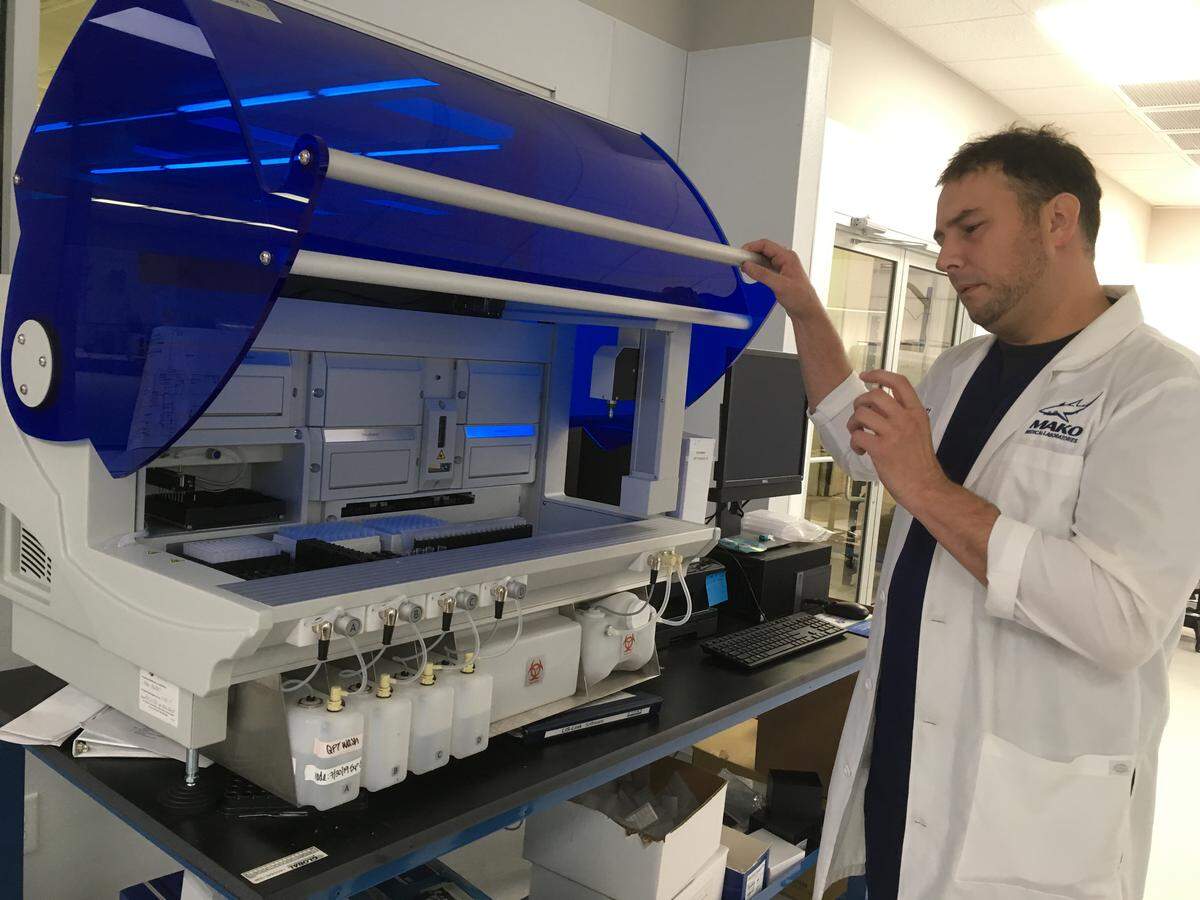
The N&O previously reported that Price had inflated his educational and work experience. He also has claimed he ran two state election campaigns, though those candidates later denied he managed them.
Much of the Mako-related campaign money went to Republicans, but in recent years Democrats benefited as they gained more power in state government. During the 2016 election when Stein won his first term as attorney general, Price gave a $5,100 contribution to Stein’s opponent, then state Sen. Buck Newton, a Wilson Republican.
The N&O sent Mako co-founders Price and Josh Arant an email with information from the investigations as part of an interview request. Arant responded with an emailed statement.
“Your questions regard files from three years ago, of which we’ve never seen and which never produced any enforcement actions against our company,” said Arant, who is Mako’s chief operating officer. “Today, MAKO has more than 500 employees providing critical COVID-19 testing services to citizens across the United States. We are focused on helping our community and country recover from the pandemic.”
Price’s business associate — Jerry Bynum of Apex — and his wife Stephanie did not donate to Newton’s or Stein’s 2016 campaigns. Jerry Bynum said he and his wife contributed to Stein last year because he’s a “good man.” Bynum said he did not know about the Medicaid case, and Price did not advise the couple to make the contributions.
In May 2018, the investigators first interviewed Price and Arant about the increase in billings. Laura Brewer, a spokesperson for the attorney general’s office, said that’s when Price mentioned he knew Stein.
Stein said he has had little involvement with Price, only recalling him at a campaign event because Price wore his dark blue scrubs with Mako’s shark logo.
Stein said even if he had been aware of the investigation at the time the campaign contributions were made, he wouldn’t have told his staff that he had received them. He said his staff did not know about the contributions as they handled the case.
“What is incredibly important to me is that there be a firm and bright line between anything that happens on my campaign side and the professional work in this office,” he said. “I never want any decision that’s made by the lawyers and prosecutors in the Department of Justice to have any impact based on what is going on on my political side.”
‘Liquid gold’
In the past decade, drug testing became a lucrative business, driven in part by the opioid addiction crisis.
Kaiser Health News and the Mayo Clinic found that from 2011 to 2014, billing for urine tests and related genetic tests to Medicare and private insurers “quadrupled to an estimated $8.5 billion a year.” Urine testing became known as “liquid gold.”
Federal Medicaid officials have since been trying to reduce the amount of testing to weed out fraud and waste. On July 1, 2016, for example, they limited the number of regular or “presumptive” urine screens for drugs to 20 per patient annually.
The Medicaid investigation in North Carolina involved two lines of inquiry. The first had to do with staff in the state Division of Health Benefits in March of 2017 questioning Mako’s billings for drug tests, including children, at a small number of providers. One investigators visited was Rowan Psychiatric, a practice led by Dr. Rajeshree Dimkpa that includes clinics in Concord, Salisbury and Wilkesboro.
“The main concerns about Mako’s billing according to (Health Benefits staff) were, amount of juvenile recipients tested for drugs, frequency of urine testing of recipients, recipients sharing the same address and diagnoses, the amount of drug classes billed per recipient urine sample, and the majority of the urine tests Mako analyzed came from only a few referring providers, suggesting inappropriate behavior between Mako and the referring providers,” the investigators’ summary of the case said.
The investigators said guardians of adolescent children “often expressed shock and confusion” when told they were being tested for drugs such as cocaine. The guardians said they never saw the test results or asked to see them.
The second line of inquiry stemmed from a federal whistleblower lawsuit filed 10 months later, in which former partners in another group of psychiatric clinics alleged Mako was involved in millions of dollars in unnecessary billings. The clinics founded by Dr. Eric Morse of Raleigh also performed urine tests on patients to check for drugs.
Medicaid is paid by state and federal dollars, so North Carolina investigations are overseen by the state Attorney General and the U.S. Department of Justice.
Neither of the inquiries found wrongdoing by Mako. Investigators determined the rise in billings in the initial inquiry occurred at a time when Medicaid billing rules were looser than they are now, and Mako had sought guidance on how to bill for its tests as those rules were being tightened. As for the whistleblower claims, the investigation led to a penalty against one of Morse’s clinics, requiring repayment of $27,000 in unnecessary billings for lab tests.
But the investigative and court records include lines of inquiry that show little evidence of being pursued. Two former employees at Rowan Psychiatric told investigators that a Mako employee was only supposed to collect samples from patients at the clinic, but also acted as an office manager and filled out prescriptions for patients that Dimkpa had dictated over the phone. They said Dimkpa appeared to be paying the Mako employee.
Federal law discourages lab company employees placed in doctors’ offices from performing other duties because the work could be viewed as an improper incentive for doctors to use a lab’s services.
When the investigators visited the clinic to request records, they reported the Mako employee was the only one who appeared to be there initially, and she agreed to handle the records request.
The investigators did not interview the Mako employee about the former employees’ claims. Brewer, the attorney general’s spokesperson, said the case was only focused on “whether there was billing to Medicaid for urine tests that were not performed. None of the parents and guardians we interviewed told us that urine samples were not collected.”
Current, former lawmakers step in
At one point, a lawmaker reached out to Stein on behalf of Rowan Psychiatric, asking for more time for the clinic to produce records. Stein notified Charles Hobgood, then the Medicaid Investigations Division director. Hobgood passed the message to the investigators on Feb. 23, 2018.
Hobgood then recused himself from the investigation. Brewer said Hobgood may have attended church with one of Mako’s owners. He retired in May 2019.
“Hobgood did not provide any additional information about the message, identity of the legislator, reason for extension, or a revised date for record collection,” according to a memo in the investigative file. The clinic got the extension; Stein said he did not remember the call, and could not remember who the lawmaker was, who had left a phone message he did not keep.
“Having no memory, I went and looked and found no record of it,” he said.
On March 8, a day before the records were supposed to be produced, the investigators got a call from Tony Rand, a Fayetteville attorney who had served as Senate majority leader when Democrats ran the legislature in the 2000s, a period that includes part of Stein’s first term as a state senator. Rand represented Dimkpa, and would be handling the records request.
Rand later produced the records. (He died earlier this year.)
Payment issues
In May and June 2018, the investigators interviewed Price and Arant about the increase in billings. Price told the investigators the Medicaid policy changes caused a backup in payments. He and Arant provided the investigators email correspondence with a state Medicaid official that they said showed they were working together to resolve the billing issues and comply with the policy changes.
The investigators asked if Mako employees are allowed to do work for doctors’ practices beyond their Mako duties. Price told them any employee doing that would be fired. The records do not show the investigators mentioned the former Rowan Psychiatric employees’ claims.
Price and Arant also made claims about their business that the investigators didn’t look into and the N&O later couldn’t verify.
Price and Arant told investigators that Mako had audited Blue Cross Blue Shield of North Carolina’s list of services and found major cost savings.
“Price stated that Mako went to the major insurers and offered Mako’s data and auditing services in addition to laboratory services,” the investigators’ report said. “Arant and Price stated for instance that Mako audited a list of services for Blue Cross Blue Shield and as a result of their audit and data analysis were able to show areas of major cost savings for the insurer.”
Price also said Mako alerted major insurers to billing issues by a company with which BCBS of NC is now locked in a court battle.
Austin Vevurka, a spokesman for BCBS, said if Mako had done audits or analyses, the insurer didn’t see them, and “never engaged” Mako to perform them. He also said BCBS officials were unaware of any information Mako provided regarding billing issues with the company.
Mako is an in-network provider for BCBS, he said, because it has the appropriate federal and industry certifications.
A claim about Mako’s efforts in fighting health care fraud emerged in a letter that South Carolina Attorney General Alan Wilson wrote on Jan. 29, 2019, on behalf of Price’s request, and using information provided by Price. Wilson acknowledged in an interview that he had no direct knowledge of Mako’s efforts to identify and combat health care fraud.
The investigators interviewed the parents or guardians of the young patients to confirm someone had taken samples for testing. Then they closed their investigation.
Dimkpa said she could not comment until consulting with an attorney. An employee of Dimkpa said the Mako employee who was alleged to have done office work in the Wilkesboro clinic left “two or three years ago.”
N.C. Medical Board records show no investigations or sanctions against Dimkpa’s practice, and the attorney general’s office took no criminal or civil action.
Whistleblower lawsuit
Vicki Ittel-Rothenberger and Dr. Elizabeth Stanton filed the whistleblower lawsuit against Morse and six of his drug treatment clinics in the Triangle region, and Mako. Ittel-Rothenberger and Stanton were originally partners in the clinics, but said in an earlier, related state lawsuit filed in 2017 that they had been pushed out after accusing Morse of giving verbal orders to staff to provide methadone and other controlled substances to patients he hadn’t seen in person.
The prior year, the N.C. Medical Board had issued a “public letter of concern” against Morse for continuing to prescribe Suboxone to a patient who had moved to West Virginia. Morse only saw the patient three times between October 2012 and May 2015, the letter said, but continued to write prescriptions for the drug every two weeks. The board ordered him to take a 10-hour course in Suboxone prescribing.
In the state lawsuit, Ittel-Rothenberger and Stanton also claimed that Morse had put Price on the clinics’ board of directors without their approval.
Morse countersued, and the state lawsuit was eventually settled. The former partners now run one of the clinics in Hillsborough. In the federal whistleblower suit, Ittel-Rothenberger and Stanton claimed Mako had given another of Morse’s clinics, Vance Recovery, equipment to analyze urine, which the clinics then used for tests that were unnecessary because Mako was also doing them.
Morse produced a lease agreement for the equipment with a California supplier to show he had paid for it. But the investigators did find Vance Recovery had billed for unnecessary testing of five patients, leading to the $27,000 settlement the state signed off on Sept. 3, 2019.
The former partners’ law firm had alerted investigators to the unnecessary testing of five patients in a follow-up letter to the lawsuit, but said it suggested a longer-standing practice.
The letter said Mako collected the urine and split it into two samples — one that went to Mako’s lab and another to Vance Recovery. Mako also delivered the samples to both places.
“Defendants have likely overbilled Medicaid over one thousand dollars per patient each year,” the law firm said. “Because Defendants treated roughly 775 Medicaid patients in 2018, they likely overbilled Medicaid by over $800,000 in 2018 for these tests alone.”
The investigation found unnecessary testing of five patients, but the settlement agreement pegged the responsibility solely on Vance Recovery, and the cost at $27,000. Brewer declined to say if those were the same five patients. Ittel-Rothenberger and Stanton shortly after the settlement ended their lawsuit.
Ittel-Rothenberger referred questions from the N&O to their lawyers, Phillips & Cohen of Washington, D.C., who declined comment. The firm specializes in whistleblower or ‘qui tam’ lawsuits. Under federal law, those who file successful qui tam lawsuits can collect as much as 30% of all money owed to the government.
Unanswered questions
Brewer said the investigation determined that Mako didn’t know about the unnecessary testing.
“We did not find any evidence that Mako, when it billed for the same tests on the same dates as Vance Recovery, knew or should have known that Vance Recovery itself was billing for the same tests that Vance Recovery had ordered Mako to perform,” she said.
The investigators did not look into potential conflict of interest issues with Price serving on the Morse Clinics’ board, Brewer said, because that was outside of their jurisdiction.
The attorney general’s office did not release its files on the whistleblower case, and declined further comment after checking with the U.S. Attorney’s Office for the Eastern District of North Carolina. A spokesman there said the records are not public.
Morse, who has been a psychiatrist for N.C. State’s athletic department since 2006, could not be reached by the N&O. His attorneys in the state lawsuit confirmed Price was a board director, but the clinics’ website currently does not show Price on the board.
Two professors — one an anesthesiologist and pain management specialist, the other an attorney with expertise in health law — told the N&O the investigations left unanswered questions. Dr. James Hitt, who teaches at the State University of New York at Buffalo’s medical school, said he could understand the investigators’ decision not to charge Mako over the billings, but he was troubled by the lack of follow up into the Mako employee’s office work.
“I wonder what they did with the allegations that a nonmedical professional is writing prescriptions. That’s concerning,” he said.
He said he also found it “a little strange” that parents and guardians weren’t being told why their children were being tested for illegal drugs.
Sara Rosenbaum, a George Washington University professor who specializes in health care law, said the allegations point to serious issues that the investigators should have explored further.
“I’m at a loss to understand why they ended up with what seems like a minimal sanction,” she said.
Stein said he has confidence in his office’s work on the Mako allegations.
“The investigator and the lawyer are professionals,” he said. “They handle a great volume of cases, they dig deep to determine is there a violation, do the facts support that and can we then assert a violation of the law. They did all that work and came to the conclusion that they could not successfully bring a case.”
This story was originally published September 24, 2020 at 9:29 AM with the headline "NC’s Josh Stein gets campaign cash from investigated donor, rejects it after N&O probe."