
Federal judge temporarily blocks Board of Elections settlement decided Friday
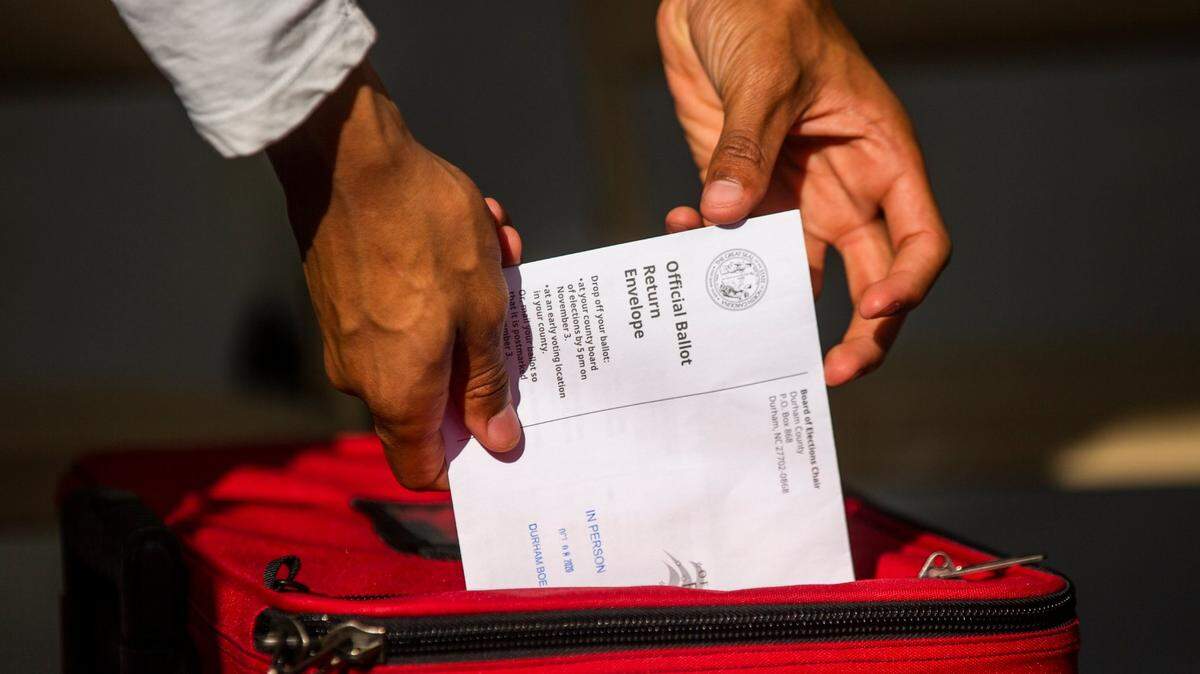
A federal judge placed a temporary restraining order Saturday on the NC Board of Elections settlement that came out of Wake County Superior Court Friday and changed state election laws ahead of the Nov. 3 election.
Attorneys representing House Speaker Tim Moore and Senate President Pro-Tem Phil Berger, North Carolina’s top Republicans, argued to Judge James Dever Friday night that the settlement violated the Elections Clause of the U.S. Constitution, which gives state legislatures the authority to set election rules. They added that the settlement is inconsistent with state law.
Wake County Superior Court Judge Bryan Collins ruled Friday afternoon that a settlement between the Board of Elections and a political group of retirees was fair and not a product of collusion between Democratic board members and the plaintiffs.
The settlement extended the number of days the Board of Elections would accept mailed-in ballots to nine as long as the ballot was postmarked by Nov. 3, which is Election Day.
It also allowed absentee voters without witness signatures to sign affidavits that it was their vote in order to fix the ballot.
Lastly, it allowed county board of elections offices to designate separate absentee ballot drop stations at all one-stop early voting locations and county board offices.
The settlement led Republican board of elections members to resign, despite agreeing to the settlement themselves.
Those board members, Ken Raymond and David Black, said they resigned because lawyers for the Board of Elections and the attorney general’s office did not provide them with important information to make their decision.
Black’s wife, however, posted that the men were forced to resign by Republicans leaders and Republicans officials confirmed the resignations did come after an angry phone call between them and the men.
Board of Elections attorneys argued to Dever that his courtroom was not the proper venue to appeal a case from state court.
But Dever blocked the settlement anyways.
A Board of Elections spokesman said Saturday afternoon that their office was still reviewing Dever’s order.
The restraining order is in place until Oct. 16 and the case will be transferred to U.S. District Court Judge William Osteen in the Middle District of North Carolina.
“Judge Dever restored sanity into this election by temporarily blocking the eleventh-hour rule changes to undo absentee ballot fraud protections,” Berger said in a news release. “This is a win for every voter in the state who would prefer not to see the Board of Elections change the rules of the game after it’s already started.”
As of Saturday, more than 1.1 million people had requested absentee ballots and more than 340,000 had been cast since the election began on Sept. 4.
Osteen is presiding over a lawsuit similar to the one Collins’ reviewed Friday and has a hearing scheduled for Wednesday in Greensboro.
Dever said having Osteen preside over all three election law cases currently under review allows for less voter confusion.
The lawsuit in Osteen’s court focuses on federal election laws while the case Collins ruled on looked at state laws.
Osteen had a different view from Collins on the Board of Elections’ intentions.
Osteen criticized the Board of Elections earlier this week agreeing that they were trying to usurp the legislature’s authority to run elections.
Legislators listened to concerns of the Board of Elections earlier this year and made changes to loosen absentee voting rules in response to the global pandemic. But one of the requests that was not met was to drop the witness requirement altogether.
“A bipartisan supermajority agreed on the law governing this election months ago,” Berger wrote. “The secretive effort by Attorney General Josh Stein and the N.C. State Board of Elections to rewrite that law while voting is underway was wrong, inappropriate, and created chaos.”
This is a developing story and will be updated.
This story was originally published October 3, 2020 at 11:53 AM with the headline "Federal judge temporarily blocks Board of Elections settlement decided Friday."