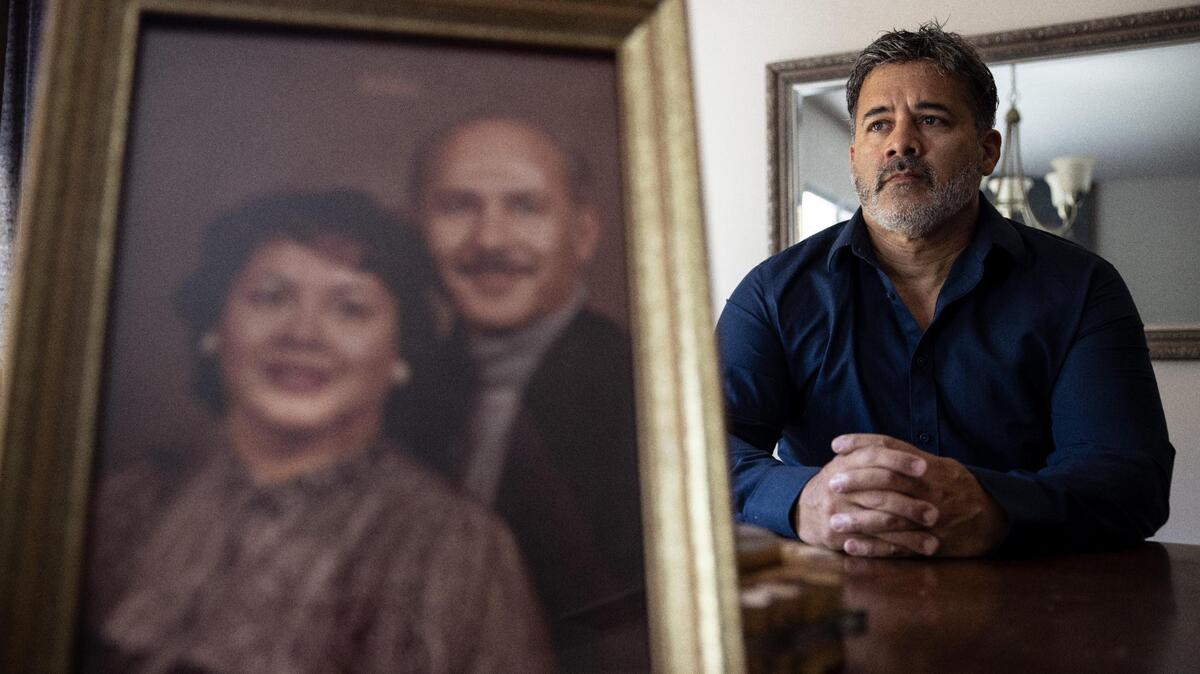
Ronnie Talent poses for a portrait in Charlotte, N.C., on Wednesday, May 12, 2021. Talent and his sister, Lisa Noguera, are suing the adult care home in Charlotte where their mother died in September but face long odds of success.
Khadejeh Nikouyeh
Knikouyeh@charlotteobserver.com
RALEIGH
In the midst of the coronavirus pandemic last September, 82-year-old Julia Quirindongo’s health was declining.
The Puerto Rican grandmother of three managed to outrun COVID-19 as she bounced between long-term care facilities and hospital visits, but she was fighting another battle: Her heart was failing.
So Quirindongo’s two children moved their mother to a Charlotte adult care home that they believed would work closely with hospice to keep her comfortable and peaceful in her final days.
Quirindongo’s death was not either of those things, her children Ronnie Talent and Lisa Noguera said.
In a lawsuit filed last month, Noguera and Talent allege that the staff at Brighton Gardens of Charlotte failed to give Quirindongo medication to help her breathe, ease her pain and quell her anxiety as she died of congestive heart failure — when the heart doesn’t pump blood properly.
In her final hours, Quirindongo’s children received little help from staff as they watched their mother claw at her neck and cry for help as her lungs filled with fluid, effectively drowning her, they allege.
Still, Noguera and Talent’s lawsuit is expected to be swiftly dismissed by a judge, because ofa temporary law passed by North Carolina’s state legislature last year. That measure gives health care providers and facilities sweeping immunity from civil liability during the pandemic.
Quirindongo’s case demonstrates how those facilities and providers could continue to benefit from the law, even when deaths or injuries on their watch are unrelated to COVID-19. Though visitors are once again allowed in nursing homes, a growing percentage of North Carolinians are vaccinated and the state’s mask mandate is no longer, long-term care facilities continue to be shielded from liability, even when facing allegations of egregious failures unrelated to coronavirus.
“They’re clearly taking advantage of this,” Talent said in an interview with The News & Observer. “This has nothing to do with COVID.”
In March, the North Carolina legislature extended the immunity provision beyond its original 2020 expiration date to end when Gov. Roy Cooper ends the coronavirus state of emergency, which is expected to last until at least June 11.
In New York, by contrast, state lawmakers repealed a similar law in March.
“I applaud the legislature for taking this critical action and ensuring that no one can evade potential accountability for the devastating loss of life that occurred in New York’s nursing homes,” New York Attorney General Letitia James said in a statement.
The governor who signed the North Carolina law is now calling for accountability, too.
“Ensuring high quality care and the ability to hold bad actors accountable in regulated long-term care facilities is important and the General Assembly should review the impacts of this provision,” Cooper spokesperson Ford Porter said in a statement sent by email to The N&O.
Elizabeth Todd, Noguera and Talent’s lawyer, said along with Quirindongo’s case, she’s handling more than 50 cases like it.
All pertain to long-term care facility residents whose death or injuries were unrelated to coronavirus, she said. With the immunity law still in place, Todd isn’t optimistic any of them will make it far.
“We’re just going to keep filing them, and we’re hoping that we will prevail,” Todd said.
A spokesperson for Brighton Gardens’ parent company, Sunrise Senior Living, said the facility couldn’t comment on specific lawsuits “out of respect for the privacy of our residents and their families.”
“We strive to provide the best possible care that we know our residents and families expect from us,” the spokesperson said in an email statementto The N&O.“We continue to work every day to earn their confidence and trust. We also take concerns about the care and safety of our residents very seriously, and take prompt, appropriate action as needed.”
The facility has not yet formally responded to the lawsuit, but after Quirindongo’s children filed a complaint with Mecklenburg County, its Department of Social Services investigated the facility.
Shortly after the pandemic began last year, North Carolina state lawmakers hashed out the details of a $1.6 billion coronavirus relief package. The result was two bills that also included some virus-related policy changes.
Ahead of the final vote to send the bill to the governor’s desk, two lawmakers raised questions about the immunity provision.
Former Rep. David Lewis, a top House Republican until his resignation last summer, assured fellow legislators that the measure would only affect “a small mistake” by providers and facilities during the pandemic.
Lewis also said the bill provided a limited amount of immunity to facilities and providers “operating in good faith” and “doing all you can during this trying time.”
The bill passed unanimously in both chambers, and Cooper signed it into law less than a week after it was filed. The legislation’s swift passage was hailed as a major bipartisan victory that provided all areas of the state a reprieve from the unexpected challenge of the coronavirus.
The law does not apply to cases in whichgross negligence occurred, but plaintiffs can’t use staffing shortages or financial problems as evidence against facilities in those cases.
Those two things are almost always the basis of lawsuits against long-term care facilities, including those that allege gross negligence, said Elizabeth Todd, Noguera and Talent’s attorney.
“The carving out of staffing and resourcing was intentional — because that’s what we all rely on to prove our cases,” Todd said. “All they have to do is say, in any kind of way, that anything they did was affected by COVID.”
Rep. Gale Adcock, a nurse practitioner and Democrat from Cary, declined to comment on the provision. Former Rep. Perrin Jones, an anesthesiologist, did not respond to a request for comment, and neither did a House Health Care Committee chair, Rep. Donny Lambeth, a Republican from Winston-Salem.
A wedding photo of Julia and Eric Quirindongo. Julia Quirindongo died in September 2020 at Brighton Gardens of Charlotte. Her children are now suing the facility but face long odds of success. Contributed photo
‘Torture’
Quirindongo, a hard-headed aspiring mystery writer, saw herself as elegant, her children said.
She wanted every meal, even just a coffee and a bagel, delivered to her on a tray. Her husband of 59 years, Eric, obliged.
The couple lived in Boca Raton, Florida, together until Eric was diagnosed with cancer. She moved to Charlotte to be closer to her son, Talent, in 2019. She had a mild case of dementia and required oxygen, and her husband could no longer care for her as he once did.
After living in a retirement community in Charlotte for nearly a year, Quirindongo’s health went downhill. She had fallen numerous times in recent months, and her children knew she needed hospice care.
Having people intimately care for Quirindongo was difficult for her, her children said, but they found a place that seemed like the perfect fit: Brighton Gardens, just down the road from Talent’s Charlotte home.
Quirindongo’s children said the facility advertised it wouldwork closely with hospice to provide their mother with “the utmost dignity and compassion” as she died.
“It was up to us to try to find the best situation, where she should be the most comfortable and most cared for,” Talent said. “We tried to cover all the bases to make sure that she had the best care, the best doctors, the best nurses, the most caring staff around her.”
Talent said that what they found at Brighton Gardens was a facade.
On Sept. 4, a hospice nurse told Talent and Noguera that their mother was in her last hours, her children said.
Quirindongo needed at least one medication administered hourly for labored breathing, as well as a handful of other medications that needed to be administered every few hours to keep her comfortable, records show.
On the evening of Sept. 4, Quirindongo’s children realized something was wrong. It had been hours since they had seen a staff member, they said, and their mother was clearly in distress. Quirindongo had liquid “pouring out of her mouth,” was struggling to breathe and moaning in distress. Talent and Noguera called for help numerous times but received little assistance, they said.
At one point, staff members arrived to change Quirindongo, but they did not provide the medication prescribed to comfort her, according to the lawsuit.
The lawsuit also alleges that a staff member checked on their mother while her colleagues were changing Quirindongo, but did not bring any medications.
Because staff did not provide Quirindongo her medications, the lawsuit alleges, she screamed in fear and pain so loudly that she woke up other residents nearby.
“It was torture,” Talent said.
Quirindongo’s children eventually reached out to a hospice nurse not at the facility, who promised to come within 45 minutes. By the time a facility staff member let the nurse inside, Quirindongo was gone, records show.
Talent and Noguera say that as a result of Quirindongo’s congestive heart failure, fluid backed up in their mother’s lungs, and they watched her effectively drown for two hours.
“We wanted comfort in her last hours,” Talent said. “It was the complete opposite of what she got.”
In an investigation, Mecklenburg County Department of Social Services interviewed staff members who said they had provided medication to Quirindongo as directed. But the agency found the facility was out of some of the medications she needed, records show.
Julia Quirindongo died Sept. 5, 2020. Her children are now suing the Charlotte adult care home where she died, but face long odds. Contributed photo
‘Get-out-of-jail-free card’
If history is any guide, Brighton Gardens and its parent company will be able to point to the coronavirus and a lack of resources or staff to have the lawsuit dismissed.
In that case, a nurse recommended a nursing home resident with an infection be transferred to a hospital. The facility declined to do so, and the resident died, ProPublica reported.
The judge ultimately sided with the nursing home in that case — the only one of its kind to be heard in court so far.
“It’s a complete get-out-of-jail-free card for them, for every skilled nursing and every assisted living, regardless of what they did,” Todd said.
At the time of thelaw’s passage, though, the North Carolina Health Care Facilities Association said that the legislation was much-needed.
“Health care providers should have protection when acting in good faith to provide needed health care services during this unprecedented global pandemic,” association president and CEO Adam Sholar said in a statement to Carolina Public Press last year.
The N&O wasn’t able to reach the association or Sholar on Monday.
Though the Quirindongo case may not go far, Talent and Noguera children say they’re pursuing a lawsuit in hopes of helping someone else.
“She would expect us to do this,” her daughter, Noguera, said.
Under the Dome
On The News & Observer's Under the Dome podcast, we’re unpacking legislation and issues that matter, keeping you updated on what’s happening in North Carolina politics on Monday mornings. Check us out here and sign up for our weekly Under the Dome newsletter for more political news.
Lucille Sherman is a state politics reporter for The News & Observer and The Herald-Sun. She previously worked as a national data and investigations reporter for Gannett. Using the secure, encrypted Signal app, you can reach Lucille at 405-471-7979.