
Princeville, flooded and rebuilt 9 times, stands as a resilient monument to freedom
READ MORE
A history of resilience
The North Carolina town of Princeville is the oldest community chartered by Black people in the United States. It has suffered major floods at least 9 times since its incorporation. Though some leave, the town inevitably decides to largely rebuild in the same place. Now, it works to celebrate its history while also protecting its people.
Expand All
The drive south from Tarboro to Princeville involves crossing a bridge over the Tar River, descending down a slight incline and passing Freedom Hill, which got its name when a Union soldier made the first local announcement of the Emancipation Proclamation.
Freedom Hill became a settlement and 20 years later the settlement became Princeville — the first town in the country to be chartered and incorporated by Black people.
Princeville was built on low-lying ground at a hook in the Tar River, swampy land white farmers couldn’t use.
The Tar flows north to south along the town’s border. Signs of the struggles the river has brought are visible throughout the town. So are signs of residents’ efforts to hold steady on what many consider hallowed ground.
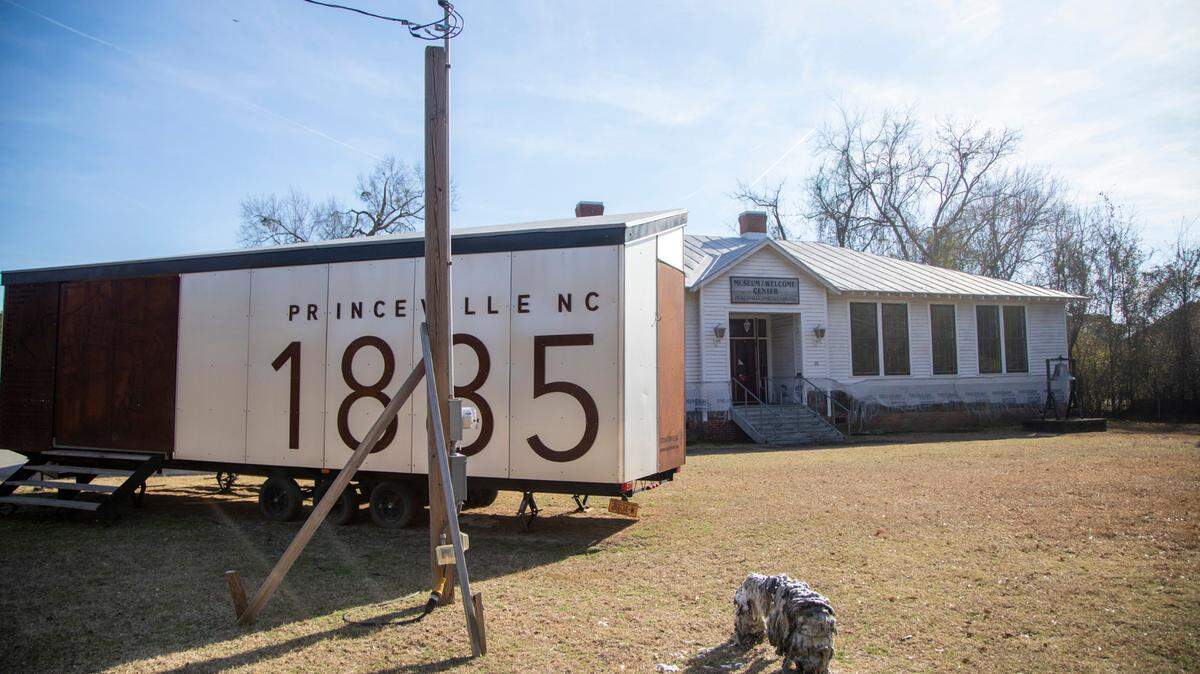
East of Freedom on Mutual Boulevard is an updated mobile museum emblazoned with “1885” — the year the town was founded — outside the flood-damaged former school that officials hope will one day hold the museum again. South of Freedom Hill is the renovated senior center, sitting 14 feet off the ground, thanks to efforts to repair it after Hurricane Matthew flooded 80% of the town in 2016.
Princeville has suffered major floods at least nine times since its incorporation, and each time talk inevitably turns to whether it should be abandoned. Each time — like after Matthew, after Hurricane Floyd in 1999 and after the floods of 1940 and 1954 — some leave, but Princeville inevitably decides to largely rebuild in the same place.
“Our forefathers came across that Tar River Bridge in 1865 with absolutely nothing but their God-given gifts and talents, and they took swampland that nobody wanted and built that into Freedom Hill,” Princeville Mayor Bobbie Jones said.
”And they used their blood, sweat and tears just to have something that they could call their own. For us to turn our backs would be a slap in the face to our ancestors, and I’m not willing to do that.”
Fighting climate change and history
As climate change brings wetter storms to Eastern North Carolina, the town is working to rebuild in a way that celebrates its history while also protecting the people who now live there. This can be seen in Princeville Elementary, the only school within town limits and a building that stood vacant for three years after Hurricane Matthew.
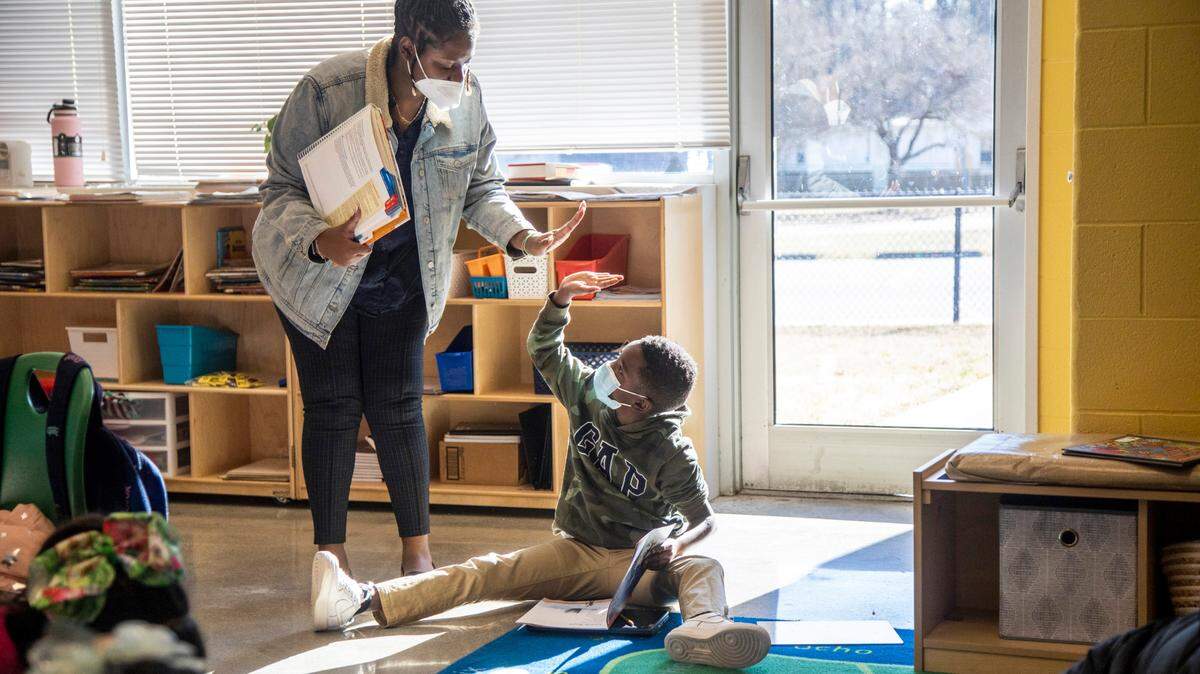
There is no carpet on the school’s floor, and vents are built into the walls of every classroom to keep floodwater from sitting in the newly renovated building — physical acknowledgments that the school is certain to flood again.
Yolanda Jones has been the school’s guidance counselor for nearly a decade. After Matthew, she and other Princeville Elementary staff tracked which hotels and shelters students were living in and guaranteed they could make it to classes at the school’s temporary home in Tarboro.
Even now, when there is heavy rain, Jones said, students become anxious.
Jones said she tries to reassure students that she and other school staff are there to help, even if there is another flood. In her conversations with kids, Jones said she tries to tell them, “We’ll do the best that we can in the event that something like that happens — hopefully it won’t — that we’re in this together. You know, we’ve come through one, we’ll come through another one.”
The efforts being taken now by Princeville also offer a kind of model for other North Carolina communities that suffered widespread damage during Matthew and 2018’s Hurricane Florence — and that seem likely to suffer flooding again in future storms.
“Princeville is one of the first communities in North Carolina that will be experiencing floods and learning to live next to flooded rivers, but it’s not going to be the last as the climate continues to change,” said Mary Alice Holley, the director of community innovation at the N.C. Conservation Trust, which has helped Princeville with multiple projects.
A long-awaited project
When the town was incorporated in 1885, it was named for Turner Prince, a carpenter and formerly enslaved person who in 1873 became one of the first people to purchase land within town limits.
Within two years, by 1887, the town had suffered its first major flood. It would suffer flooding again in 1899, 1919 and 1940 — and lesser flooding in other years — raising concerns about water-borne diseases and chasing some residents away each time.
After a large flood in 1958 stirred lingering concerns about Princeville’s survival, the U.S. Army Corps of Engineers built a 2.5-mile dike on the southern edge of the Tar River.
As the Corps started work on the dike in 1965, Ray Matthewson, then Princeville’s mayor and a champion of the project, told the Associated Press that “fear of the river” was keeping the town from making progress.
Matthewson said, “We have high water practically every year, and every five or six years things get so bad that some families have to leave.”
For more than 30 years, the dike was enough to protect Princeville, allowing the town to grow behind it.
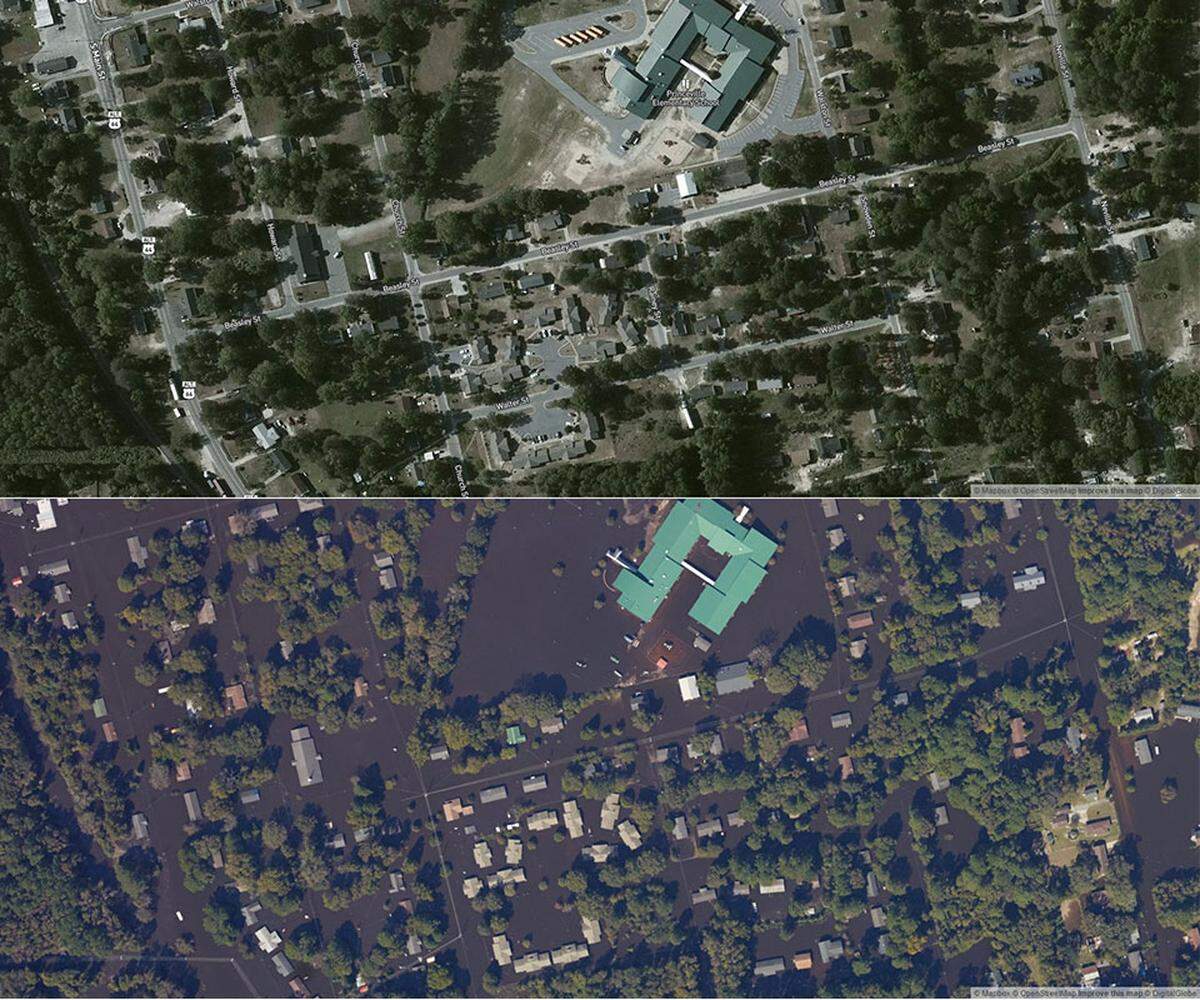
But in early September 1999, remnants of Hurricane Dennis saturated ground throughout Eastern North Carolina and raised the Tar River. That was followed less than two weeks later by Hurricane Floyd, which left Princeville, a town that sits at an elevation of about 30 feet, entirely underwater.
The Tar reached 41.5 feet near Princeville after Floyd, topping its previous high by more than seven feet. Following Matthew, the Tar reached 36.29 feet. The Tar River’s flood stage in the area is at 19 feet, according to the National Weather Service.
Since 1992, Princeville has averaged about 45 inches of rain annually, according to data from a nearby rain gauge. But in 2016, the town received nearly 65 inches of rain. And in 2020, without a major hurricane, there were nearly 62 inches of rain near Princeville.
17 years of studies
In the wake of Floyd, the levee received increased attention and was the subject of multiple studies to determine its future. The studies went on for 17 years — until July 2016.
But before money could be allocated for the upgrades Hurricane Floyd made clear were necessary, Hurricane Matthew doused the region; the Tar spilled around both ends of the dike and into the town.
Comparing Floyd and Matthew, Jones said, “In ’99 we lost every building and every house. In 2016, it was amazing because on one side of the street we lost everything, on the other side of the street you lost nothing.”
In 2019, the federal government appropriated $39.6 million to the Corps to extend the levee east, build an additional part of the levee near the interchange of U.S. 64 and U.S. 258, and raise some roads. The announcement was hailed as a long-awaited win for Princeville, with U.S. Rep. G.K. Butterfield saying its impact “cannot be overstated” and Sen. Richard Burr calling it a “long-needed project.”
But after receiving the funds, the Corps conducted more analysis and found that the planned improvements could not move forward, said Dave Connolly, a spokesman with the Corps’ Wilmington District.
“It would cause impacts to Tarboro and structures outside of the Princeville floodplain itself,” Connolly said.
Connolly said the Corps is still analyzing the project but that changes to the dike would cause flooding in “multiple locations upstream and downstream” of Princeville.
Nearly three years after being funded, construction on upgrades to the levee has not started, and Connolly said he’s not sure when it will.
Jones, Princeville’s mayor, said town officials understand the Corps has more work to do on the dike and don’t want something that protects their town to cause problems elsewhere.
But, Jones said, “It should not take 20 years.”
“The study should have been completed, and work should have been completed,” he said, “but here we are. We’re not going to dwell on the past, but we certainly want them to move forward with upgrading the dike now.”
‘Alternative methods’ to prevent floods
Even as they push for the dike to be extended, Princeville officials are working on other projects they hope will make it easier for the town to cope with future flooding.
“It’s very critical that Princeville find alternative methods and plans to better protect this community because the reality to the levee is that it may be some time before the experts land at a secure, safe place to pursue construction of that project,” Glenda Knight, Princeville’s town manager, said.
Knight, a former Princeville board member, coordinates with emergency management officials about disaster recovery efforts like the elevation of homes, has successfully completed repairs to the town’s stormwater system, and plans to move the town’s fire department and public works department out of the 100-year floodplain.
After Matthew, the town’s offices were located in Tarboro for about five years. In November 2021, Knight and her staff moved back across the river to a restored town hall on Princeville’s Main Street.
In the ongoing Matthew recovery, Knight said, 75 homeowners are working to elevate their homes, 19 are seeking a buyout and three are having their houses rebuilt entirely.
Princeville has plans to grow ... outside the floodplain
Town leaders are also trying to grow Princeville outside of the floodplain, with the purchases of two parcels — one 53 acres, the other 88 acres. Knight hopes the 53-acre tract can be used to bring businesses to the area to grow the town’s tax base, while the 88-acre tract could be used to build affordable housing.
Jones said, “That will allow us to grow — not to leave Princeville, not to abandon Princeville, but allow us to grow.”
N.C. State University’s Coastal Dynamics Design Lab has studied the town’s flood risk and evaluated some of the ways its land could be used to better control floodwaters.
“Princeville is of national and statewide historic importance, and so understanding why Princeville is where Princeville is in the landscape and why it is vulnerable to floods is part and parcel of the history of its settlement,” Andy Fox, the Coastal Dynamics Design Lab’s co-director, said.
About 87% of Princeville sits in the 100-year floodplain, meaning it has a 1-in-100 chance of flooding each year. A map created by the Coastal Dynamics Design Lab shows that such a flood would inundate nearly all of Princeville, posing a particular risk to the western and northern parts of the town, including the area around Freedom Hill and the rebuilt town hall.
This area flooded during both Floyd and Matthew, storms that swelled the Tar River beyond the levels of a so-called 100-year flood.
A historical retrospective published in Tarboro’s Daily Southerner in 1982 said that when newly freed Black people began gathering around Freedom Hill in the 1860s, “the land was of such poor quality and so susceptible to flooding that it held little value or interest for white planters.”
How flood-prone land can help prevent flooding
Fox said his lab is not necessarily focused on a hurricane or similar flooding event. Instead, it is considering how flooding from heavy rainstorms can be prevented on the town’s roads or how flood-prone property that has been bought out can help the whole community.
Among the projects suggested by the plan was a “rain garden” featuring plants that retain large amounts of water. The Conservation Trust for North Carolina and the Conservation Corps North Carolina built the garden at Princeville Elementary School to help control water running off the roof.
“People who reside in those areas have this fear any time there’s a possibility of a flood,” said Tenika Mercer, Princeville Elementary’s principal. “So the importance of this is to show kids flood interventions so that we can embrace stormwater instead of being so fearful of it.”
The N.C. State lab’s plan also led the two groups to build a quarter-mile walking trail that connects the school with the Princeville History Museum. The museum building suffered significant damage during Matthew and has not yet been repaired, but N.C. State designed and donated the trailer that now serves as a mobile museum.
The Conservation Trust and Conservation Corps will build another walking trail in the town this summer, helping the creation of a local farmers market.
Within the next two years, the groups hope to build rain gardens and possibly community farms on four to six properties that have been bought out using federal disaster money, returning the property to the community while lowering the financial strain that maintaining the sites can pose to local government.
The Coastal Dynamics Design Lab has also created flood-mitigation plans — “floodprints” — for Lumberton and Pollocksville. Over the next three years, Fox expects to do similar work with four other communities in Eastern North Carolina.
In Princeville, all of the ongoing projects come together to create a townwide effort to reduce the risk of flooding, to try to curb the impact of another Matthew-type storm. In many ways, Jones faces the same challenges that Matthewson and other mayors faced before him.
“Once we do all that we can do, that’s humanly possible, and it floods again maybe we need to consider moving someplace else,” Jones said. “But until that time, there’s no reason we should move.”
Honoring Princeville’s history
Mercer, the Princeville Elementary principal, often can be found walking the hallways talking with each student, asking them a series of three questions including what can be improved about the school.
The school has lessons about reading comprehension and math, just like every elementary school in the state. But there are also lessons about Princeville’s history and what the town means.
Gwanetta Revis has taught second grade at Princeville Elementary for three years, starting at the former location in Tarboro. She now teaches at the restored Walston Street building that flooded during Matthew.
This year, Revis and her second graders researched Princeville’s history, looking up how Abraham Lincoln and the Emancipation Proclamation led to the town’s beginnings, and then how Turner Prince came to purchase land and become the town’s namesake.
“It lets them learn about their ancestors, it lets them know where they came from, it lets them know they can be proud about where they live,” Revis said.
Under Revis’ guidance, the class wrote a play about the town’s history featuring roles like Lincoln, Prince and other freed enslaved people.
The second-graders performed the play on Feb. 18, the last school day before Princeville’s 137th birthday celebration. In doing so, the students re-enacted the town’s past inside a building designed to protect its future.
This story was produced with financial support from 1Earth Fund, in partnership with Journalism Funding Partners, as part of an independent journalism fellowship program. The N&O maintains full editorial control of the work.
This story was originally published February 23, 2022 at 5:45 AM with the headline "Princeville, flooded and rebuilt 9 times, stands as a resilient monument to freedom."