
Sea level rise along the NC coast has picked up pace in the last decade. Why?
Accelerating sea level rise along the Atlantic coast from Cape Hatteras south to the Gulf of Mexico can be partially attributed to human-caused climate change and partly to natural cycles, according to the lead author of a study published this month.
The study, published in the peer-reviewed journal Nature Communications, found that since 2010, sea levels from Cape Hatteras to the U.S.-Mexico border have averaged increases of about 10 millimeters a year, up from a long-term average of one to two millimeters a year.
Researchers found that about 40% of the accelerated sea level rise seen since 2010 can be attributed to global warming caused by emissions of greenhouse gases from humans, while 60% is being caused by natural cycles of ocean currents and winds. But they cautioned that those findings still stressed the importance of limiting greenhouse gas emissions and preparing for higher seas.
“These natural cycles have always been there but now with the man-made acceleration of sea level rise they are more risky for our coastline,” said Sönke Dangendorf, an assistant professor in Tulane University’s Department of River-Coastal Science and Engineering who was one of the study’s lead researchers.
The paper suggests that the natural cycle is likely to reverse itself in the next decade or so.
Even then, Dangendorf said, greenhouse gas emissions that have already occurred mean that global warming would continue and seas will continue to rise, only at a slower pace. And the natural patterns that lead to higher seas are certain to return.
Debate about just how much of the acceleration seen along the Atlantic and Gulf coasts in recent years should not detract from the fact that humans play a key role, said Philip Bresnahan, a University of North Carolina Wilmington oceanographer who had reviewed the Tulane study.
“Some bad actors are really good at misleading people into looking at any kind of debate or uncertainty and using that to political advantage,” Bresnahan told The News & Observer.
Why are water levels rising faster?
Global and local reports in recent years have joined the overwhelming amount of scientific evidence pointing to emissions of greenhouse gases from human activities as the main driver of global warming. The United Nations’ Intergovernmental Panel on Climate Change reported this year that humans “have unequivocally caused global warming.”
Bresnahan noted that another recent paper, as well as at least two that are available in pre-print, have tried to tease out the causes of the acceleration in sea level rise seen along the Atlantic and Gulf coasts. And, he said, they all have one common theme.
“All of these papers are saying the same thing: Humans are to blame for a lot of it, and we need to change that to improve everyone’s well-being,” Bresnahan said.
Paul Liu, an N.C. State University oceanographer, said he is familiar with the Tulane researchers’ work and is confident in their methods. Liu also noted that subsidence of the coast along the Outer Banks leaves that area more vulnerable to sea level rise.
“No matter how, the result is the same,” Liu said. “The water level is rising and rising faster than we expected.”
What are the effects of sea level rising?
Understanding what causes sea level rise to accelerate sea is important, Dangendorf said, in order to be able to anticipate future times when the natural cycles will drive seas higher than expected. Warming caused by human emissions of gases that warm the atmosphere, he said, will exacerbate that cycle when it drives seas higher.
That could mean more severe hurricanes and tropical storms whose impacts are coming on top of waters that are already risen.
“If that sea level is higher, the storms can be more destructive due to the storm surge because they build up on a higher base level,” Dangendorf said.
In North Carolina, the National Hurricane Center reported that 2018’s Hurricane Florence brought a storm surge of 8 to 11 feet around the mouth of the Neuse River. Some of the most significant flooding was seen in downtown New Bern, near where the Trent River flows into the Neuse.
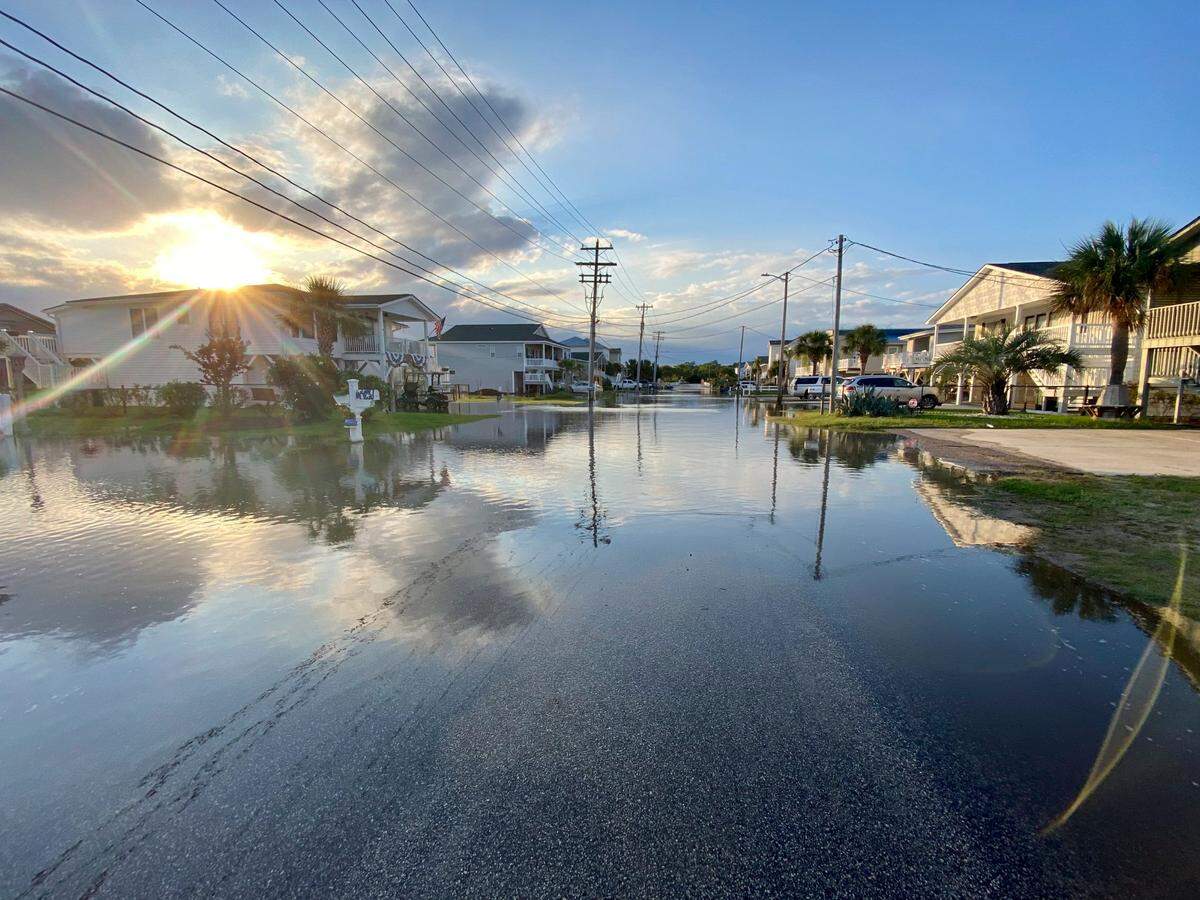
The rising sea levels also affect so-called sunny day flooding — floods that happen without heavy rains or a similar cause.
Oregon Inlet Marina, for instance, experienced about one sunny day flood a year in 2000. In 2021, there were five such floods, the National Oceanic and Atmospheric Administration reported, and the federal agency projects between 110 and 155 days with such flooding by 2050.
Much of the sea level rise that’s occurring today is coming from a century of emissions, Dangendorf added, meaning that sea levels will continue to rise even if greenhouse gas emissions were to rapidly plummet.
“Even if we get to net zero CO2 emissions, sea level doesn’t stop rising. If we stopped emissions it would rise less which is important but it wouldn’t stop, so we need to adapt,” he said.
This story was produced with financial support from 1Earth Fund, in partnership with Journalism Funding Partners, as part of an independent journalism fellowship program. The N&O maintains full editorial control of the work.
This story was originally published April 14, 2023 at 6:00 AM with the headline "Sea level rise along the NC coast has picked up pace in the last decade. Why?."