
‘Crazy Rich Asians’ is more than a film. It’s the first time I’ve seen someone like me on the big screen.
Lane in “Gilmore Girls.” Claudia Kishi in “The Baby Sitters Club.” Mulan. The yellow ranger of the Power Rangers.
When I was a kid, that was my complete list of characters on the small and big screens who vaguely resembled me — and one of them was a cartoon.
The last time there was a mainstream film with an all-Asian cast was in 1993, when “The Joy Luck Club” came out. I was 5 years old, so a little too young to appreciate an R-rated movie.
Flash-forward to now, when as an adult with two young children of my own, I’ve finally seen a movie on the big screen filled with characters who look like me and talk like me.
“Crazy Rich Asians,” which arrives in theaters today and is based on Kevin Kwan’s novel of the same name, follows a primarily Asian cast through high-jinks of the uber-wealthy. The main character, American-born Chinese professor Rachel Chu, navigates the Singaporean social elite when her boyfriend invites her to attend his friend’s wedding and meet his family across the world.
Rachel’s story will resonate with anyone who has nervously met a partner’s family or who has felt out of place in his or her own home.
But as an Asian-American, it especially struck a nerve because it reflects experiences that I haven’t seen represented in film before. Like Rachel, I was born in the United States to a family of immigrants, and until this summer I worked in the world of higher education. And like Rachel, I visited Asia and felt like I didn’t quite belong there.
But with those four characters in my childhood media experiences listed above, I didn’t seem to quite belong here, either.
Like a ‘banana’
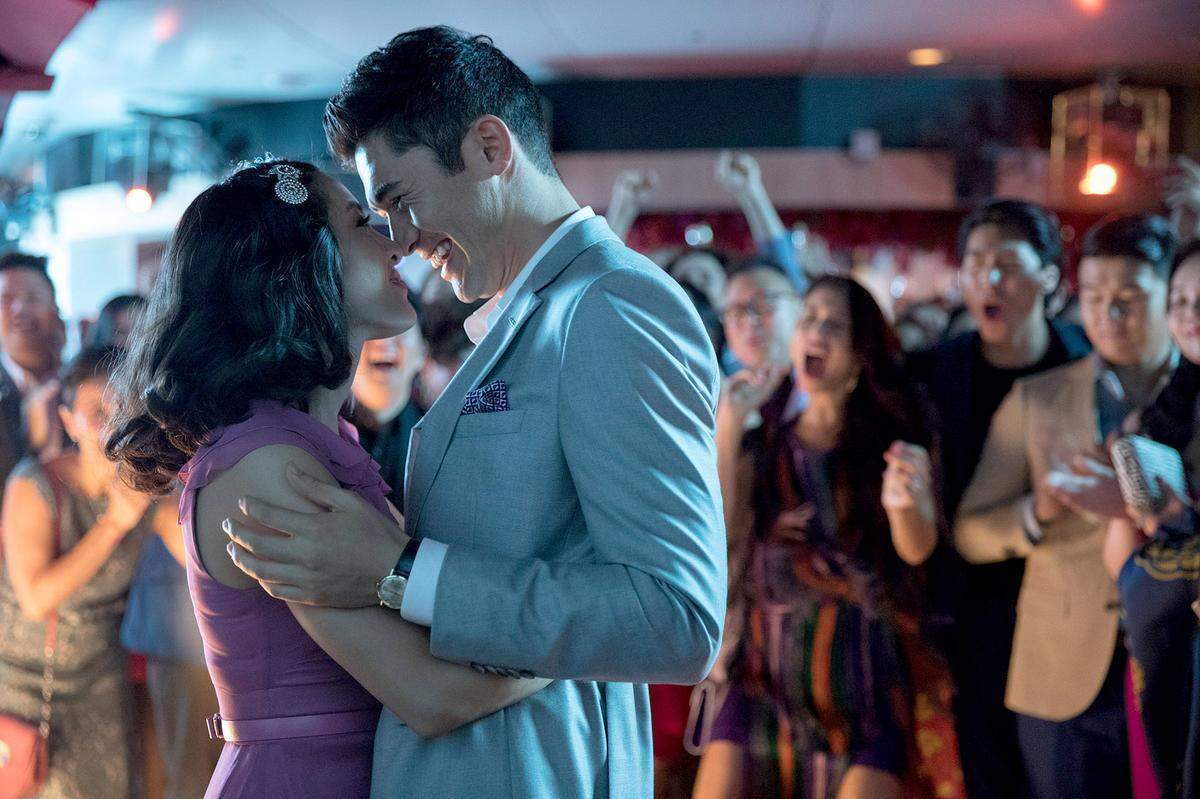
In the film, Rachel (Constance Wu) is surprised by the secret, ridiculous, beyond-”Great Gatsby” levels of wealth of her boyfriend Nick Young (Henry Golding). Rachel thinks she’s Chinese enough for the family, but they disagree, especially Nick’s mother (Michelle Yeoh).
Throughout the movie, Rachel acts unapologetically Asian-American. It’s a joy to write that, because it’s the first time I can write that someone is “acting Asian-American” and offer concrete examples of what that phrase means.
She chooses a red dress for meeting Nick’s family because it’s “lucky,” then gets shot down that the color is reserved only for envelopes. She proudly speaks Chinese, but not the dialect good enough for the family. Her friend calls her a “banana”— yellow on the outside, white on the inside.
“That’s me,” I thought excitedly. “I’m a banana, too!”
Vietnamese people in Vietnam know immediately that I’m not one of them. A Vietnamese friend told me she could tell as soon as I walked in a room that I wasn’t from Vietnam. I don’t wear the right clothes or use the right pronunciation, and just like Rachel, I’ll always be seen as American when I visit Asia.
But in my own country, that’s not always the case. I know that when strangers ask me, “Where are you from?” they’re often disappointed when I answer that I was born and grew up in a small town in Minnesota. They don’t realize until that moment that what they were really questioning was why I’m here. What is a person who looks like me doing here?
.JPG "Film Crazy Rich Asians Henry Golding (1).JPG")
The problem with tokenism
As I watched the film, I scribbled, “Almost too many Asians?” in my notes, because I’m so used to seeing zero, or exactly one, Asian character at a time. In what might be an unexpected reaction, I was unsettled by the entirely Asian cast.
Rachel’s best friend Goh Peik Lin, played by hilarious scene-stealer Awkwafina, mentors Rachel through the foreign world of the 1 percent. Groan-worthy dad Goh Wye Mun, played by Ken Jeong, makes bad jokes and fakes a heavy accent but reveals he attended Cal State Fullerton. Nick’s coolly poised cousin, Astrid, played by Gemma Chan, struggles through a rich girl-poor boy love story, which acts as a fun-house mirror to Rachel and Nick’s romance.
My reaction reveals one of the problems with tokenism, or when a movie or group includes a minority in an attempt to show diversity. In that case, the character is expected to represent everyone from that background. If Jin Doe acts soft-spoken, his classmates conclude all Asians are soft-spoken.
Tokenism also implies that there should be one non-white person in the room — and only one of us. So when I read Stephanie Foo’s stunning take in Vox on watching “Crazy Rich Asians” as an Asian-American woman journalist, I wondered if there would be space for an article on my own thoughts about the film.
But as the movie unfurled, my shock of “too many Asians” turned to glee at the sheer number of them. There’s not just one character representing all Asians, and there isn’t just one journalist to represent all of us, too. There’s room for all of these voices, including mine.
.JPG "Film Review Crazy Rich Asians (2).JPG")
Integrating films
A friend pointed out that there are no movies with Asian-American leads and white sidekicks. Besides the upcoming film “Searching,” starring John Cho, if the lead of a mainstream movie is Asian-American, then the entire cast is Asian and the movie is either “Joy Luck Club” or “Crazy Rich Asians.” If you believe the movies, Asian-Americans can‘t integrate into other communities as leaders, just as supporting characters. We can only lead in our own communities.
In one of the best examples of film writing, critic Wesley Morris wrote in The Boston Globe, “The movies, meanwhile, have become lucrative in their segregation.” In the 2011 piece, for which he won a Pulitzer Prize, he referred to how Hollywood funds all-black films rather than seeking out integrated films.
“In a sense, the balkanization of movies would appear to be an example of how much culture has splintered into niches — more proof, if we needed it, that we no longer watch, listen to, or read the same material,” Morris wrote. “But moviegoing is one of our last shared public acts. Hundreds of millions of people continue to watch movies together, and it’s easy to scan the house and see who’s watching with you.”
After I watched “Crazy Rich Asians,” I chatted with four middle-aged white women who loved it, especially the “handsome men” who take off their shirts. Then, two Chinese-American teenage boys mourned how “it was different from the books” and how the actors had “weird accents” when speaking Chinese. The man next to me cracked up loudly throughout the film. He could’ve been Filipino or Vietnamese or Mexican, but it didn’t matter.
We were an integrated audience enjoying a movie about a niche population.
Faces like us
As I stared at a 20-foot high face of Wu gloomily looking across a beach, I thought about an article I wrote earlier this summer on a study showing that prospective teachers were worse at recognizing the emotions of black students. That divide can result in harsher discipline for the same misbehavior when teachers think black kids are more hostile in their intentions than white kids.
Maybe we’re worse at judging emotions from people of color because we’re taught to read “white emotions” by the giant white faces in the movies at moments of emotional tension and revelation. Filmmaker and critic Kevin B. Lee dubbed this technique “Spielberg Face” in a 2011 video essay.
Like “Black Panther,” a film with a majority African-American cast, the success of “Crazy Rich Asians” at the box office could usher in more Hollywood support for films that don’t have majority white casts.
That’s what I want — movies that reflect us, the audience which includes Asians and white people and black people and Hispanics and disabled folks and queer people. I want both niche films that explore specific cultural experiences, like “Crazy Rich Asians,” and I want integrated films that explore our shared experiences. I want American cinema to reflect American reality.
“Crazy Rich Asians” is not the most important movie out there. It’s a funny, indulgently glamorous romantic comedy.
But more movies that feature non-white Spielberg Faces are important, as they can teach us to recognize emotions and intentions.
It makes people like me feel seen, and perhaps just as importantly, it makes us all see faces not like our own.
This story was originally published August 15, 2018 at 12:05 PM.