
How Earl Scruggs learned that he could make a career out of making music
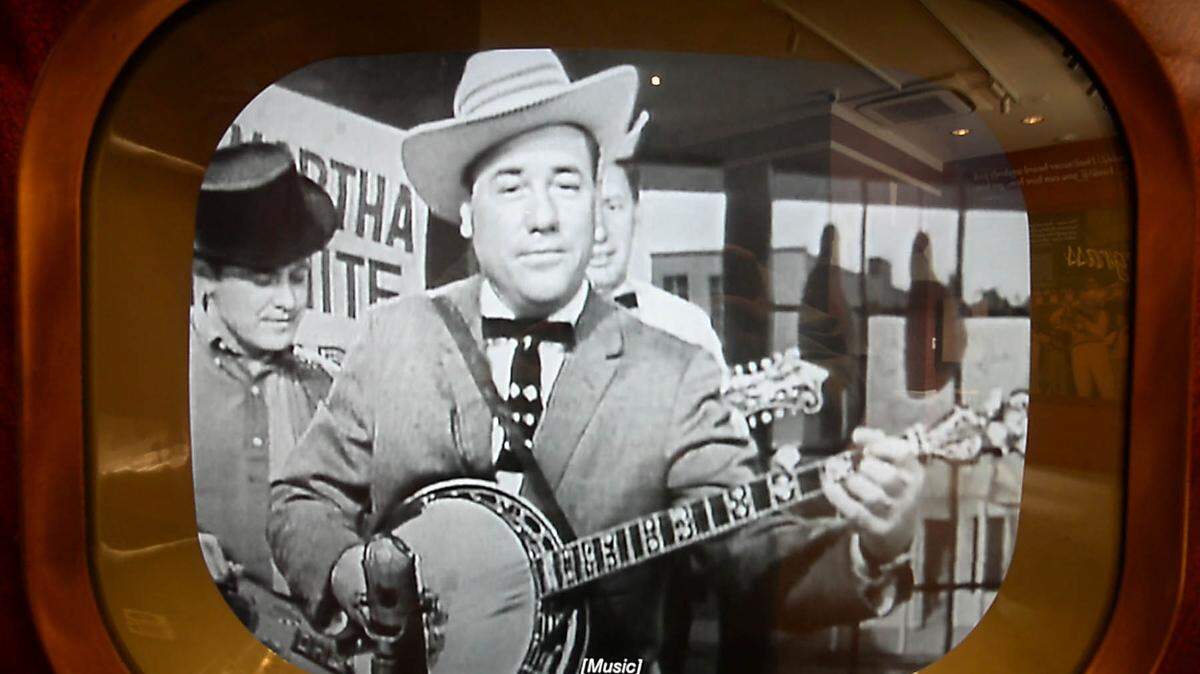
This excerpt from “Earl Scruggs and Foggy Mountain Breakdown: The Making of An American Classic” finds native North Carolinian Earl Scruggs at the limits of what he could achieve as a musician in the Tar Heel State in the 1940s, even for a player who would become the foremost practitioner of five-string banjo.
While still in elementary school in Boiling Springs, Scruggs expanded the banjo-picking vocabulary of the day by coming up with a fluid three-finger roll in his right hand. The story reveals hints that Scruggs’s playing was exceptional, that he might go far, but first he had to navigate the music business as it existed in his native Cleveland County, then in the piedmonts of the Carolinas, in Asheville, then in Knoxville, Tenn.
It was in East Tennessee that he played his last dates before joining bluegrass founder Bill Monroe on the Grand Ole Opry in Nashville. The men’s partnership — and rivalry — created the musical fire that would become bluegrass music, the style that still attracts avid listeners and musicians from across the state, the nation and the world.
Earl Scruggs’ early professional days
If 11-year-old Earl Scruggs had achieved his breakthrough on an instrument other than the banjo, in a larger place than his Flint Hill front room, he might have arrived much sooner on the national stage. Instead, it took about a decade for Scruggs to move on from front-porch and small-town music sessions, to regional radio, then to the nationally heard WSM Grand Ole Opry broadcast.
Young Earl initially picked in a two-finger style of the day, at family gatherings, with neighborhood groups and at fiddle contests, wherever he could practice his growing skills in front of people.
By age 6, he took his first steps in a more professional direction. He went with his family to play on radio station WSPA in Spartanburg, in his best Sunday clothes and with slicked-back hair.
In Depression-era Flint Hill, Earl continued to attend nearby Boiling Springs High School and to pull his weight on the farm. People around Cleveland County remembered young Earl’s playing from those days, well into the 21st century. Brooks Piercy was Earl’s teacher at the high school in Boiling Springs as well as his accomplice on one of his first road trips, to a stringed- instrument contest in nearby Casar in 1938. (According to the North Carolina Gazetteer, the town had intended to take the name of the Roman emperor Julius Caesar, but fell victim to a spelling error.)
“Of course we won the thing, but they wouldn’t let Earl stop playing,” Piercy said when in his ’90s.
Scruggs’ daily work was so time-consuming that he began looking for a way to support himself and his family by other means.
“All it amounted to in those days was just trying to play with whatever groups I could get with and working as many places as possible,” he said. “I just enjoyed — even back then — different atmospheres and different locations.”
As mentioned, Earl sometimes played at one of Cleveland County’s fish camps, an informal kind of spot that Charlotte Observer reporter Joe DePriest described as “a screened-in shack with a few picnic tables,” where diners could get fresh-caught catfish, slaw, and other dishes. Scruggs told DePriest that he used to walk from his house with his brother to play at Ollie Moore’s fish camp on the Broad River, some three miles below Boiling Springs.
“We’d put on clean overalls and work shirts and make about a nickel apiece,” Horace Scruggs said.
Late in life, Earl Scruggs recalled an idyllic scene by the river, with wooden shutters propped open, kerosene lamps glowing, people dancing, and a piedmont breeze keeping everyone comfortable.
“It was a pretty scene, hearing the Broad River running, and it was cool down there on a hot summer night,” he said.
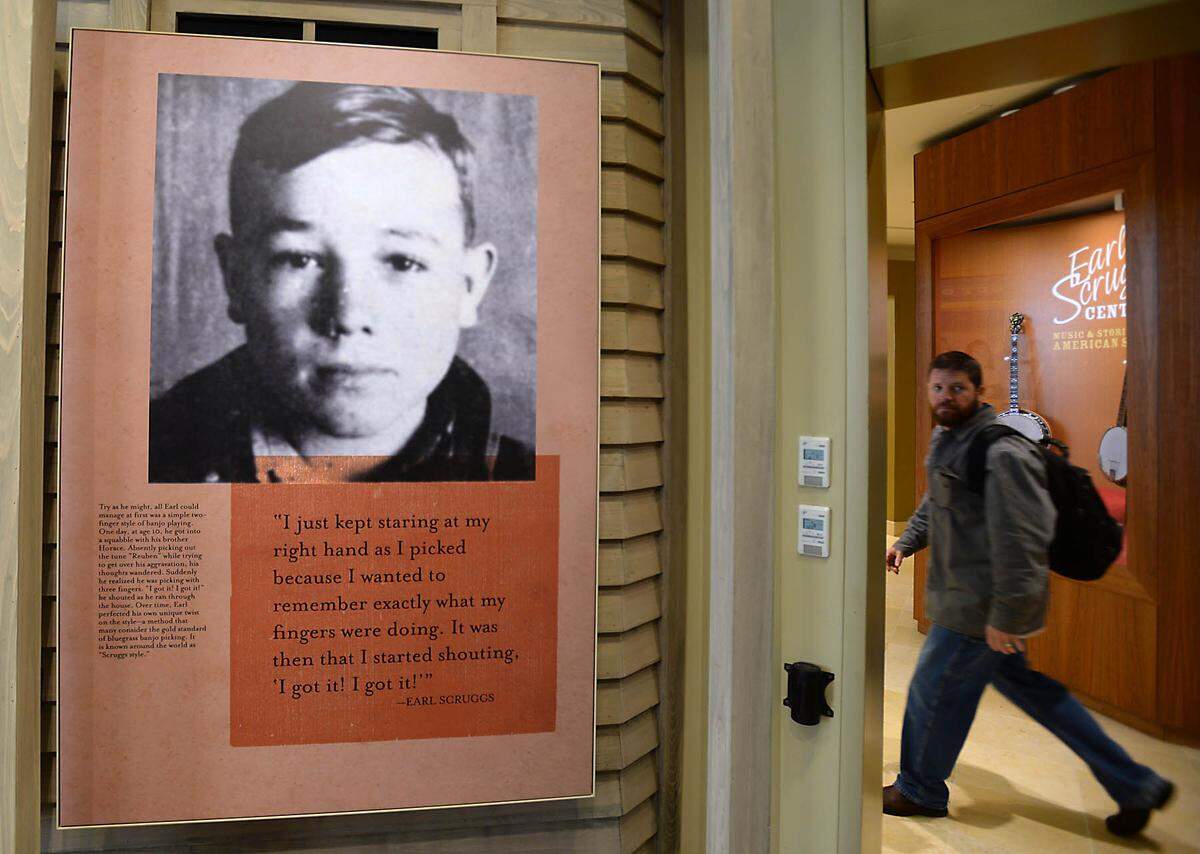
As Earl grew, hard times on the farm led to his taking a job at a mill in Shelby. Trish Camp, daughter of Earl’s friend and eventual picking partner Grady Wilkie, has heard stories about Scruggs all her life. Camp said that her father, who worked at Lily Mills in Shelby, was friends with Lula, Earl’s mother. Lula visited Wilkie to ask whether he could “get Earl on” at the thread mill, that is, see that he was hired to a full-time, cash-money job.
“We’re about on starvation and we need some help if you can get him on,” Camp said, as she recalled the words of Lula Scruggs’s plea.
And Wilkie did. He reached out to young Earl, got him a job at the mill, and had him stay with the family.
“Mom and Dad just lived right up the street from the mill, on Morton Street,” Camp said. “They would all walk to work together every day.”
Even at the thread mill, Scruggs found opportunities to work on his craft, picking with Wilkie in the backseat of Earl’s Chevy during breaks.
“He’d play guitar and I’d play banjo until they’d motion us to come back into the mill,” Scruggs said. “That’s when I finally realized that what I was doing was of interest to other people. They’d stand around and watch us pick.”
“One of them hadn’t heard nothing like that before, and he took his hat off, threw it on the ground and said, ‘Hot damn!’ That’s the only time I’ve run into a guy that when he got excited would throw his hat down and dance on it. ... That’s hard on a hat.”
As Scruggs continued to encounter the world outside the farm, he started pondering the idea that music might be more than his private obsession: It might become his job. In 1941, he did a stint with Paul Carpenter and the Orange Blossom Hillbillies, picking along with his buddy Wilkie and guitarists Carpenter, Junior Wiseman, and Charles Hopper. One January they played at the opening of Bridges Amoco service station near Lattimore, North Carolina.
Scruggs played an early radio stint with the Gastonia-based Carolina Wildcats band and then encountered a brother team who had climbed higher up the show-business ladder. His first professional job came playing dates with Zeke, Wiley, and George Morris. Many sources, probably relying on Earl Scruggs’s own banjo book, give 1939 as the year when he joined the Morris Brothers. For several reasons, that date is likely inaccurate.
Earl was only 15 in 1939 and still in high school in Boiling Springs. But more significantly, several sources say he replaced banjo player Hoke Jenkins, Snuffy Jenkins’ nephew, who was going into the service. According to Army records, Hoke Jenkins was inducted in January 1941.
The 1940 census shows Earl Scruggs still living at home in Flint Hill. Most North Carolina high schools were in the process from going from an 11-year schedule to one that specified graduation after 12 years. That means Scruggs probably graduated in spring 1941.
Earl likely went to work with the Morrises in 1941 or possibly early 1942, as the brothers said there was a gap between Jenkins’s leaving and their hiring Earl.
The Morrises, best known for their version of the eventual Flatt and Scruggs favorite “Salty Dog Blues,” had been working as bandleaders and separately as side musicians in the network of radio stations that kept pickers busy in North and South Carolina. Wiley Morris told journalist Wayne Erbsen about the night Scruggs and his mill friend Grady Wilkie showed up at a date in Chesney, South Carolina.
“They had both driven up to Chesney in a model A Ford coupe, and both were wearing blue shirts and overalls,” Morris said. “Grady said, ‘I got a guy out here I wish you boys would listen to on the five-string banjo.’ Well, we were needing one at the time because Hoke Jenkins had been called into the service, so I said, ‘Bring him in here. Let’s tune him up and hear how he sounds.’
“So Earl came in and tuned his banjo to my guitar, and he could play as good that night as he can now, if not better. He was just shaky and nervous then. He’s always been nervous and I’d have thought he’d have missed everything on the banjo, but he didn’t miss a string. So we hired him that night and paid him 20 dollars a week.”
Jesse McReynolds, of the highly regarded brother team Jim & Jesse, remembered the Morris Brothers as a colorful act with raucous overtones. “They couldn’t get along playing for fighting together,” McReynolds said. “A lot of their show was fighting on stage.”
Like most hillbilly acts of the day, the Morris Brothers included lots of comedy in their performances, including blackface and cross-dressing routines. It is not known what role, if any, Scruggs played in the Morris Brothers’ hijinks, although he later described his attempts at comedy as mostly unsuccessful. Scruggs spent about eight months with the Morris Brothers, according to Wiley, then returned to Cleveland County and received his draft notice in 1942.
Because his father had died, Scruggs got a deferment to stay out of the Army and support his mother. As World War II neared an end, Scruggs continued to work in the textile mill and then hooked up in 1945 with another regional act, Lost John Miller and his Allied Kentuckians, based in Knoxville. Jim Mills, who zealously collects anything associated with Scruggs, once took Scruggs a picture of Miller’s band circa 1945, more than 40 years later.
“They never took a picture with Earl in the band,” Mills said. “He was only in the band about six months.”
Scruggs recalled Miller fondly, Mills said, and could still name all the Allied Kentuckians. But in the day, the band couldn’t get past Miller’s personal situation.
“The main problem with the band was his wife,” Mills said Scruggs told him. “She just nagged the hell out of him all the time and he gave it up. That’s when Jim Shumate called me and said, ‘Hey, why don’t you try out with Bill Monroe?’”
By 1946, Miller was back on the road with a fresh batch of Allied Kentuckians, but he never regained the place in history that came from his hiring Earl Scruggs.
Many years later, in an article that accompanied his National Heritage Fellowship from the National Endowment for the Arts in 1989, Scruggs offered a glimpse of the struggle he went through in deciding to commit to music. After all, he was a smart, capable young man with beautiful hand-writing, the son of an accountant and a church organist, educated in school and on the land. He could have done plenty of things other than pick the banjo.
The NEA essay gets deeper into Scruggs’ thoughts during that time than almost any other interview:
“The music business was, he said, ‘like looking into a dark room,’ and after playing with a few local bands, he was ‘forced to weigh carefully whether it would be stable or not.’ As he began to refine his three-finger picking technique, he wasn’t sure whether he was going in the right direction with his music. ‘I wasn’t happy about what I was doing,’ he said, ‘but I didn’t know what to do about it.’”
In his early 20s, Scruggs had played everywhere the opportunity arose since his preteen years but remained mostly unknown outside his original stomping grounds. However, Scruggs was about to be offered as much work as he could handle, playing in country music’s big leagues.
From “Earl Scruggs and Foggy Mountain Breakdown: The Making of An American Classic” by Thomas Goldsmith. Used with permission of the University of Illinois Press. Copyright 2019 by the Board of Trustees of the University of Illinois.