
Fifty years after MLK's death, artists still give voice to civil rights leader's words
On April 4, 1968, the Rev. Martin Luther King Jr. was supposed to be on a tour of North Carolina. But he was needed in Memphis to continue his efforts to aid the sanitation workers on strike seeking better wages and working conditions.
King never made it back to North Carolina. He never made it out of Memphis.
Today marks the 50th anniversary of the day the civil rights activist was killed. Since his death, art communities around the country have sought to celebrate King's efforts and honor his memory with murals, plays, exhibitions, statues, music and more.
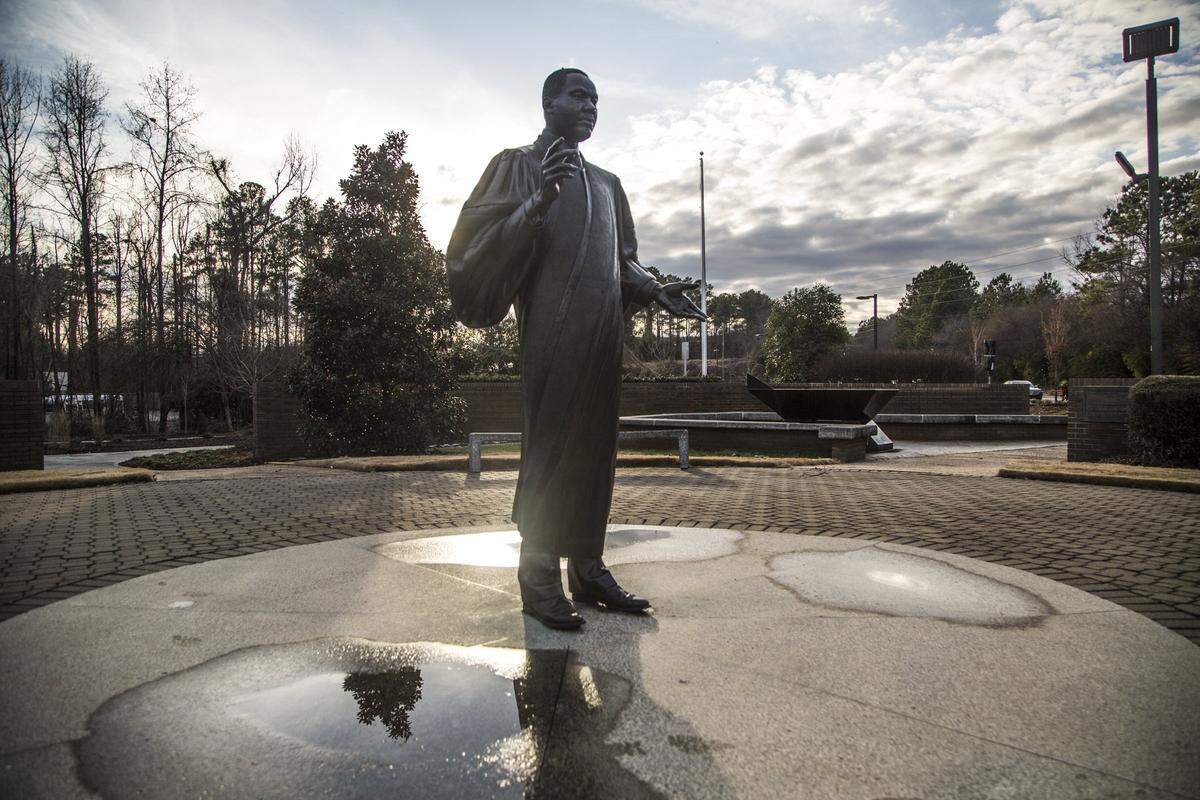
In Raleigh, there's the Dr. Martin Luther King, Jr. Memorial Gardens on Martin Luther King Jr. Blvd., which includes a 6-foot-2-life-size sculpture.
William Henry Curry, music director at Durham Symphony Orchestra, wrote "Eulogy for a Dream," which premiered in 1999. It will be broadcast on classical music station WCPE 89.7 FM at 8 p.m.
Ira Knight's "Martin Luther King: An Interpretation" was a one-man show at the Carrboro ArtsCenter exploring the many facets of Dr. King.
The African American Cultural Center at NC State featured an exhibition in January called "I Am A Man," created in honor of the Memphis sanitation strike.
On the 50th anniversary of King's assassination in Memphis, we asked members of the Triangle arts community to reflect on the anniversary, sharing what King meant to them. We also asked what role art has in continuing King's mission. Here are excerpts.
Linda Dallas
Artist, City of Raleigh Arts Commissioner, art professor at St. Augustine's University
"He went (to Memphis) in the face of the danger that he knew he was in, because these people's lives mattered. And they were not just a commodity or tool to be used. And here we are 50 years later having to explain — and I think that the arts do that really well — that everyone's life matters. That is the thread that connects that event to today. ... That's the thing that the arts touch on so profoundly."
Natalie Bullock Brown
Assistant professor of film and broadcast media at St. Augustine's University; adjunct professor at NC State
"I think (artists are) supposed to pull out and illuminate those issues that still elude us as a society in terms of being resolved, and race is absolutely one of those issues ... As a country, we seem to not be able to reckon with."
Erica Porter
Board of Directors, VAE Raleigh
"Artists have really been leading the way for the change we want to see. Being with VAE Raleigh, we've done some awesome exhibitions. ... It's been life-changing for me. I've enjoyed seeing the artwork come from these artists and showing they are upset and ready for things to change."
Carly Prentis Jones
Performing artist and cultural activist
"Art, and the performing arts, has a transformative power that we need in this country. We have a very diverse country, and we have so many differences. The way to create empathy and the way to move forward and work together as a country — we need art, we need that transformative power."
Moses T. Alexander Greene
Playwright, cultural and performing arts executive
"The arts allow our communities to bring truth to real-life struggles. ... (They) have a way of providing a lens on the realities of African-Americans and people of Pan-African culture of the civil rights movement."
William Henry Curry
Music director, Durham Symphony Orchestra
"I was just beginning to compose the year he was assassinated. ... One of the things I remember vividly about that week was the funeral. No one was crying. I didn't know that sometimes people are all cried out by the time funeral and memorial services come. And that put in my idea, maybe a piece of music about this experience. Fast forward to 1999, where I premiered my 'Eulogy For a Dream,' which is a piece for speaker in orchestra, using the words, speeches from Dr. King."
This story was originally published April 4, 2018 at 5:25 PM with the headline "Fifty years after MLK's death, artists still give voice to civil rights leader's words."