
Greensboro Science Center’s giant clam gets life-saving surgery
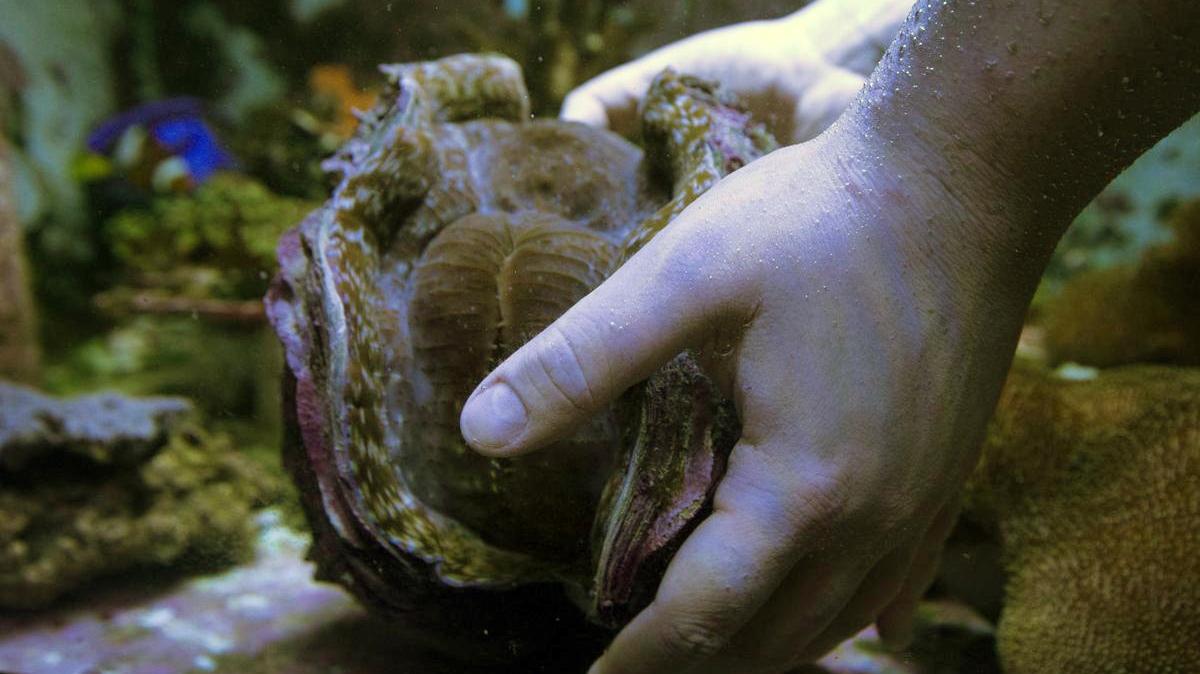
There was trouble in the tank at the Greensboro Science Center.
The aquarium’s Living Corals exhibit — usually a world of watery tranquility, where bright tropical fish dart through a forest of glowing orange, pink and yellow corals in a re-creation of an Indo-Pacific coral reef — had become a scene of strife for one of its largest inhabitants: the giant clam.
About the size of a basketball and with a shell tough enough to cut the wayward inexpert hand that may try to lift him, the giant clam is a native of the waters surrounding Fiji, the Philippines and Indonesia. This marine region of the world is exceptionally high in species diversity, with more than 3,000 species of fish, 500 species of reef-building coral and several species of giant clams that can live for decades.
Since his arrival at the science center five years ago, the giant clam had passed the time peacefully on the exhibit’s pebbled floor, his shell open to catch the light that maintains the beneficial algae inside his mantle — algae which also turn him a near fluorescent shade of orange.
Lately, though, that shell was snapped nearly shut. Something fishy was going on.
“We started noticing that the fish were picking at him,” said Rachel Rodgers, the aquarist who takes care of the corals and the clam. “If the clam is healthy, he’s big enough that the fish will leave him alone. But if something’s wrong, they’ll start taking a nibble here and there.”
The clam — who has no name but is generally regarded by staff as a “he” — wasn’t opening up about his problem. However, Rodgers could tell that the mantle, the fleshy part of the animal inside the shell that aquarium visitors can see when the shell is open, had little pieces missing. The fish, apparently, had sensed a moment of weakness and were diving in for a clam dinner.
Rodgers and center veterinarian Dr. Sam Young had noticed that the clam’s hinge, a tough ligament that holds the two halves of his shell together, was beginning to degrade.
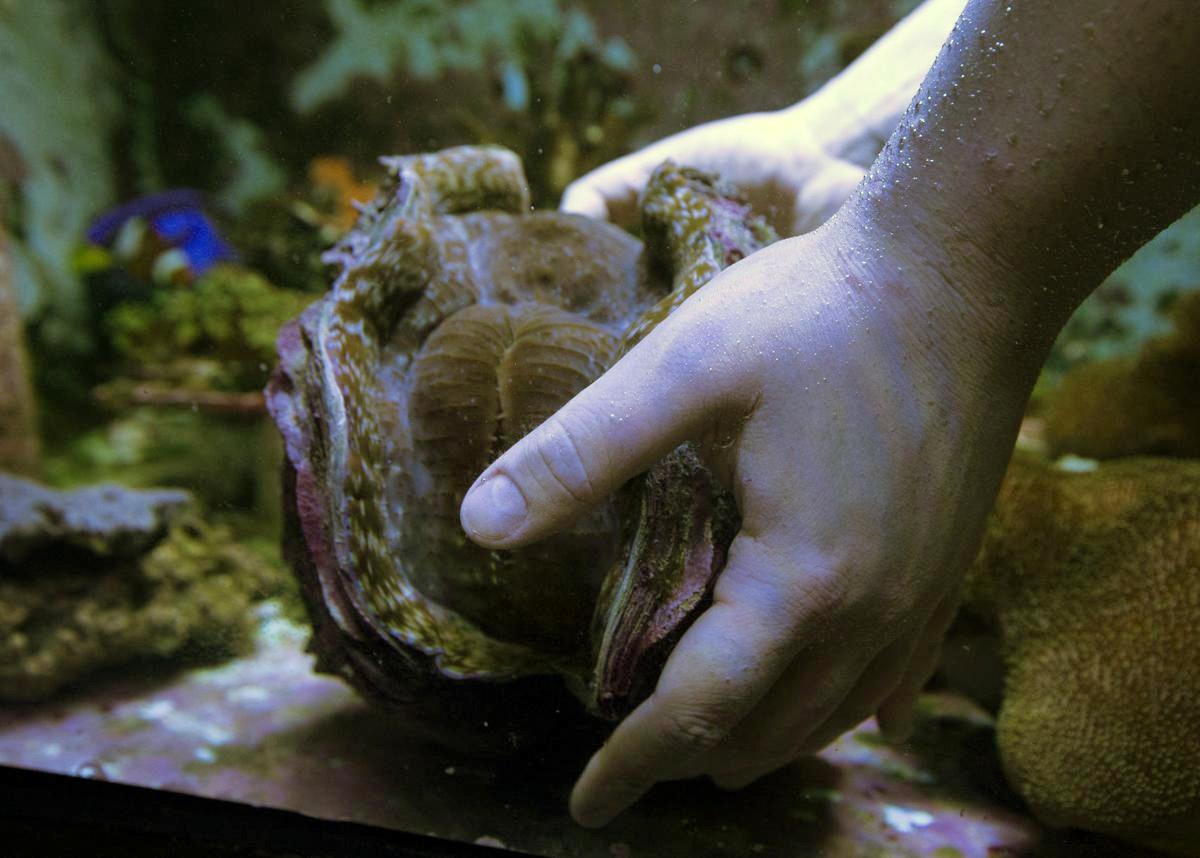
“During regular exams, I’d get into the tank and check him, and I noticed that the hinge was not in the shape that we wanted it to be,” Rodgers said. “Without a functioning hinge, the clam can’t close to keep out predators or regulate its environment well. So, we made the decision to reinforce the hinge.”
Clams, like corals, are tricky to keep alive. An animal whose body is covered in a hard shell made of two halves, they depend on a well-controlled temperature, water flow, light and water chemistry to live. Removing one from its habitat is no easy feat.
“You don’t want to kill the animal through stress, or stress out the other animals in the tank,” Young said. “But this repair needed to be made to keep the clam healthy.”
To make the repair, Young made a butterflylike hinge out of metal that would be safe in salt water. He and Rodgers measured where to put the metal hinge on the clam and then made a marine-grade epoxy to adhere the hinge to the outside of the clam’s shell.
While a class of N.C. State veterinary students watched the procedure, Rodgers removed the clam from his habitat and set him in a shallow container with water from his tank. Young used a Dremmel tool to roughen the shell so that the epoxy would adhere well. Like a marine-grade super glue, the epoxy set and hardened over time.
While Young worked, Rodgers used a turkey baster to keep the underside of the hinge moist with water from the tank.
“Even though he was in a good amount of water, I didn’t want the part of the hinge that was exposed to the air to dry out,” she said.
When the procedure was over, the team made a cushion for the clam out of hose weighted down with gravel, so that he could sit up in his tank without the risk of the epoxy touching anything.
Right away, Young said, the clam began to respond to his surroundings and opening toward the light, happy as a … well, you know.
“It was amazing how you could really see a difference in him,” Young said of the recovering clam. “He relaxed right away.”
As the center’s veterinarian, Young said, he has seen many things. But this was his first operation on a clam, a procedure that he may have been the first to do.
“I ordered some books, and I did a lot of research. I’m always talking to colleagues,” he said. “There was not a lot of literature about this. Clams are usually pretty hardy; you don’t see a lot of issues with them. That’s why we invited the vet students to come watch, so that they could get exposure to this unusual case.”
Young works closely and collaborates with other zoo and aquarium veterinarians across the country and also with the veterinary school at N.C. State and the animal science program at N.C. A&T, helping to train the next generations of animal caregivers.
Young also biopsied the hinge to see why it broke down. He plans to publish this information in veterinary publications to add to the body of knowledge about the animal and the procedure.
Now that the clam is a mollusk on the mend, he’ll be cleared to leave his recovery tank and go back into the Living Corals exhibit.
Young said that the unusual procedure is part of the Greensboro Science Center’s commitment to all of its animals, not just the furry or crowd-pleasing ones.
“We try to treat all of our animals as similarly as possible,” he said. “This clam could live longer than a human, so why not take the extra time to be sure that he’s OK?”
This article is published through the N.C. News Collaborative, a partnership of BH Media, Gannett and McClatchy newspapers in North Carolina that aims to better inform readers throughout the state.
This story was originally published January 4, 2020 at 1:50 PM with the headline "Greensboro Science Center’s giant clam gets life-saving surgery."