Artists capture the protest movement in plywood, filling Raleigh and Durham with murals
In this moment of protests against racial injustice in Raleigh and Durham and cities across the country, protest art has become the companion piece for the voices in the street.
Boards put up to cover broken windows and buildings, or preserve the unbroken ones, now fill downtowns, giving artists new, blank canvases to paint words and images, calls for justice, cries of anger and the powerful markings of a movement.
Following protests the weekend of May 30, which saw destruction and looting in Raleigh, artists were organized in a matter of hours in Raleigh and Durham. Arts groups and businesses commissioned artists to take the beige plywood and make their own statement, including portraits of George Floyd and the words Black Lives Matter.
“This is a place for people to put those feelings,” said Marcella D. Camara of Art Ain’t Innocent, an arts advocacy group.
Camara helped organize the Durham murals with Laura Ritchie of The Carrack and Monét Marshall, also of Art Ain’t Innocent. There are 21 murals throughout downtown, all created by local Black artists.
She said the murals aren’t an act of beautification, but pieces connected to the ongoing protests against systemic racism.
“A lot of this was joy, Black joy,” Camara said. “But it comes out of something very horrible.”
Artists were paid for the work, either by the business where the mural is located or through the North Star Church of the Arts Durham Artist Relief Fund. Artists were paid $200 for two panels, plus $80 for any additional panel.
In Durham, businesses and building owners started boarding up windows Monday, June 1, the day of the first evening protest in the city following a weekend of riots in Raleigh. As boards went up, they were immediately tagged with “Black Lives Matter” and other protest phrases, and those early paintings weren’t covered up.
The scene is similar in Raleigh. In-between colorful, bold murals on building walls, other impromptu art has sprung up in the form of chalk drawings and words, even poetry, on sidewalks and streets, some signed by children.
One one board along South Wilmington Street, one small sprig of faux flowers is duct-taped to the board, with “Black Lives Matter” written in permanent marker on the tape. A similar theme is found on a door near 42 & Lawrence coffee shop. Dozens of flowers are taped to the door with names of people killed by police on the tape. They surround the words “Say Their Names.”
Camara said tagging a board and painting a mural each come from the same urge of expression.
“The human experience is big on legacy,” Camara said. “The fear of being forgotten or unheard. Here we have a blank canvas and there’s no one to tell you how to shape it.”
Camara collaborated with artist Derrick Beasley on a piece with a black background and the words “Imagine a world without police...” There are wheatpasted images of African American men, women and children above the words.
Raleigh protest murals
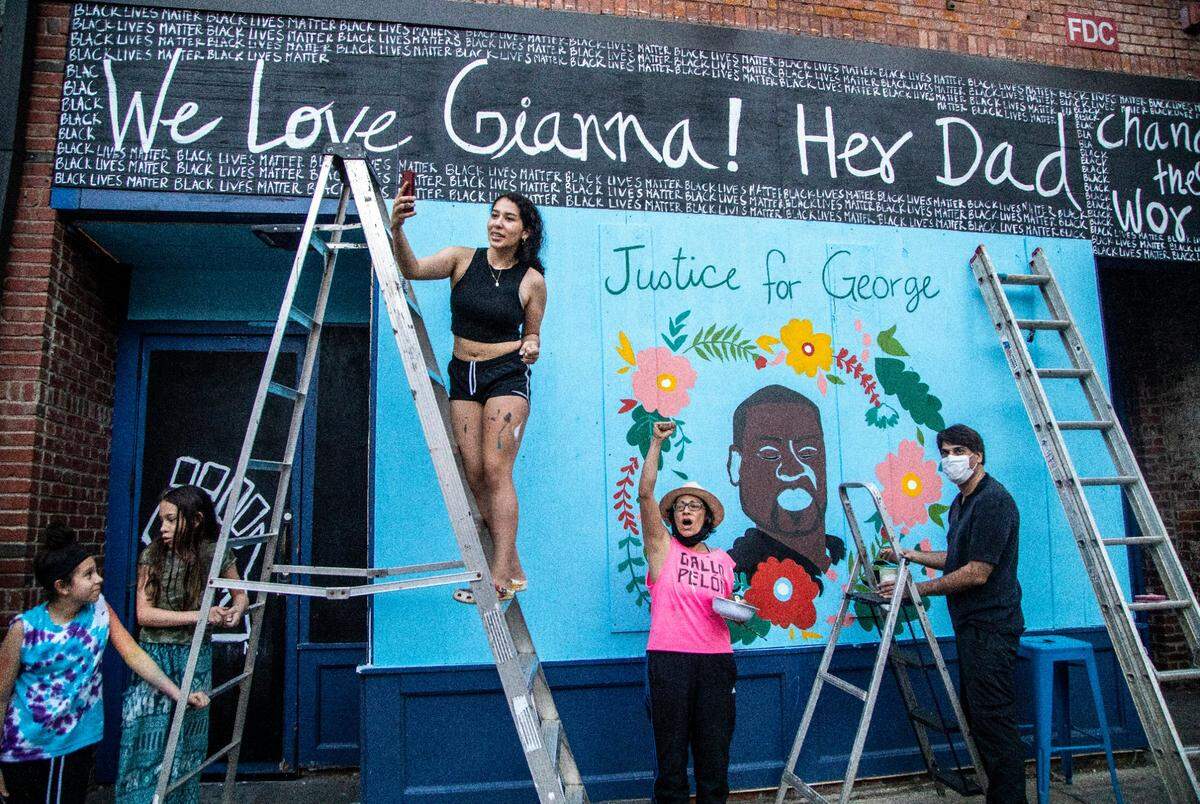
Raleigh restaurant owner Angela Salamanca organized a group to paint a mural of Floyd on Centro, her Mexican restaurant on South Wilmington Street. The mural is a recreation of artist Shirien Damra’s portrait of Floyd, which went viral on social media, and includes the words “We Love Gianna! Her Dad changed the world!” referring to Floyd’s daughter. The words “Black Lives Matter” are also written 100 times.
“For me, art has always been a way of processing and sitting with difficult things,” Salamanca said. “As a mother, you’re always seeing everything through the lens of parenting. Writing ‘Black Lives Matter’ 100 times over let me really sit with what that meant and the importance of standing with that.”
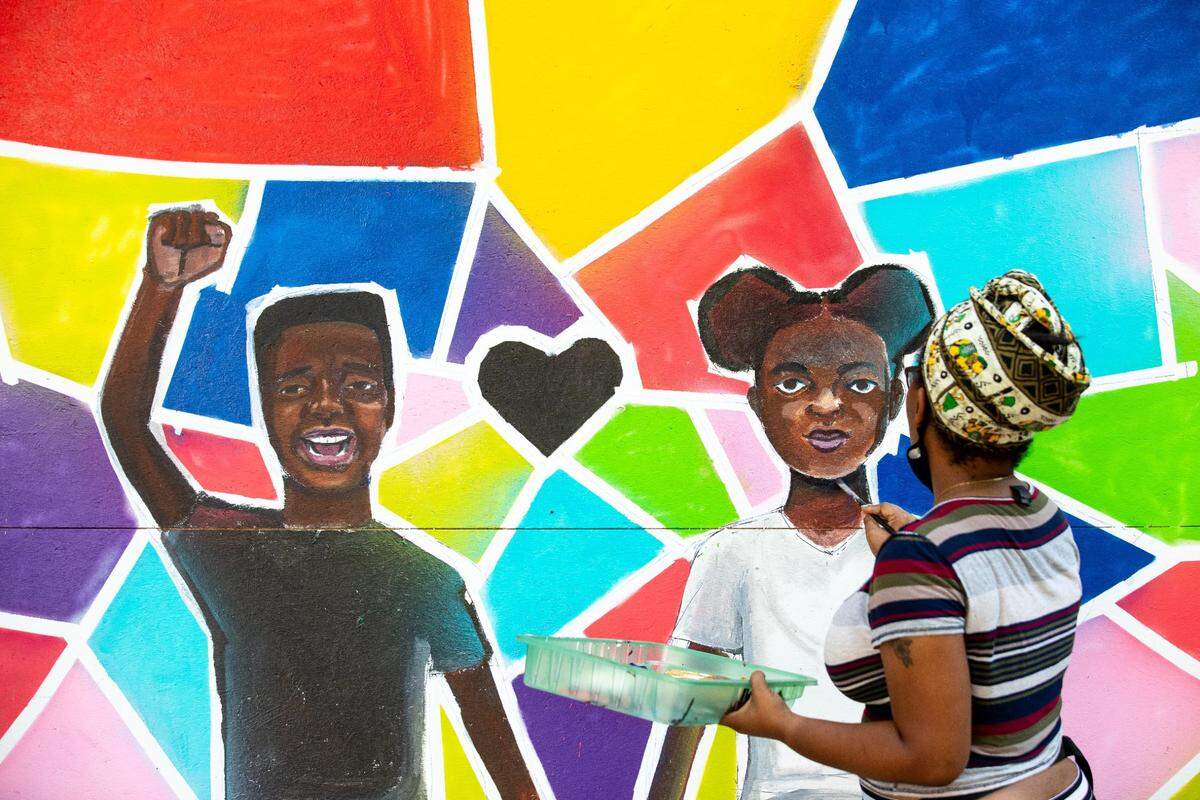
NC State student and Durham native Joseph Campbell was commissioned to paint a mural on the boards covering clothing shop Art of Style on West Hargett Street. Campbell said the mural was one of several commissions organized by arts group VAE, as part of the Raleigh Mural Project’s Public Art Response.
Campbell’s piece features four portraits of who he describes as regular Black people.
“With almost all of my art, I like to create a space for Black and Brown bodies to exist,” Campbell said. “Art is a good way to validate the existence of and artistry of the Black and Brown body.”
Temporary art
There’s an impermanence to all the pieces, painted on windows and buildings that will one day reopen. Collectively, they capture a seismic moment in time in the country’s history.
Campbell said he hopes to see murals auctioned off, with proceeds used to address affordable housing issues in Raleigh. In Durham, Marshall suggested installing the pieces in a public park.
With museums and galleries closed because of the coronavirus, the murals are among the only pieces of art accessible to the public, Marshall said.
“So many are acting like art isn’t happening, but 20 murals went up in a few days,” Marshall said. “If something is sitting on a museum wall, we’re trained to think that that work is valuable. It’s important who’s on the wall and who’s not and who gets to decide what’s on the wall.
“Put a mural on plywood on Main Street, anyone walking by, driving by, on a bus can experience it,” Marshall said. “No one is contextualizing it for me. That’s why public art is important.”