
Author takes us on a historic train ride through the Civil Rights-era South
Amid the current political craziness, I decided to step back in time with Shannon McKenna Schmidt’s recently released “You Can’t Catch Us” (Sourcebooks, $27.99) narrative about a historic train ride through the Civil Rights-era South.
Times in 1964 were violent and uncertain, to say the least, when Lady Bird Johnson embarked on her eight-state, whistle-stop tour that Schmidt portrays in riveting, fast-paced fashion and meticulous detail.
The train was called the Lady Bird Special, and Johnson’s positive messages about the nation’s accomplishments and future left crowds cheering, Schmidt writes.
The tour on the specially outfitted, 19-car train included 47 stops over four days and covered 1,682 miles. Much of the terrain turned hostile to Democrats with the signing of the Civil Rights Act three months earlier by her husband, President Lyndon Johnson.
Placard-waving hecklers who supported Barry Goldwater, the Republican nominee for president, tried to interrupt Lady Bird’s speeches at many of the stops. She’s forever admired for her steadfastness amid the protests and for taking a leading role in the presidential campaign.
Cheering crowds in Durham, Charlotte, Rock Hill
I was particularly interested in Johnson’s stops in the Carolinas, including Raleigh-Durham, Charlotte, Rock Hill and Columbia, and many small towns in between.

Crowds in Raleigh-Durham, Charlotte and Rock Hill were overwhelmingly enthusiastic for Lady Bird Johnson, while more opponents surfaced at other S.C. stops and ones in other Deep South states.
The following month, her husband won North Carolina, Virginia and Florida in the general election. He lost the five other states on his wife’s tour but scored an overall landslide victory.
“I don’t know when I’ve ever been so flattered to see so many people getting up this early in the morning,” the author quotes Lady Bird Johnson remarking about the 12,500 people “waving and cheering” at 7 a.m. Oct. 7 in Durham.
Just before noon that day, about 25,000 people packed Independence Square at Trade and Tryon streets in Charlotte for festivities celebrating the first lady’s arrival, Schmidt reports. Johnson waved to the cheering spectators who lined her eight-vehicle motorcade route from a railway station.
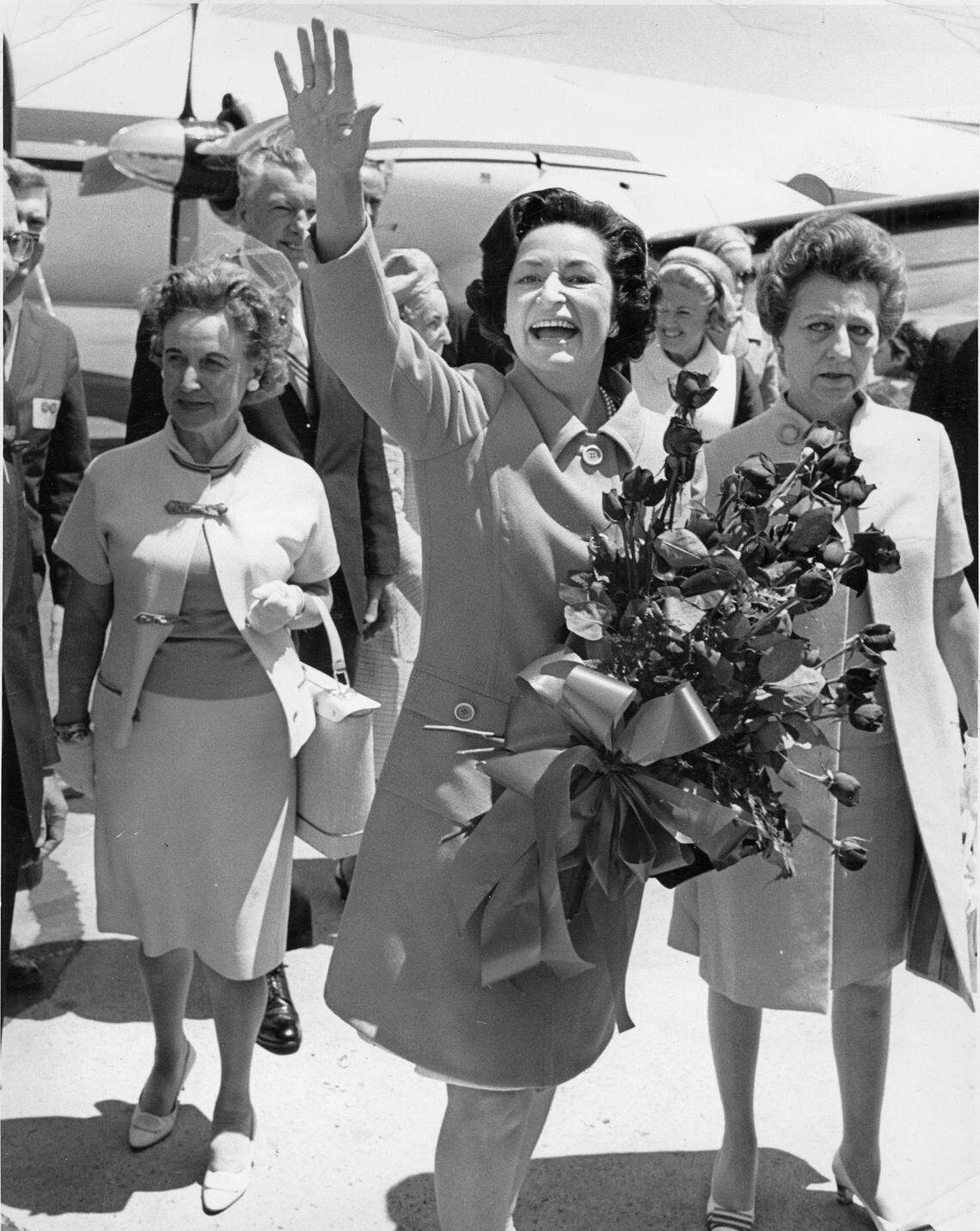
She drew “thunderous applause” with her first words to those at Independence Square, Schmidt writes: “I am pleased to be here in the Queen City of Charlotte — the crown jewel of the Piedmont Crescent.”
Johnson noted the city’s pride in its Revolutionary War history, particularly British Gen. Charles Cornwallis’ reference to Charlotte as a “hornet’s nest” of resistance, Schmidt writes. Johnson also mentioned the Mecklenburg Declaration of Independence.
Not even a prankster who drew five fire engines to the scene with a false report of a fire could dampen the crowd’s enthusiasm, Schmidt writes.
“We’re running so strong that the Republicans figure they had best call out the fire department to help them with their problems,” Schmidt quotes former N.C. governor and then-U.S. Secretary of Commerce Luther Hodges joking at the time.
The reception for the Lady Bird Special in Rock Hill that afternoon “was as tremendous as any along the route so far,” writes Schmidt, who lives in Hoboken, N.J.
Goldwater supporters grew more vociferous and obnoxious in Columbia, where they beat drums, chanted “We Want Barry” and waved placards that read “Fly Home, Lady Bird, You Old Buzzard.” She was 51 years old that year.
Praise from Martin Luther King Jr.
The rudeness prompted University of South Carolina President Thomas Jones to telegram his “deepest apologies” to Lady Bird Johnson, Schmidt writes.
In the end, the train tour that ended in New Orleans was so successful it drew high praise from the likes of civil rights icon Martin Luther King Jr., according to Schmidt’s research.
Two days after Lyndon Johnson’s trouncing of Goldwater, the president mentioned to King in a phone call of thanks: “She took on a pretty hard assignment, didn’t she?” referring to his wife.
“I’m telling you!” King replied, according to Schmidt’s book. “But she did it beautifully and eloquently. We are all mighty proud of her.”
I was amazed at the amount of archival research Schmidt put into the book, including local newspaper accounts and gems of documents at the Lyndon B. Johnson Presidential Library and Museum in Austin, Texas.
Schmidt previously authored “The First Lady of World War II: Eleanor Roosevelt’s Daring Journey to the Front Lines and Back.”
Her latest book shed new light for me on a presidential couple I knew relatively little about, in part having been 1 1/2 years old during the Lady Bird Special. My parents moved from Charlotte years earlier when my dad got a better job up North.
Two months after the tour, Lady Bird was named “Woman Newsmaker of the Year” by the editors of AP-affiliated newspapers and TV stations. Schmidt quotes famous names of the time who noted Johnson’s “precedent-breaking” tour and her positive societal impact for all women.
It’s a time I’ve always wanted to know more about. Thanks to Schmidt’s book, now I do.
This story was originally published April 16, 2026 at 5:00 AM with the headline "Author takes us on a historic train ride through the Civil Rights-era South."