
Sunscreen’s growing role in makeup routines: Here’s how to reapply without smudging your look
Your morning sunscreen isn’t a set-it-and-forget-it product. Protection drops throughout the day as sunscreen rubs off, absorbs into the skin or breaks down under light. Skipping a reapplication leaves your skin exposed to UVA rays that reach you even through car and bedroom windows, which is why dermatologists say a proper reapplication routine matters as much as the first layer you put on.
The catch is obvious for anyone who wears foundation, blush or concealer. Rubbing lotion over a finished face can smear the makeup you just spent time perfecting. Dermatologists and beauty pros have workable answers, and most of them fit into a small handful of tools you can keep in a bag.
Why reapplying sunscreen matters
Lily Talakoub, MD, a dermatologist at McLean Dermatology and Skincare in Virginia, told SELF, “Sunscreen efficacy decreases over time. As it rubs off or gets absorbed into the skin, it won’t provide as much protection as when you initially put it on. As long as there’s daylight, you’re getting exposed to UVA rays, which can even penetrate through your car or bedroom window.”
That daylight exposure is the piece most people underestimate. UVA rays contribute to premature aging and skin cancer risk, and they travel through glass. A single morning application, no matter how careful, cannot cover an entire workday of sun exposure.
How to reapply sunscreen over makeup with SPF powder
Powder is the most makeup-friendly option because it settles on top of foundation without disturbing it. Board-certified dermatologist Marisa Garshick, MD, told Women’s Health, “Gently brush the powder over your face, spending at least 15 seconds per quadrant of the face to ensure adequate application.”
The 15-second guideline matters. A quick dusting won’t deliver enough product to reach the SPF level printed on the label.
Using a sponge to blend liquid sunscreen
If you prefer a traditional cream or lotion formula, a makeup sponge lets you apply it without smearing your look. Ashley Rebecca, writing for Byrdie, explains, “Using a sponge or Beautyblender to blot your regular sunscreen on top of your makeup is also a suitable and efficient option for reapplying your SPF. To do this, add your regular liquid or cream SPF to a sponge and lightly blot all over the face until it’s been absorbed and each area is covered.”
Blotting instead of rubbing is the key move. Pressure lifts foundation. A light bounce sets the sunscreen into the skin without disturbing what’s already there.
SPF mists and setting sprays
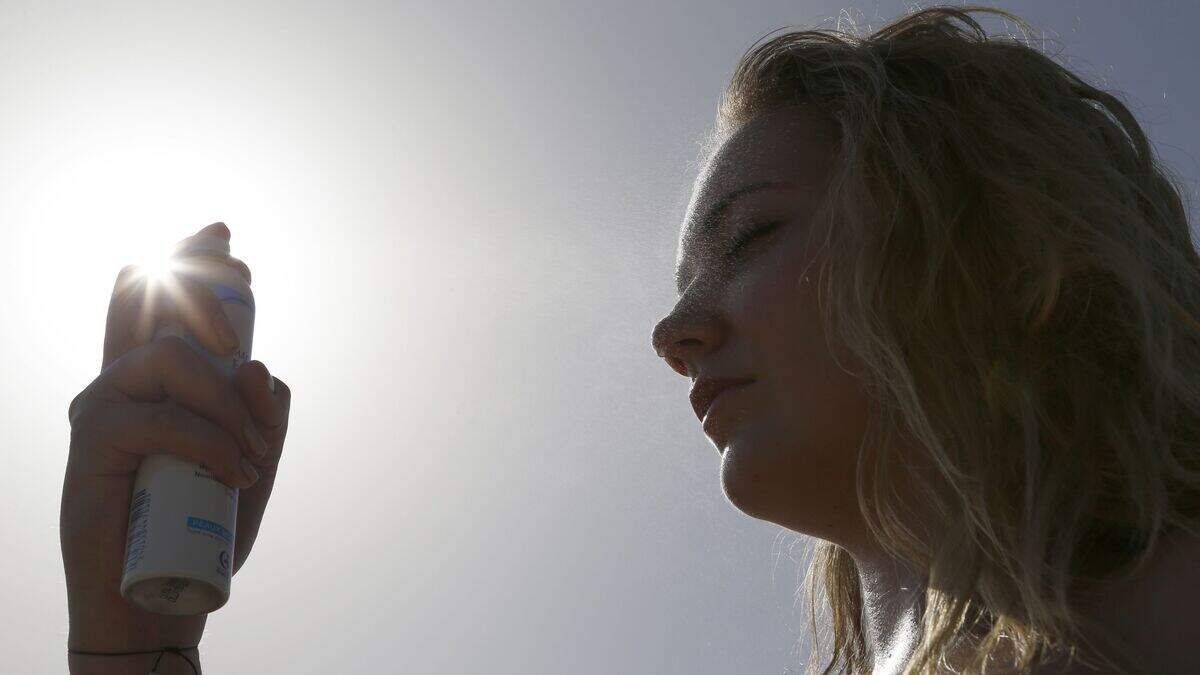
Sprays are the fastest option and require no touching at all. Board-certified dermatologist Dr. Josh Zeichner told E News, “I find that sunscreen after your makeup can be a challenge. Setting sprays with SPF are a great option. Alternatively, sunscreen sprays or mists can be essentially airbrushed onto the skin without disrupting the work you spent putting your makeup on.”
Hold the bottle at arm’s length and mist evenly across the face, closing your eyes and mouth during application.
Clear sunscreen sticks for touch-ups
Clear sunscreen sticks use transparent chemical UV filters or clear synthetic ingredients, so they glide on without the white cast that many mineral sunscreens leave behind. Because they are solid, they are less likely to drip, smear or require rubbing compared with lotions.
For a smooth reapplication over makeup, try these steps.
- Make sure your makeup has set first.
- Gently glide the stick across the skin using light pressure.
- Avoid dragging it back and forth repeatedly, which can lift foundation.
- Pat lightly with clean fingertips or a makeup sponge to blend any shine.
Whichever format you pick, the goal is the same. Reapplying every two hours during sun exposure, or right after sweating or swimming, keeps the protection you started with intact.
This article was created by content specialists using various tools, including AI.