Silver Queen corn can be hard to find. Where (and why) to search.
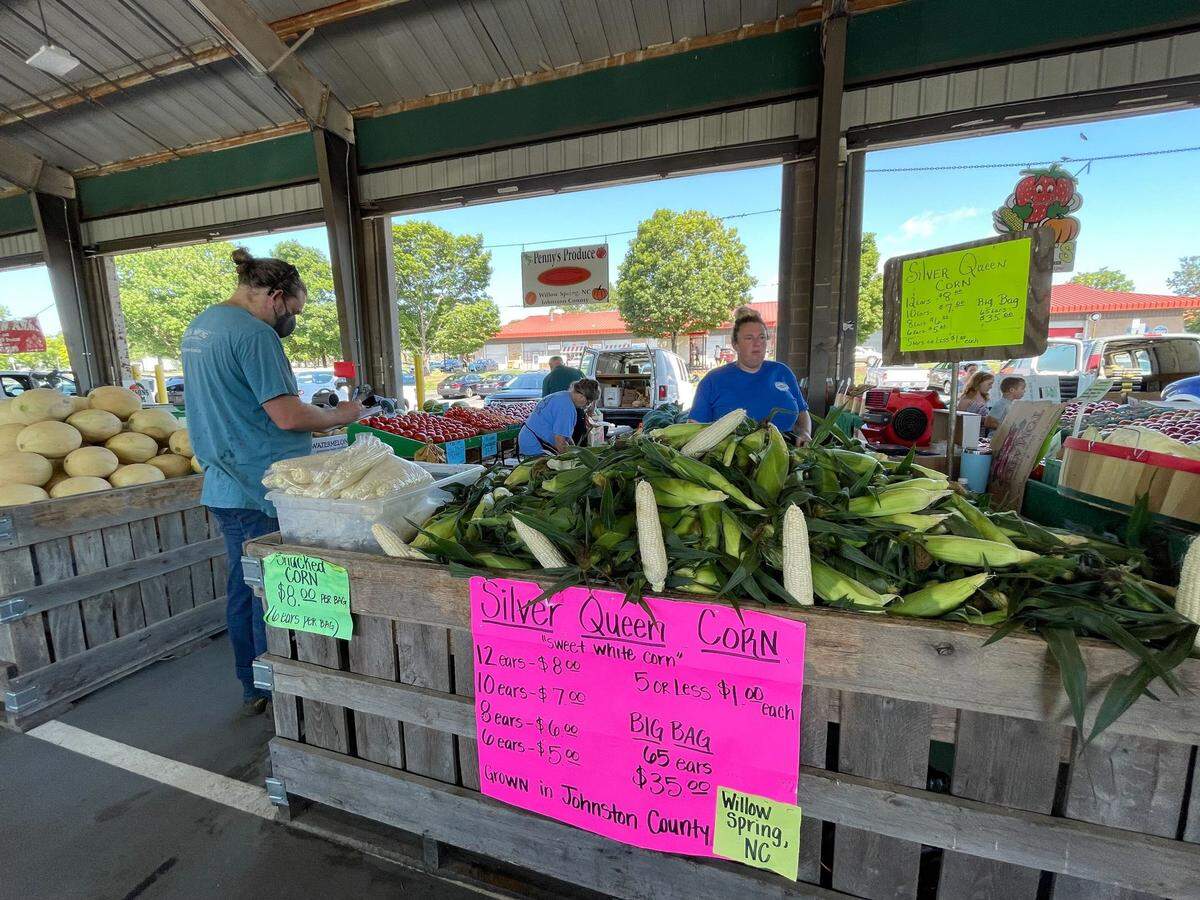
.jpg "Silver Queen corn from Penny’s Produce in Willow Spring, NC, for sale at the NC State Farmers Market on July 19, 2022.")
It’s Silver Queen corn season — but the traditional corn variety is not always easy to find.
Few farmers grow it now (and fewer grow it to sell), but Indigenous members of the Triangle hope that the corn makes a comeback. Silver Queen corn, a white corn variety, is sacred to some tribal nations in North Carolina.
When looking to buy any fresh, local corn in the Triangle, the first stop for many is the State Farmers Market, so that’s where we started. We found one stand selling the elusive corn variety: Penny’s Produce.
Laura Penny confirmed that their family-owned and operated farm in the Johnston County town of Willow Spring, is the only Silver Queen vendor at the State Farmers Market. Penny’s father-in-law started the farm, and it’s been in operation for 45 years.
What’s so special about Silver Queen corn?
“Silver Queen is just an old fashioned corn, a lot of people, especially from older generations want it. That’s all my family has ever grown,” Penny said. “That’s what we grew up on. That’s what my daddy grew, his daddy’s daddy grew — it’s the best. It’s just so old-timey that a lot of people have gone to this new stuff.”
The reason Silver Queen is harder to find is because fewer farmers grow it now, Penny said. It takes Silver Queen about 120 days to yield, while newer varieties take between 70 and 80 days, she said. Plus, newer corn varieties are sweeter — “a whole lot more sugar” — with bigger kernels.
“This is an old-fashioned variety, it’s just a good ole sweet corn,” Penny said of Silver Queen.
Bigger, faster and sweeter corn doesn’t always mean better corn, said Lisbeth Rasmussen, an owner of Split Acre Farm in Rougemont.
Split Acre Farm doesn’t grow or sell Silver Queen — they have nearly everything else, though — but Rasmussen appreciates its heirloom qualities.
“It’s very similar to an heirloom tomato — there’s an heirloom for any vegetable,” Rasmussen said. “It’s not bred to be the biggest and the fastest, but it’s a great flavor and people remember it!
“It’s how they expect corn to taste, and people love Silver Queen for that.”
The importance of white corn for Indigenous peoples
White corn, which includes Silver Queen corn, is of major importance to Indigenous peoples in North Carolina, said Quinn Smith Jr., an Indigenous documentarian whose work highlights Indigenous peoples and traditions.
In the Meherrin Indian Nation, one of the eight recognized tribal nations in North Carolina, white corn plays a major role in their people’s creation story.
“A part of this story is how the Three Sisters — corn, beans and squash — were gifted to the people. The white corn, which for the Meherrins is probably the Silver Queen, was called ‘the Milk of our People’ because it was seen as something sustaining, the lifeblood of the people,” Smith said.
One of Smith’s storytelling projects through the Equity Through Stories program at Sarah P. Duke Gardens looks at “The Story of The White Corn,” featuring elders and tribal members from across North Carolina. Smith is a citizen of the Chickasaw Nation and a senior at Duke University, leading the Native American & Indigenous Student Alliance.
Though this corn isn’t as sweet as newer varieties and takes longer to grow, Smith wants farmers to consider the importance of maintaining traditional crops. Plus, Indigenous ways of growing this corn probably make it have a bolder flavor, he said.
“Newer varieties are being grown for all kinds of fruits and vegetables, and corn is no exception,” Smith said. “The main problem farmers are trying to solve is how to take the least risk and make the most money. That makes sense, but in doing so, you lose traditional varieties, and some of these varieties might have strengths that other corns may not.”
In Smith’s documentary series, he learned about the mission to bring the Catawba Corn, a corn grown by members of the Catawba Nation that hadn’t been harvested in over 50 years, back to tribal members in North Carolina. To listen to this story, visit gardens.duke.edu/indigenous-land-relationships.
“We see how traditional knowledge and storytelling become important in preserving biodiversity. If you’re only focused on making the most money or keeping your customers happy, you’ll put all your eggs in one basket in the sense of monocropping, and we lose a lot. Through large-scale farming methods, we’ve lost a lot of biodiversity.”
Visit the NC State Farmers Market
The State Farmers Market is located at 1201 Agriculture St, Raleigh.
Brooke Cain contributed to this report.
This story was originally published July 19, 2022 at 3:53 PM.