
Protestant churches find Easter renewal in older rituals
Like children who delight in finding colored eggs hidden in the new grass of spring, Protestant congregations increasingly celebrate Easter renewal with rituals rediscovered from the past.
Even some denominations that once eschewed ancient liturgies because of their connection to the Catholic Church now incorporate a wide range of those practices, though updated to appeal to modern congregations.
Easter, the celebration of the day Jesus Christ rose from the dead according to the Gospels, was marked by many Protestants just a generation ago by attendance at a sunrise or regular worship service. Children hunted eggs and received candy from the Easter Bunny. Little girls got new dresses, hats and patent-leather shoes.
Today, the six-week period of Lent which stretches from Ash Wednesday through Holy Week, which includes Palm Sunday, Maundy Thursday, Good Friday and Easter Sunday, competes with Christmas as the busiest time of the Christian calendar. Churches hold services and programs throughout the Easter season with the idea that followers need to understand the dark days that led to Christ’s crucifixion in order to fully appreciate the celebration of his rising from the dead.
“We’re finding meaning and power in moving toward liturgical practices that deepen our understanding and our relationship with God,” said the Rev. Marcus McFaul, interim pastor at Binkley Memorial Baptist Church in Chapel Hill. “And nothing does that quite like a well-performed ritual.”
Protestants deliberately omitted many liturgical practices of Roman Catholic worship after leaving the Catholic church in the 16th and 17th centuries, saying they smacked of high-church rule-making and gave the false idea that adherence could win practitioners points toward salvation. Historians say Protestants remained suspicious of Catholic practices for more than three centuries, until the Second Vatican Council in the 1960s improved relations between Catholics and Protestants.
By the 1970s, some Protestant churches began observing Lent, the period stretching from Ash Wednesday to Easter Sunday during which Catholics follow a modified fast that symbolizes the 40 days Jesus fasted in the wilderness before he began his ministry. Instead of fasting, Protestants are encouraged to give up something such as a favorite food or pastime, or, more recently, to add something such as community service.
Around the same time, some denominations began holding a version of the devotional on the Stations of the Cross, also called the Way of the Cross or Via Dolorosa. The traditional Catholic version has 14 stations, which follow Christ’s journey as he is condemned to death, nailed to the cross, dies and is laid in the tomb, using accounts from the Gospels. In Protestant versions, the last station often is Christ’s resurrection.
Adapting to congregation
Some Protestants still see these and other traditions as “too Catholic,” too showy or unsupported by Scripture. Others, hoping to attract new people to worship or to enrich the experience for existing church members, continue to incorporate the practices into worship for as many people as want to partake.
Three years ago, the congregation at Good Shepherd Lutheran Church in Raleigh was considering whether to add foot-washing to its Maundy Thursday service. That service, usually held at night on the Thursday before Easter, includes communion and commemorates Jesus’ last meal with his disciples, which was itself a celebration of the Jewish Passover.
In his Gospel, John says that that night, Jesus washed his disciples’ feet, something that normally would have been done for a guest by a slave or servant. He wanted to show them, he said, that no master is greater than his servant. He directed them to wash one another’s feet, and later gave them a new commandment, to love one another as he had loved them.
In the Catholic Maundy Thursday service, a priest washes the feet of a group of parishioners who represent the church as a whole.
In some Protestant churches, members wash one another’s feet. But as he considered this symbolic gesture, Pastor Dave Wegner at Good Shepherd knew that members of his congregation did not need to have the dust of a long day’s travels rinsed from their feet, and in fact many would be too self-conscious to participate in such a ritual.
“So I thought about our hands, and about all the different ways our hands are used in the world,” Wegner said. “I know carpenters who have lost parts of their fingers, and machinists whose hands are covered in a metal coating that can’t be fully removed. I know people whose hands hold preschoolers here in our parking lot, and I know people who hold each other’s hands walking through the mall.
“So I asked a few people, ‘If we were to wash each other’s hands instead of feet, would that be significant to you?’”
Wegner said nearly everyone who attends the service washes hands.
Millbrook Baptist Church in Raleigh also includes a hand-washing ritual in its Maundy Thursday service, along with communion and parts of the Tenebrae service. The Tenebrae, from the Latin word for “darkness” or “shadow,” recounts Jesus’ suffering and death. Throughout the service, sanctuary lights and candles are extinguished, signifying Jesus’ death on the cross. The congregation leaves in silence.
Smaller services
Unlike Easter Sunday services, which draw one of the biggest crowds of the year for most churches, Ash Wednesday, Maundy Thursday, Good Friday and other services that have been added through the season remain relatively small.
On an average Sunday, about 150 people attend services at Millbrook, in North Raleigh. About 60 people attended on Maundy Thursday, which followed a meal in the church fellowship hall.
“It’s OK that it’s a small, intimate group that attends these services,” said Pastor Andrea Dellinger Jones. “You’re reminded of how few people stayed with Christ until the end.”
For those who participate, rituals can add new meaning to the Easter story, whether they closely adhere to the original Catholic liturgy or completely reinterpret it.
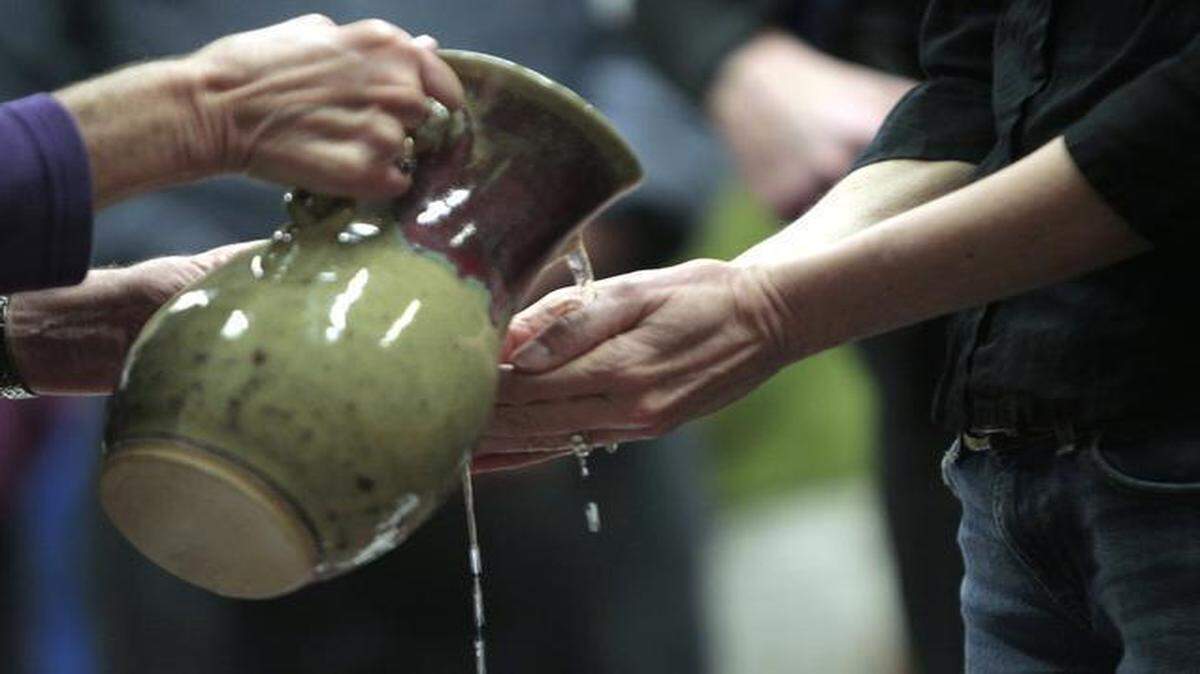
Everyone who came to Millbrook’s Maundy Thursday service got out of their pew and stood in line at one of two stations to hold their hands above a pottery bowl while another church member poured cool water from a pitcher, then patted their hands dry and said, as the Bible says that Jesus did, “It is better to serve than to be served.”
Each then took their spot behind the station to perform the ritual for next person.
Some husbands washed their wives’ hands; some mothers washed their children’s. Aneda Jackson’s 10-year-old son, Luke, washed the hands of his 6-year-old brother, Colt, and Colt washed his mother’s hands.
“Knowing that’s what Jesus did that night – washing his disciples – that’s very much a deep connection,” said Jackson, who was married at Millbrook and has attended services there for more than 14 years. “That saying, that it’s better to serve than to be served? That’s important for my kids to learn. It’s a big old world out there, and they need to be part of something that’s bigger than just themselves.”
Sharing a common liturgy helps people make that connection, said McFaul of Binkley Baptist, which holds a Wednesday night Lenten study series, performs the Way of the Cross, holds Maundy Thursday and Good Friday services and, with eight other local congregations, sponsors a Holy Week Labyrinth in the church sanctuary. The large, handmade labyrinth floorcloth is a replica of the design at Chartres Cathedral in France; many faiths have used labyrinth walking since medieval times for spiritual centering, contemplation and prayer.
“I think the biggest benefit of some of these rituals,” McFaul said, “is that they really underscore that we are a people. We’re not just individuals coming together, but it really is a village.”
McFaul and others say rituals can also bring a sense of mystery back to religion, at a time when he said faith has become so much a cerebral exercise. Participating in an ancient rite can be deeply – and inexplicably – moving.
“I think the best congregations make that bridge between head and heart,” McFaul said, “and make a place for the spirit and the regenerative nature of God to be at work.”
Catholics, who have long understood the value of symbols and rituals in worship, appreciate the desire among some Protestants to add a physical expression to the ethereal practice of faith.
“We want something that we can see, something that we can do, something that we can touch sometimes, to help bring us into contact with God in our midst,” said Father Scott McCue of St. Thomas More, a Catholic church in Chapel Hill. “These things help us to pray, and they help us to pray well.”
Still, Protestant versions of Lenten and Easter traditions can sometimes seem watered-down.
For instance, Jesus’ washing his disciples’ dirty feet was a profound act of servitude, McCue said, “And Jesus says, ‘You must do the same.’
“So there is a difference between washing the feet and washing the hands. It really loses a lot of that meaning.”
In all their variations, these practices are a form of storytelling, said Jill Crainshaw, a professor of worship and liturgical theology at Wake Forest University’s School of Divinity in Winston-Salem. Though churches or denominations may conduct each ritual slightly differently, and each will likely continue to tweak them, the practices spring from biblical teachings and faith principles that are the same.
“All of these things are ways for Christians across the centuries to connect to the biblical stories of Jesus … and somehow connect to the power of those stories in their lives,” Crainshaw said.
“The reason they are so powerful is they touch on something that is central about what it means to be human.”
Quillin: 919-829-8989
The meaning behind the rituals
Ash Wednesday marks the start of the season of Lent, 40 days before Easter (minus Sundays, which are not included in Lent). Ashes may be placed on the forehead at Ash Wednesday services as an outward expression of the need to begin again the work of turning from sin and toward God. During Lent, Christians observe a period of repentance, moderation and spiritual discipline.
Holy Week begins with Palm Sunday, marking Jesus’ triumphal entry into Jerusalem. Within a few days, however, everything had changed. On Thursday, Jesus shared a last meal with his disciples, the Jewish Passover Seder, commemorating the exodus of Jews from Egypt. Jesus told the disciples that the bread and the wine were his body and his blood, and they should use these to remember him. The next day, according to the Gospels, Jesus was crucified. Maundy Thursday services usually include communion, and many also include ceremonial foot- or hand-washing, symbolic of Jesus’ washing his disciples’ feet that night.
The Tenebrae Service, sometimes combined with the Maundy Thursday or Good Friday service, uses diminishing light to symbolize the events of from Palm Sunday through Jesus’ death and entombment.
Good Friday marks the day Jesus was crucified and, according to the Gospels, willingly suffered and died for human sin. Two days later, on Easter Sunday, according to scripture, he was resurrected. Easter, a moveable feast, is Christianity’s most important holiday. Many churches celebrate with an Easter Sunrise service, to mark the empty tomb that greeted Mary as dawn broke on Easter morning. The first Easter Sunrise Service held in the U.S. was organized by Moravians in Winston-Salem in 1772. The Salem Congregation held its 243rd Easter Sunrise Service this morning.
The 14 Stations of the Cross retrace the journey Jesus took from the time he was condemned to death until his body was laid in the tomb and, in Protestant versions, was resurrected.
The Easter Prayer Vigil, or Paschal Vigil or Great Vigil of Easter, is the first official celebration of the resurrection, beginning at sunset on Saturday before Easter Sunday. Some churches light an Easter Fire at this time, and use that to light the paschal candle, symbolizing Jesus’ resurrection. Some hold a scripted prayer service while others offer prayer vigils through the night, until the worship service on Easter morning.
Sources: about.com; lifeteen.com; biblegateway.com; brittanica.com; christianity.com; history.com; time.com; salemcongregation.org; umcdiscipleship.org; umc.org
This story was originally published April 4, 2015 at 4:00 PM with the headline "Protestant churches find Easter renewal in older rituals."