John Bolton speaks at Duke about working under Trump, but dodges many specifics
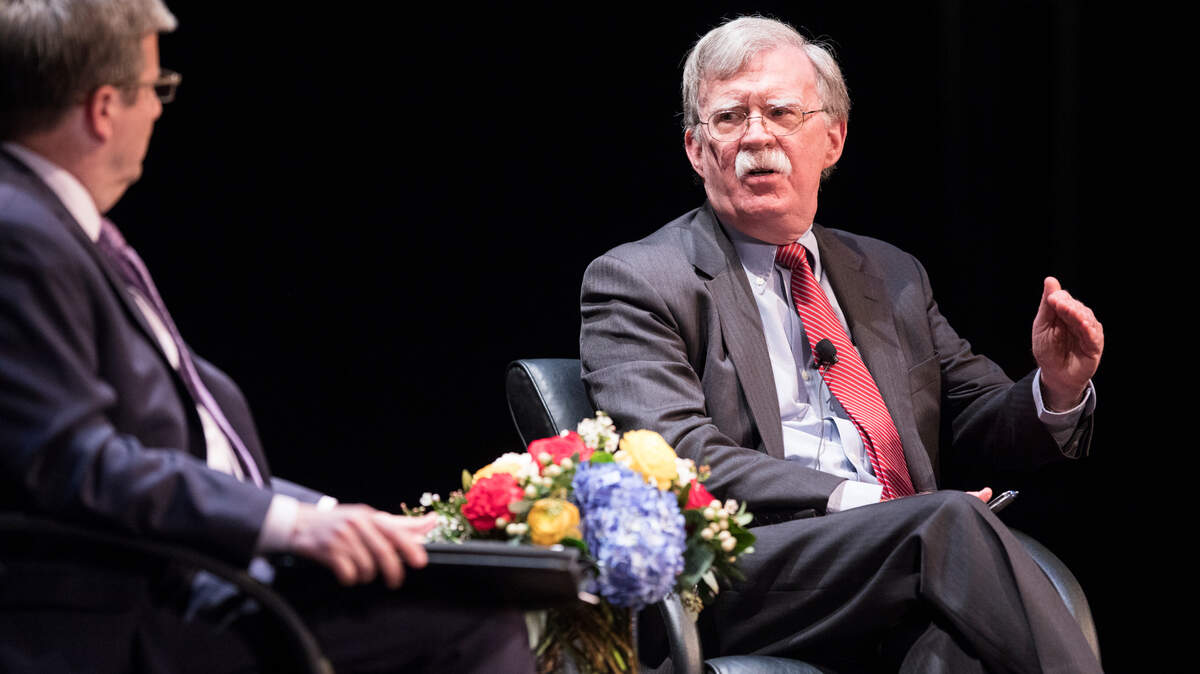
John Bolton, the former national security adviser to President Donald Trump, sat for a public interview at Duke University on Monday night but dodged some questions about his time in the job before being ousted last year.
In a sold-out event at Page Auditorium, Bolton was interviewed by Peter Feaver, director of the American Grand Strategy program and a professor of political science and public policy at Duke.
Press questions and audio recordings of the event were not allowed.
Still, Feaver said, prompting laughs from the audience, “I am pleased that Duke is going to do what neither the House or the Senate will do.”
Bolton took questions from Feaver and questions submitted by students that covered his time as national security adviser and ambassador to the United Nations under former president George W. Bush.
“The central challenge of American strategic thought is to preserve the independence and free society we have here from a variety of external threats,” Bolton said.
He spoke at length about his perceived successes, citing his work in the Trump administration’s decision to leave the Iran nuclear deal and an arms-control treaty between the U.S. and Russia.
Asked about his failures, Bolton cited U.S. intelligence lapses in the Middle East and the lack of support for the opposition government in Venezuela against the regime of dictator Nicolás Maduro.
On Iran, Bolton expressed his belief that the conditions for regime change were better than before. He praised the Trump administration’s decision to kill Iranian military general Qassem Soleimani, saying his “only quibble was that it didn’t happen sooner.”
The former national security adviser declined to answer a range of questions, saying he was constrained by the upcoming publication of his book that details his time working under Trump.
Among the questions Bolton avoided: Who did he think was the worst person he had worked with? Why did he join the Trump administration in spite of disagreements over foreign policy in Iran and North Korea? And what was it like to work alongside Secretary of State Mike Pompeo?
“I hope we can get that published and that it’s not suppressed,” Bolton said, pointing out that certain details may be omitted in the final draft of the book, which is scheduled to be published in March.
“The things he said about me,” Bolton said of Trump, “I hope they become public.”
Other student-submitted questions asked Bolton why he didn’t testify in the president’s impeachment hearings. Bolton said that he would have testified if subpoenaed by the Senate, but couldn’t reveal more details, citing his upcoming book.
“(Trump) tweets, but I can’t talk about it. How fair is that?” he remarked.
Asked about the president’s controversial phone call with Ukrainian president Volodymyr Zelensky, Bolton hinted that his book would reveal more of Trump’s involvement with Ukraine.
“To me, there are portions of the manuscript that deal with Ukraine ... I view them like the sprinkles on the ice cream sundae, meaning in terms of what’s in the book,” he said.
Bolton added that he was not at liberty to answer certain questions due to the potential “threat of litigation from the executive branch.”
Asked if the president’s call with Zelensky was “perfect,” as Trump has claimed, Bolton responded: “You’ll love chapter 14.”
Duke students protest
The event prompted a student-led protest that took place outside of the Duke Chapel to counter the event, organized by Duke Students for Justice in Palestine. Protesters criticized Bolton’s reputation as a foreign policy hawk, advocate for war and supporter of regime change operations abroad.
Lama Hantash, a Duke student and member of the group, estimated that around a hundred protesters gathered outside.
“Our protest is intended to highlight the dissenting voices that will not be heard during Bolton’s speech,” Hantash said. “Particularly victims of the wars, illegal invasions, and crippling sanctions Bolton has pushed forward.”
Hantash said that these events were meant to honor students and speakers, but that Bolton is a “war criminal” who should be “tried” instead of hosted to speak.
This story was originally published February 17, 2020 at 9:06 PM.