Tech job openings in NC rebounded slightly in June. But will they fall again?
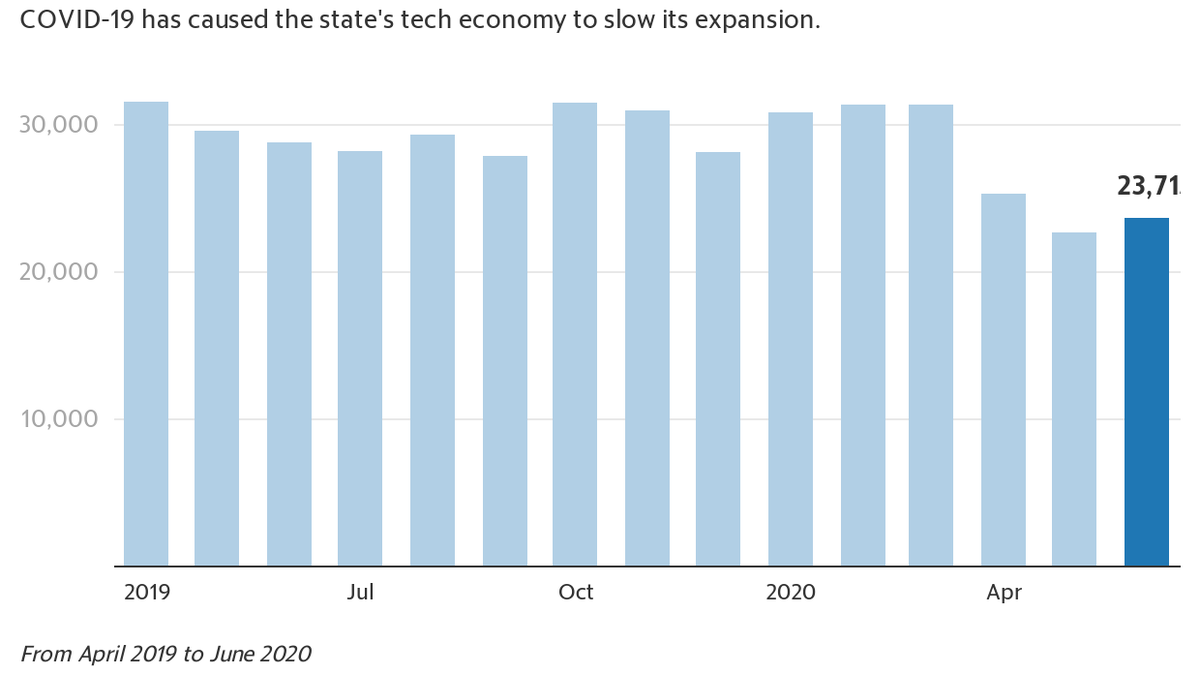
The number of tech job openings in North Carolina, a marker of the industry’s expansion in the state, rebounded slightly in June, though the number still remains much lower compared to last year.
Since the coronavirus pandemic hit North Carolina beginning in March, job openings in the fast-growing tech industry have fallen sharply, as companies sent workers home and tried to determine how COVID-19 would affect their bottom line.
A new report from the North Carolina Technology Association, an advocacy group, shows that May might have been the nadir of uncertainty for tech companies here, with the number of job openings falling to 22,729 across the state, a 23.3% drop from a year prior.
In June, the number of tech openings grew to 23,715, a 4.3% increase from the month prior.
But even with that growth, job openings remain nearly 18% below 2019 levels.
“The June results showed there was an uptick. It was a modest one but pronounced,” Brooks Raiford, the president of NC Tech, said in an interview. “That is in keeping with the national general employment numbers. ... It’s coming from a large drop off, so it’s not exactly a healthy increase, but it is welcome.”
In June, companies across the nation added 4.8 million jobs, according to the U.S. Department of Labor, the second straight month of gains. But that growth came before a surge of coronavirus cases began accumulating in large swaths of the country.
Raiford said he has been following reports that the spike in coronavirus cases has caused some companies to think twice about hiring again. “I will be interested to see if the full jobs numbers in July will show an upward trend or a slide,” he said.
NC Tech’s surveys of business leaders in the state show a growing sentiment that economic recovery will take longer than many anticipated a few months ago, Raiford added.
The association has been polling tech leaders in the state for the past few months to get a sense of how tech companies are approaching the pandemic. A vast majority of them have sent employees home to work for the long haul, helping insulate the industry from some of the problems that industries like retail and food service have had.
In its latest survey on June 30, more than 63% of respondents said they don’t expect an economic recovery until after September at the earliest. In April, only 37.4% thought that.
“Early on there was some optimism that the economy would begin to rebound and return to normalcy around now,” Raiford said. “That shifted as time went on. ... What was once a pretty optimistic feeling about a third-quarter rebound has moved toward the fourth quarter and beyond.”
According to the June job openings report, the Triangle is seeing bigger declines now than the Charlotte area.
Raleigh tech job openings have fallen more than 23% compared to last year, and the Durham-Chapel Hill metro area has seen a 25.2% decline. Charlotte has only seen a decline of 15.3%.
The report says that is because finance companies have continued to hire at a brisk pace. Technology jobs in finance and banking have increased since last year by 41.9%, the report said.
Wells Fargo, Truist and Bank of America — which all have significant operations in Charlotte — were all listed as top 10 hirers of tech talent in June.
Companies with a significant presence in the Triangle on that list included IBM, HCL Technologies and Oracle.
This story was produced with financial support from a coalition of partners led by Innovate Raleigh as part of an independent journalism fellowship program. The N&O maintains full editorial control of the work. Learn more; go to bit.ly/newsinnovate