Just 4% of Raleigh businesses with employees are Black owned. Why that’s a problem.
There is no metro area in the U.S. where the share of Black-owned firms with employees matches the Black population there.
That gap is creating significant wealth inequities across America and causing communities to miss out on tens of thousands of jobs, according to a new study from the Brookings Institution, a Washington, D.C.-based think tank.
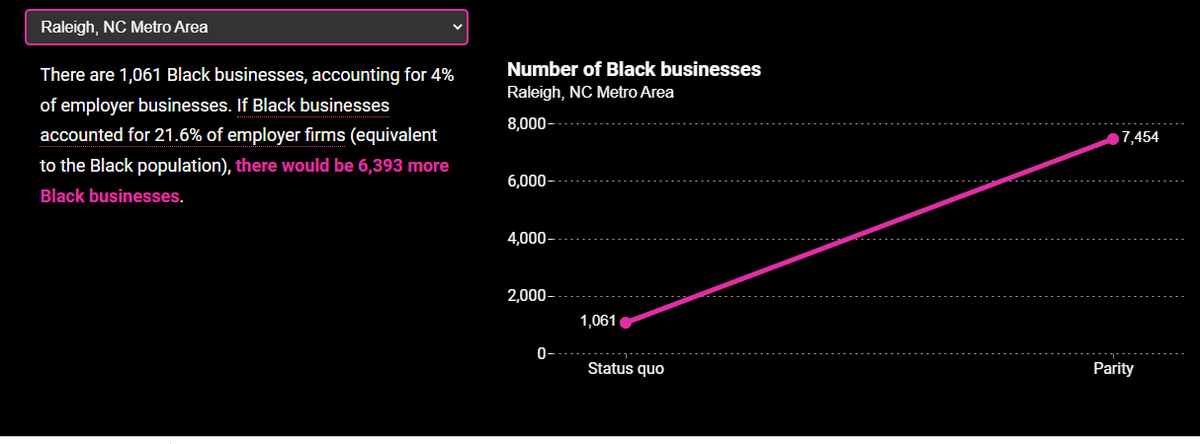
In Raleigh, just 4% of employer firms are Black-owned, or around 1,061 businesses, the study says.
For Black businesses to make up 21.6% of employer firms — a rate equivalent to the Black proportion of the population — the Raleigh metro area would need an additional 6,393 Black businesses, the study estimates.
If it could reach that number of Black businesses, the report says, the city could potentially see 11,560 new jobs.
Black businesses could reduce wealth gap
Before the pandemic, the national median net worth of white families was $188,200 while the median net worth of Black families sat at $24,100, according to the Federal Reserve. The lack of assets makes it much more difficult for Black families to form businesses or get loans.
But a Black business owner is typically 12 times wealthier than their peers, according to the Path to 15|55 initiative, a group raising capital to invest in Black businesses.
Black businesses are crucial to social mobility, but they aren’t receiving enough support, said Henry McKoy, a professor and director of entrepreneurship at the N.C. Central University School of Business.
And during the pandemic, Black businesses were hit hard. More than 40% of Black business owners closed their doors in the early months of the pandemic. Many struggled to get aid from the government, like from the Paycheck Protection Program, which denied Black applicants more frequently than white ones.
“It’s bad out there,” McKoy said in an email. “The inequities are enormous and growing between the races in entrepreneurship.”
Raleigh’s numbers are similar to several other metro areas in the Southeast, which in general did better than other parts of the country, and has a higher number of Black residents.
In North Carolina, Black-owned businesses accounted for 4% of employer firms in Charlotte and 5% in Greensboro. In Fayetteville, they made up 11% of employer firms, the highest share of any metro area in the country.
A potential surge in Black entrepreneurship?
In the wake of the first few months of the pandemic, though, a new trend has given rise. A record number of people seem to be forming businesses.
In 2021, new business filings grew to 178,300 in North Carolina — the largest number ever recorded, according to the N.C. Department of the Secretary of State.
There is evidence of large upticks of business formations in Black neighborhoods, according to research from the National Bureau of Economic Research. Many of those businesses are online microbusinesses, according to Brookings.
Johnny Hackett Jr., owner of downtown Raleigh’s Black Friday Market, which creates space for Black entrepreneurs to sell items, said he’s seeing an increase in Black entrepreneurship during the pandemic. “There are way more than 1,061 Black-Owned Businesses in Raleigh,” he said in an email.
In part, he said, it’s because many Black businesses registered for the first time or were historically under-counted.
Investment and support
Hackett said there needs to be an increased focus on supporting these businesses.
“I don’t know if I care to increase the number of Black-owned businesses in Raleigh or to make them as evenly proportioned to other races ... I think it’s more important to better support the Black-owned businesses we already have,” he said, adding the local community needs to provide them access to working capital, invest in them and promote them.
“Once that happens, people will move here to create Black-owned businesses, and we’ll jump on the ‘count’ data lists too,” he said.
McKoy believes there is a more pressing reason to support Black businesses.
“America is becoming blacker — and browner — and on its way to becoming a majority minority country,” he wrote in a 2020 presentation. “If the majority of a country has low, no, or negative wealth, then it is not only a problem for that population, but for the entire country.”
Investing in more Black businesses and pulling down systemic barriers to capital, he wrote, could change that narrative.
But “if Black businesses in the U.S. become functionally extinct, and no longer play a significant role in the overall American ecosystem function, then there will be grave and negative consequences for the entire country,” he wrote.
This story was produced with financial support from a coalition of partners led by Innovate Raleigh as part of an independent journalism fellowship program. The N&O maintains full editorial control of the work. Learn more; go to bit.ly/newsinnovate
This story was originally published February 17, 2022 at 2:12 PM.