NCDOT says it wants to hire more minority and women contractors but is falling short
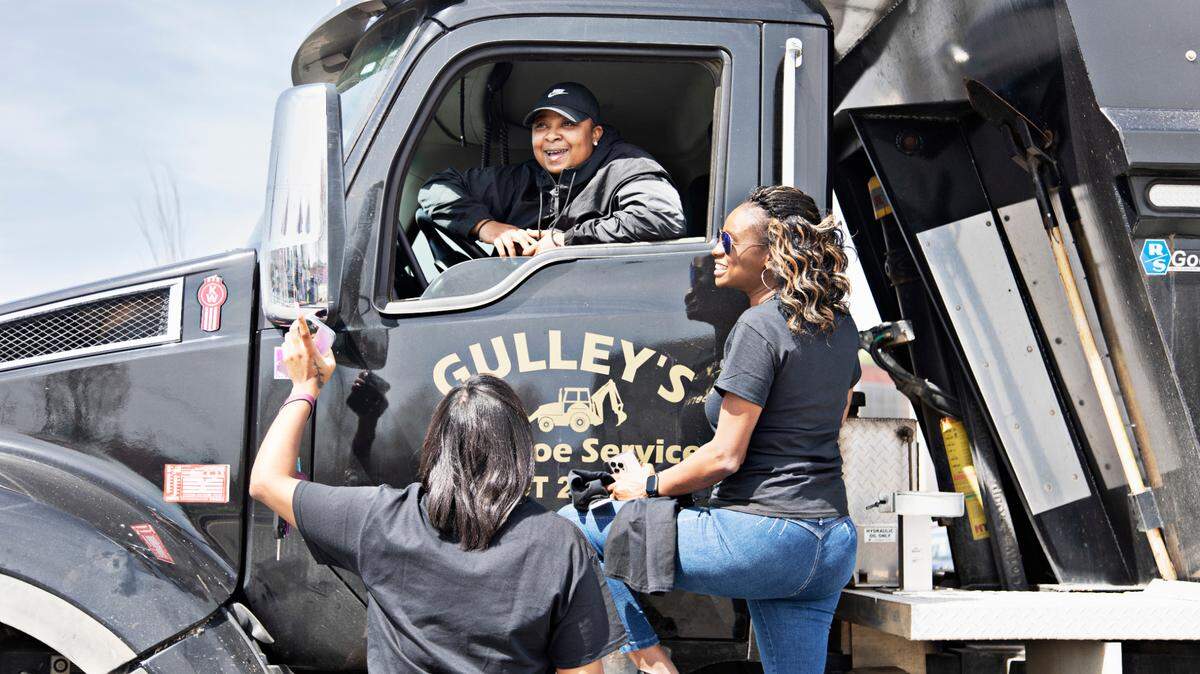
Candice Gulley Hines owns the type of business the N.C. Department of Transportation says it wants to hire more often to plan, build and maintain the state’s roads.
Hines runs Gulley’s Backhoe Service, a 12-person construction company based outside Garner that her father, James, started in the 1980s. Hines is Black, and her company is registered as a minority-owned business under NCDOT’s Disadvantaged Business Enterprise program.
NCDOT says it isn’t doing enough business with DBEs like Gulley’s Backhoe Service. The department wants the companies it hires to reflect the communities in which it works, but that isn’t happening.
A study completed last fall found that minority- and women-owned firms made up about 41% of those eligible to bid on NCDOT contracts for construction, engineering, consulting and other goods and services. But, the study found, minority- and women-owned businesses accounted for just 14.4% of contract spending.
The disparity is more pronounced among minority-owned firms. They received 4.4% of contract spending, though they made up 25.4% of eligible firms, according to the study.
The disparities persist even after factoring in differences other than race and gender, such as a firm’s size or age, said Rodney Strong, an attorney with the consulting firm Griffin & Strong in Atlanta, which produced the report.
“It’s clear that we have to do a better job,” Cullie Tarleton, a state Board of Transportation member, told fellow board members when Strong presented the study results in March. “We need an action plan that will lead us toward doing a better job of reaching out and involving everyone across the state who is in a position to take on projects, to give them an opportunity to participate.”
Transportation Secretary Eric Boyette said the study’s findings were not a surprise; NCDOT knew it wasn’t living up to its goals for women and minority contractors. Boyette said the department began addressing the problem more than a year ago, though he acknowledged to board members, “We’re not in no ways where we should be.”
Hines would agree. Her company does clearing, grading, hauling and septic work and has four dump trucks that she’d like to see used more often. She has bid on several NCDOT projects over the last three years but hasn’t won any work or gotten any explanation of what she could do to improve her chances.
“Some feedback would have been nice for the next time,” she said. “It’s kind of hard to get in.”
Bringing minority-owned firms into the process
Hines’ latest effort to get in involved attending a networking event at the Hilton Raleigh North Hills where DBEs and small business owners could meet large NCDOT contractors and learn how to compete for work.
NCDOT began holding these events last summer on Saturdays, so small business people wouldn’t have to miss work to attend. Department employees explain how to do business with NCDOT and highlight some upcoming projects.
The events are meant to eliminate any mystery surrounding NCDOT contracting.
“I think a big problem is that a lot of the small businesses don’t know the process or guidelines,” said Melvin Mitchell, a Board of Transportation member from Rocky Mount. “They’re afraid to approach a project with DOT. So we’ve got to be more involved about educating.”
More than 500 people have attended NCDOT’s outreach events for DBEs since last June, according to spokeswoman Athena Stanfield. In that time, 171 businesses became certified as DBEs, making them eligible for special assistance from the department, up 39% from the same period a year earlier, Stanfield said.
The Raleigh event was also attended by representatives of a dozen large construction firms that typically win highway contracts worth tens or hundreds of millions of dollars. If small or minority businesses are going to get some NCDOT work, it’s usually as a subcontractor for one of these firms.
Someone from each of the primary contractors — in every case a white man — stood to introduce their company and to offer advice. Jason Schuster of Balfour Beatty Infrastructure urged would-be subcontractors to get their bids in early and to call its office in advance to go over the bid process and what’s needed.
Schuster concluded with a refrain echoed by the other big companies: “Everyone needs good help.”
Devin Robinson drove from Mint Hill near Charlotte to the Raleigh networking event. Robinson’s 2-year-old ACE Trucking Services consists of two trucks, including one dump truck he hopes to use on road projects hauling sand or gravel.
Robinson said he came for the chance to “talk to the main players in my industry.”
“I’m just trying to figure out how it works so I can participate,” he said. “I’m assuming once you know the people and the players, if you’re able to compete you’ll get some work.”
Minority contractors face other challenges
The state also helps small and minority-owned businesses deal with financial barriers that can prevent them from being successful contractors. It helps them manage their money and build the capital they need to compete, said Tunya Smith, director of NCDOT’s Office of Civil Rights.
“Many firms don’t have the financial resources to remain solvent, remain an entrepreneur,” Smith said. “So we have a series of business development and training courses to help firms along the way to look at how to manage their funds and how to plan for expenses and also how to be able to do cost estimation to remain profitable.”
Another challenge is bonding. Prime contractors must put up bonds that will pay to finish a project if the company for some reason can’t, and that requirement sometimes falls to subcontractors as well. NCDOT is encouraging its large contractors to help smaller firms get the bonding they need, said Lamar Sylvester, director of field support for the Division of Highways.
“It’s really all about the conversation and bringing everybody to the table,” Sylvester said.
Smith said the Office of Civil Rights has labored for many years to improve diversity in contracting at NCDOT. Now, she said, it works much more closely with the Highway Division and with more support from top administrators. And the department is now more carefully tracking how many DBEs are working on NCDOT projects and how that matches with its goals.
The Griffin & Strong disparity study included several recommendations for other ways NCDOT could improve diversity. They include designating some minor projects solely for small businesses and adopting prompt-payment policies so small contractors aren’t waiting months to be paid.
The study covered a five-year period, ending June 30, 2018, and doesn’t reflect recent efforts NCDOT has made to improve diversity, said Ebony Pittman, deputy secretary for business administration.
“These initiatives are embedded into our processes moving forward,” Pittman said. “And so we are hopeful that we will see a change in the numbers.”
NCDOT must have a DBE program by federal law, which prohibits discrimination in projects that use federal money. But asked why it matters that women- and minority-owned businesses have better access to NCDOT contracts, Pittman only mentions the department’s obligation to its residents.
“We are becoming a more diverse state. And with that, we have to change as an agency,” she said. “We want our contracting opportunities and our workforce to reflect the diverse communities that we serve. And so it’s important that those changes take place, that we are the changemakers ensuring that all people have access to contracting opportunities.”

This story was originally published April 27, 2022 at 10:39 AM.