
In UNC address, Shell executive outlines path from oil and gas to renewable energy
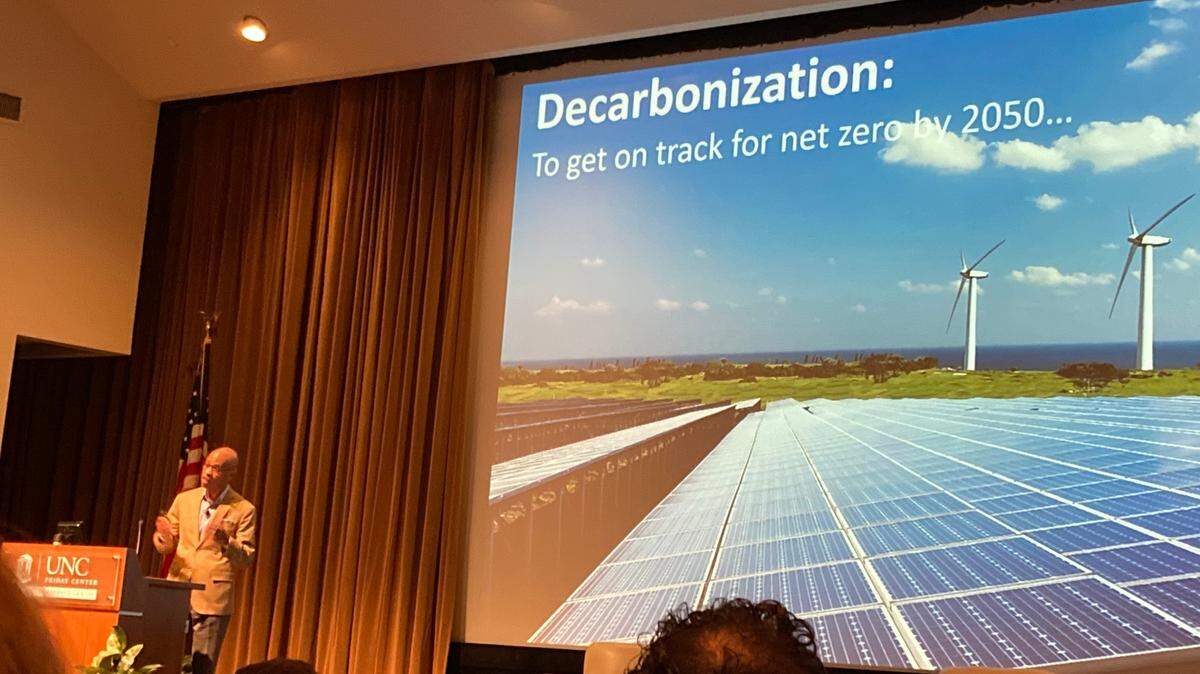
Shell, the multinational energy company that is one of the world’s leading suppliers of oil and gas products, doesn’t want to go the way of Kodak — a once-dominant company that lost its market share because it failed to anticipate change.
Glenn Wright, Shell’s vice president of renewables and energy solutions, Americas, told the UNC Clean Tech Summit that the energy giant knows that wind, solar and potentially hydrogen energy will shift generation away from carbon emitters like oil and natural gas.
“Shell seeks profits,” Wright said. “The profits of the future are in clean energy. This is a wonderful nexus where we have the opportunity to do that which is good for society and for the climate and to do well for our investors.”
Shell has set a goal of net zero emissions by 2050, the same date targeted by many other large companies and by many governments.
Wright acknowledged that many are skeptical about Shell’s role in the energy transition. Critics point to the company’s ongoing exploration for oil and gas and argue that the company has historically made a very small amount of its long-term investment in renewable energy sources.
“We recognize that as we embark on this journey, we have to do so with a sense of humility,” Wright said. “We have to gain the confidence, the trust of those who have a concern about climate change, and we have to maintain the trust of customers that we served so effectively for so many years.”
Shell’s oil production peaked in 2019, Wright said, and the company projects that it will continue to fall annually until at least 2030. According to the company’s annual report, Shell’s oil and gas production in 2019 was the equivalent of 3.67 million barrels of oil a day. In 2021, the same production was the equivalent of 3.24 million barrels of oil a day.
Last year, The Guardian reported that critics have argued that by basing its carbon targets on the “carbon intensity” of energy instead of total emissions, Shell can continue to produce large amounts of fossil fuels as long as it also produces more clean energy alternatives.
A Shell subsidiary is one of the 16 companies that the Bureau of Ocean Energy Management has labeled a qualified bidder for a pair of offshore wind energy sites off of Bald Head Island in North Carolina. Other companies that could bid on the the sites include Avangrid Renewables, which holds a lease to a site off of Kitty Hawk; BP US Offshore Wind Energy; Duke Energy Renewables Wind, a Duke subsidiary; and Orsted North America.
Shell and its partners have won auctions to develop offshore wind in three places along the East Coast: off Massachusetts, New Jersey and New York. The company’s winning bid off New York was $780 million for a 79.35-acre site.
From permitting to navigating the relationships with local fisheries, Wright said Shell’s experience with offshore drilling leaves the company poised to develop offshore wind. That experience, Wright said, “is directly applicable here.”
During his remarks Tuesday, Wright also called for more electrification of homes and transportation and touted the company’s investments in hydrogen energy.
By 2050, Wright said, oil and natural gas will not be the world’s dominant source of energy. Instead, he said, power will come from sources like wind, solar, geothermal, biofuels and hydrogen.
“Some things change,” Wright said. “But others remain very much the same. Climate change is caused, at least in part, by human activity, and humans must solve the climate challenge.”
This story was produced with financial support from 1Earth Fund, in partnership with Journalism Funding Partners, as part of an independent journalism fellowship program. The N&O maintains full editorial control of the work.
This story was originally published March 29, 2022 at 1:24 PM.