VinFast ended roller coaster debut week on Wall Street with a thud. What happened?
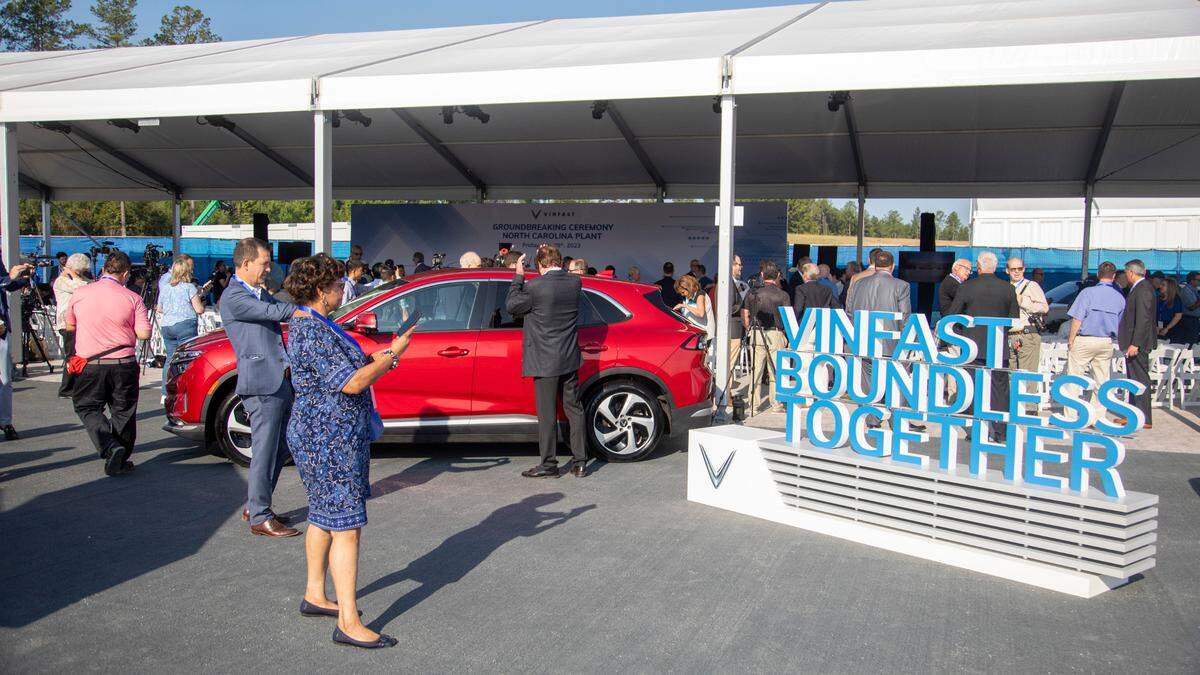
.JPG "VinFast CEO Le Thi Thu Thuy and Gov. Roy Cooper clap during a groundbreaking ceremony Friday, July 28, 2003 at the future site of a Vinfast plant in Moncure.")
In its Wall Street debut, VinFast surprised.
The Vietnamese electric vehicle startup with plans to construct a $4 billion factory in North Carolina joined the NASDAQ exchange Tuesday, and by the end of the day, its share price had risen 68%. This gave VinFast a market capitalization of $86 billion — higher than Ford, GM, Volkswagen and all but four of the world’s carmakers.
Not bad for a 6-year-old company that’s experienced billion-dollar losses, poor reviews and rollout delays. If successful, VinFast’s move to the market will give it additional capital to pay for its electric vehicle factory in southeast Chatham County, about 30 miles from Raleigh. This will be the automaker’s first foreign plant and could eventually employ 7,500 workers.
Amid the headlines of VinFast’s lofty market value, many cautioned its high share price might not last. And sure enough, the stock that entered Tuesday at $22 and rose to $37 had fallen to $15.40 by Friday afternoon.
This still values VinFast at $35 billion — more than rival public electric car companies like Rivian and Lucid.
What drove the rapid rise?
Why did VinFast stock soar and then slide? One reason could be the relatively few shares the company made available.
According to regulation filings, 99% of VinFast shares are owned by the chairman of its parent company, Vingroup. This makes VinFast a low float stock, which are associated with more dramatic price swings.
“All that makes VinFast’s stock performance seem more like a triumph of financial engineering than mechanical engineering,” the news outlet Rest of World wrote on Wednesday.
New York University law professor Michael Ohlrogge, who studies financial regulation, hypothesized that short seller activity prior to VinFast’s merger with a special purpose acquisition company, or SPAC, could have prompted a “short squeeze” that fueled the higher share price Tuesday.
“I wouldn’t make much of (the share price) until at least a week post-merger,” he told The News & Observer.
Others were more bullish on the company’s initial market success.
On Wednesday, an analyst for the UK firm GlobalData wrote in an email, “VinFast’s robust entry into the NASDAQ trading area comes as no shock considering its solid business fundamentals and the optimistic global trajectory of electric vehicles.”
North Carolina’s big VinFast bet
A lot of North Carolina money and jobs hinge on the fledgling auto company.
Between state and county incentives, VinFast is eligible to receive up to $1.25 billion in public assistance if it meets its aggressive investment and hiring goals. Central Carolina Community College has committed to train the plant’s sizable projected workforce.

VinFast formed in 2017 and only began producing electric vehicles in late 2021.
Today, the company has 122 stores across the world and as of June 30, it had delivered 19,000 electric vehicles. However, its rollout in the United States has been rocky — the first vehicles it delivered were all recalled due to a glitch in the software for its dashboard display and it has only around 350 cars on U.S. roads this summer.