In one of North Carolina’s quietest rooms, the silence is meant to be felt
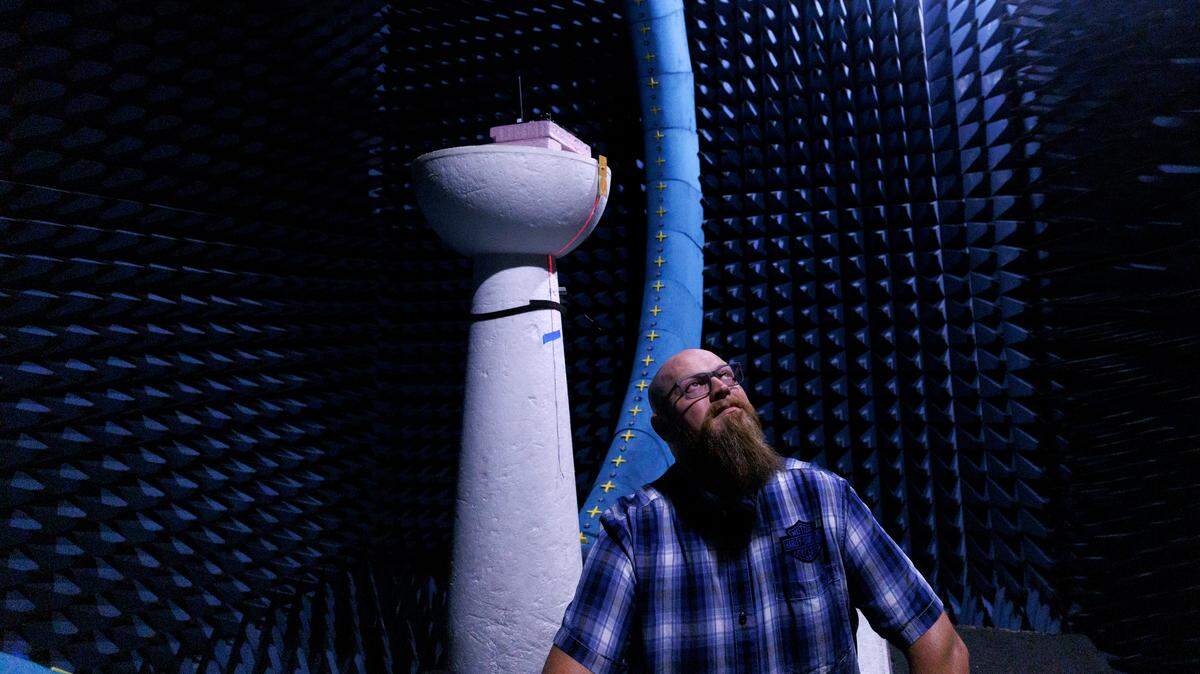
The room without noise is a five-meter cube, encased in metal and kept at 67 degrees Fahrenheit. Blue spikes with black ends jut from the ceiling, walls, and floor, somewhat evoking a supervillain’s lair, except these points lack menace. They are instead a soft composite of foam, carbon and salt that absorb the radio frequency waves they encounter.
One feels the absence of sound in this anechoic chamber, housed within the Wake Forest offices of the nonprofit Wireless Research Center. Claps are deadened. Voices eerily crisp. Balance is disturbed as the inner ear struggles to readjust. Anechoic means “without echo,” and the space is an ideal setting for major organizations and small startups alike to test cell signals and antennas.
“It shields anything inside from going out and anything outside from going in,” said Gerard Hayes, president and founder of WRC.
The chamber isn’t completely silent, at least not the way humans hear sounds, as a signal amplifier unit hums in the background. There are quieter anechoic chambers elsewhere in the U.S. for sound testing, but for the purpose of radio frequency testing, a hum — or even blasting rock music — doesn’t matter.
It’s the same reason a car antennae won’t be disrupted by the driver screaming; the noises this chamber eliminates are at a radio frequency we can’t detect.
Hayes saw the need for a local anechoic chamber in the late 2000s when his previous employer Sony Ericsson, which had one, shut its Research Triangle Park campus. At his next job, a local defense tech startup called GreenWave Scientific, Hayes found the process of shipping devices to testing facilities as far away as California inefficient. Former Sony Ericsson colleagues in the area faced similar obstacles.
In 2010, Hayes approached Wake Forest officials about supporting local telecommunications companies with a radio-silent chamber. The Wake County town gave a loan for the Wireless Research Center, around $1 million, and the Golden LEAF Foundation added a $962,000 grant.
Today, the WRC has five chambers, and companies book them by the hour to test and measure devices. The oldest chamber was reassembled from a unit Sony Ericsson discarded and is used to check for federal pre-compliance standards. The smallest chamber measures very high frequencies, up to 60 gigahertz, on more cutting-edge equipment.
In addition to the space, WRC engineers help customers troubleshoot their connectivity issues. The nonprofit has supported patents on several solutions born at the facility. And when companies ask for additional support, the WRC refers them to for-profit telecommunications firms in the area.
“The cool part is it brings more attention to Wake Forest, North Carolina, and the region,” Hayes said. “A lot of times they say they didn’t know this was here.”
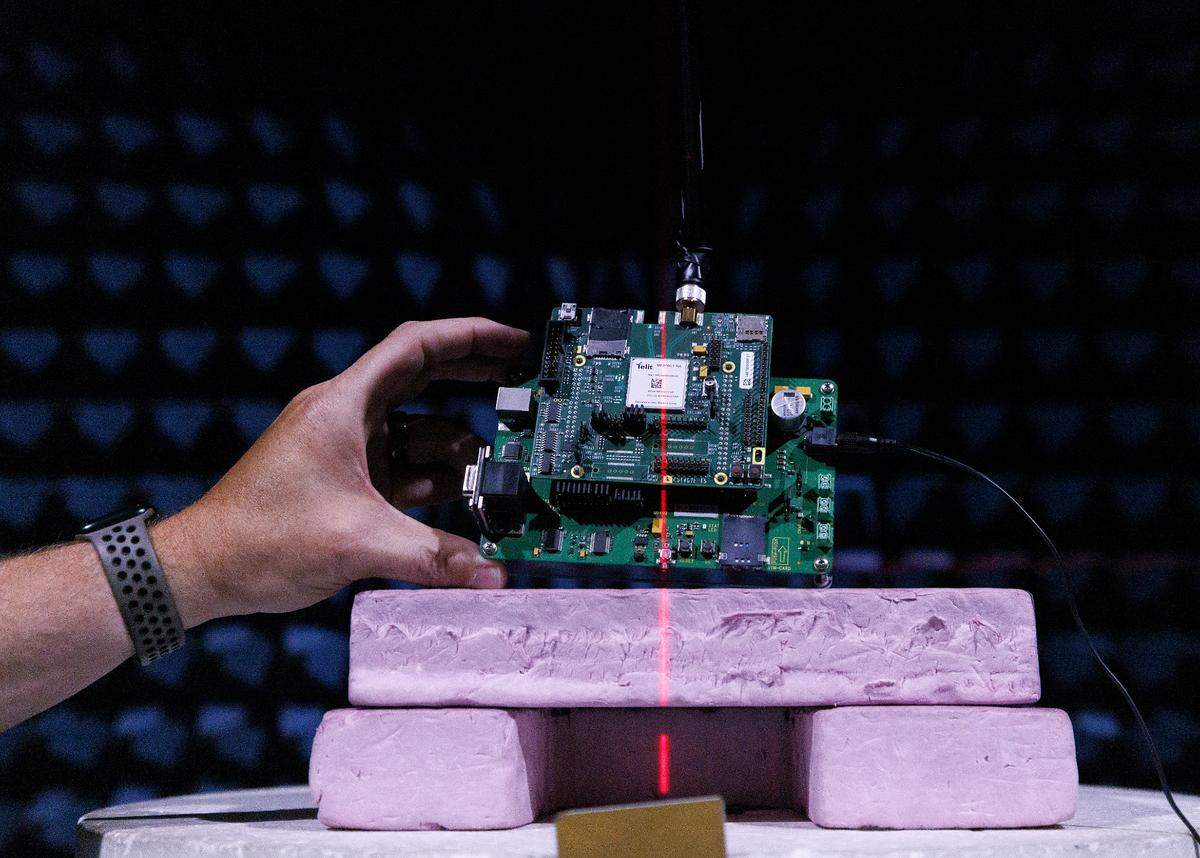
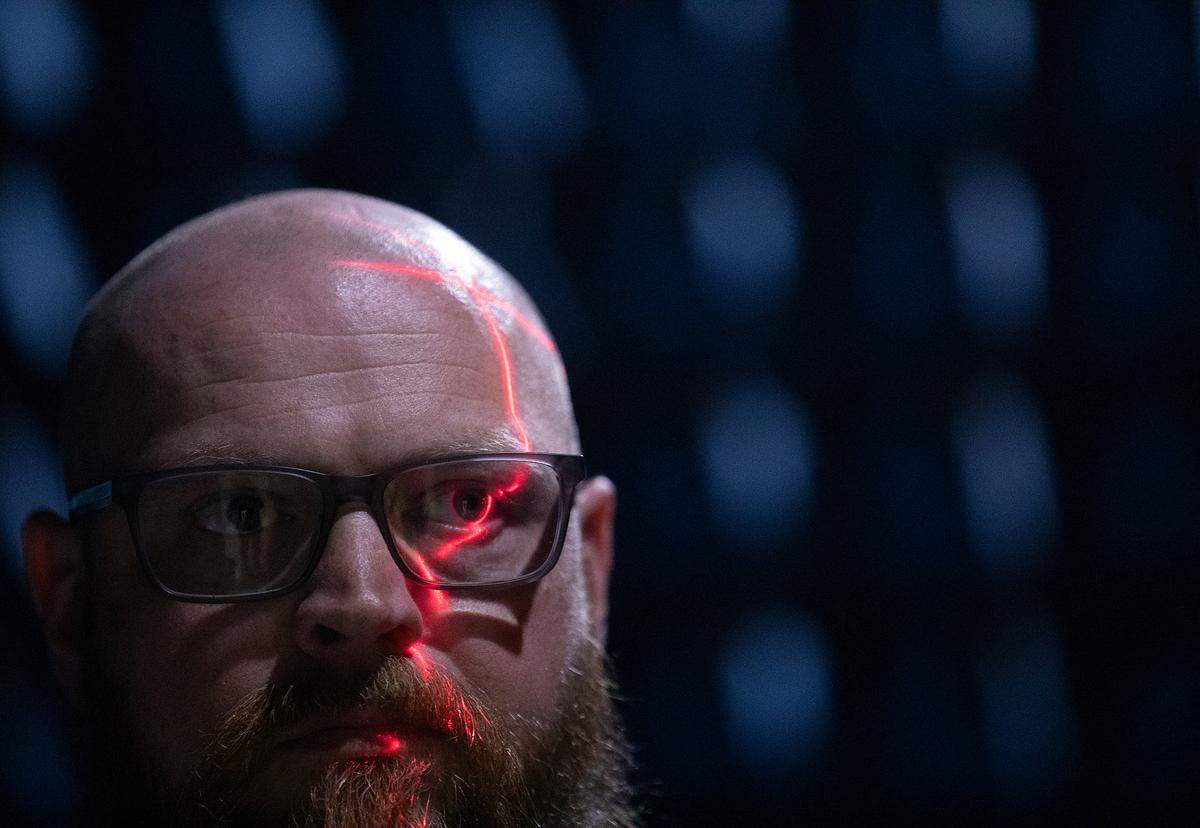
The largest chamber, nicknamed the Satimo chamber after its manufacturer’s previous name, contains $1.5 million worth of equipment. In its center, a light blue arch with 125 probes encircles a Styrofoam-covered plinth on which devices are placed. A pair of red lasers run towards the podium to help center items. The chamber has unique range, capable of measuring electromagnetic frequencies between 400 megahertz and 18 gigahertz. This enables an assortment of testing, from on-body medical tech to defense satellite communications.
Two key measurements WRC staff capture are total isotropic sensitivity (how well a product can “listen” for outside signals) and total radiated power (how well a product can “speak” signals out).
The Satimo chamber has seen vending machine card payments, smart thermostats, home security systems, wearables, and cell phones. Basically, most things with an antennae or cellular radio, said Jordan Stearns, an operations manager at the Wireless Research Center.
“For me, getting to see the devices that come in here is the best part,” he said. “We get devices that are still on the drawing board to those ‘ready’ to market.”
To test wearable products like smartwatches or CPAP machines, WRC engineers place a “body phantom” in the chamber, a dummy named POPEYE that mimics the electrical properties of the human body.
In the center’s early years, before POPEYE arrived, staff themselves would sit inside the Satimo chamber to measure wearables. The lights would go off and any sense of orientation would disappear as they rotated through the void in a chair. Even today, engineers perform this task when they want to achieve testing angles the dummy can’t.
The hum of the amplifier and red laser lines provide some sensory references. But it’s still hard to know which direction is which.
The News & Observer’s Inside Look takes readers behind the scenes to illuminate the people and places in our community.
This story was originally published July 7, 2024 at 5:30 AM.