
In a national first, Carrboro sues Duke Energy alleging decades-long climate deception
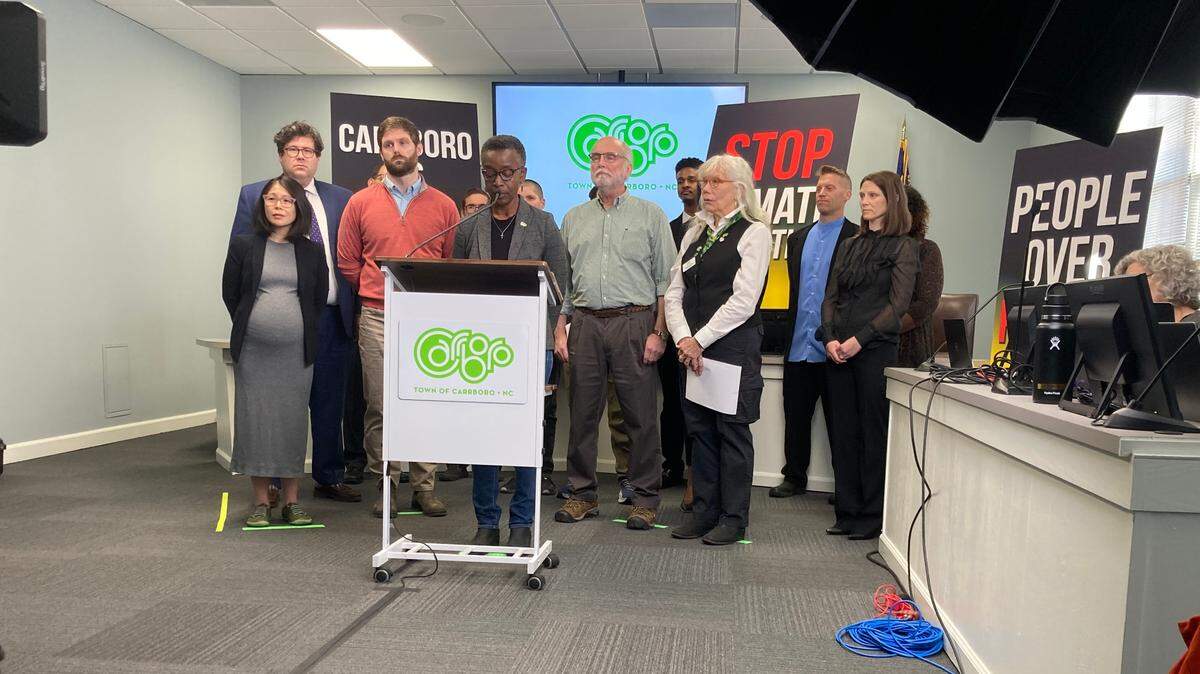
The Town of Carrboro is suing Duke Energy, alleging that North Carolina’s monopoly utility has engaged in decades of deception around climate science that has stalled the transition to renewable energy and resulted in “largely unabated” greenhouse gas emissions.
Filed Wednesday in Orange County Superior Court, the lawsuit likely marks the first time that a municipality has sued an electric utility alleging harms caused by deception about the risks from fossil fuels. Several lawsuits across the country have targeted oil and gas companies, including a 2023 lawsuit a local government in Oregon filed against a gas utility.
“We have to speak truth to power as we continue to fight the existential threat that is climate change. The climate crisis continues to burden our community and cost residents their hard-earned tax dollars,” Carrboro Mayor Barbara Foushee said in a statement.
Carrboro is alleging that the role Duke executives played in continuing to use and promote fossil fuels even as they knew of the associated risks are similar to the tactics deployed by the tobacco industry. Environmental nonprofits NC WARN and the Center for Biological Diversity are both assisting with the case but are not formal plaintiffs.
“We are in the process of reviewing the complaint. Duke Energy is committed to its customers and communities and will continue working with policymakers and regulators to deliver reliable and increasingly clean energy while keeping rates as low as possible,” a Duke spokesman wrote in a statement.
Under a resource plan approved in November by the N.C. Utilities Commission, Duke will pursue the construction of 6,700 megawatts of solar energy; seven new gas-fired power plants totaling 5,620 megawatts; 2,700 megawatts of battery storage; and 1,200 megawatts of onshore wind. All of those are targeted to be built by 2031, while targets for offshore wind and new nuclear projects are several years beyond that.
The plan also officially scuppered a 70% reduction in greenhouse gas emissions target that was written into state law, with Duke and the Public Staff, a ratepayers’ advocate, agreeing that meeting that goal would be too expensive and threaten reliability.
Adding natural gas was particularly contentious during hearings, with environmental groups expressing concern about the utility’s continued efforts to burn methane and add greenhouse gases when alternatives like solar, wind and battery storage are available. Duke has maintained that instantly dispatchable resources like gas are necessary to maintain reliability, particularly as the state continues to grow and add projected new businesses.
Carrboro’s role
Carrboro officials voted to move forward with the lawsuit Tuesday evening.
The lawsuit says Carrboro will likely incur millions of dollars of costs due to climate change, ranging from more frequent road repairs due to more extreme temperatures and rainfall to infrastructure upgrades to cope with more severe storms.
Should temperatures increase as projected, the suit notes, Carrboro anticipates spending millions of additional dollars cooling the town’s facilities. That money will go to Duke, the town’s electricity provider.
“It is clear that our town and hardworking taxpayers cannot and should not be forced to pay for this. The Carrboro community deserves a safe and healthy climate, not the crisis that Duke Energy Corporation’s fossil fuels continue to cause,” Foushee said at a Wednesday press conference.
Foushee added that town officials have been discussing Duke Energy and potential litigation for “a little more than a year,” beginning with council members receiving information from various nonprofits in June 2023.
Foushee and Matthew Quinn, Carrboro’s attorney, told several media outlets that it will cost Carrboro at least $60 million to adapt to climate change. Wednesday, Quinn said that figure is based on modeling that looks at expenses and damages that have been incurred now and could be incurred in the future compared to what would have been spent had Duke pursued a more aggressive transition.
The model was not immediately available to see, Quinn said Wednesday, because it is now part of active litigation.
Carrboro’s lawsuit is being funded by NC WARN, not the town’s taxpayers, said Quinn, who also frequently represents the environmental nonprofit in utilities matters.
Carrboro has taken a number of steps to curb the town’s own greenhouse gas emissions, said Randee Haven-O’Donnell, a town councilwoman. Those included creating a home and business weatherization and energy efficiency loan program; establishing a stormwater utility enterprise fund; and partnering with Solarize the Triangle to spur rooftop solar adoption.
The town’s citizens are angered, Haven-O’Dennell said, when they are taking those steps only to see Duke pursue more fossil fuels.
“It becomes zero sum when they’re working their hardest and they see that (with) one quick action of use of methane or expanding methane gas, their efforts are erased,” Haven-O’Donnell said.
Alleging deception
Duke Energy officials were active participants in groups that acknowledged the risks of burning fossil fuels as early as 1968, the lawsuit alleges, but failed to act, instead participating in other groups that downplayed those same risks. Beyond that, the suit says, Duke is aiming to create the impression that it is shifting to renewable sources much more dramatically than it actually is.
Shearon Harris, a past Duke CEO, was chairman of the Electric Power Research Institute’s board of directors from its 1972 founding until 1977, for example.
In September 1977, New York University professor Merril Eisenbud published an article in the group’s member journal that said, “If we’re going to go fossil fuel rather than nuclear, the increase of CO2 is going to continue, and one can project that if it continues into the next century, it may increase the global temperature sufficiently to cause profound climatic changes.”
The lawsuit also notes that Duke has pursued upgrades to harden its transmission and distribution system against climate change even as it has pursued the construction of new fossil fuel-powered assets.
Duke was closely aligned with the Edison Electric Institute, which started to more aggressively cast doubt on risks posed from burning fossil fuels in 1989, the lawsuit alleges.
And in 2004, the lawsuit says, Duke’s predecessor corporation, Cinergy, focused on global warming in its annual report, including writing there is “an unresolved but robust debate on the ‘science’ of global warming.” Jim Rogers, then Cinergy’s chief operating officer, became Duke’s CEO when the companies merged.
“In fact, the utility and energy industry, including Cinergy and Duke, were well aware in 2004 of the seriousness of human-made fossil fuel emissions and their contribution to global warming,” the complaint said.
In January 2007, Rogers remarked at a press conference that new coal plants could be built as long as they were also able to capture and store carbon emissions. But the lawsuit notes that the Edison Electric Institute had published a paper as early as 1985 that concluded carbon capture was not a viable solution to emissions problems.
Duke also joined and helped fund the American Coalition for Clean Coal Electricity in 2007, the lawsuit said. In May 2008, the group ran a TV commercial that touting that coal, the country’s “most abundant resource,” could generate electricity with reduced emissions, including via carbon capture and storage.
Just a month later, the suit says, Rogers, then Duke’s CEO, said carbon capture and storage as “a magical technology that solves the carbon problem for coal plants is oversold.”
The suit notes that Duke aims to portray itself as a leader in renewables, positioning itself as a leader in the transition from fossil fuel generation. That includes a page on Duke’s website titled “The Business We’re In’ with the text set over an image of solar panels.
Those images, the lawsuit says, could leave viewers with a mistaken impression that Duke’s transition is more dramatic than the one the company is actually undertaking.
This story was produced with financial support from the Hartfield Foundation and Green South Foundation, in partnership with Journalism Funding Partners, as part of an independent journalism fellowship program. The N&O maintains full editorial control of the work. If you would like to help support local journalism, please consider signing up for a digital subscription, which you can do here.
This story was originally published December 4, 2024 at 5:44 PM.