In Apex, an old gas station becomes one of the country’s first ‘rechargeries’ for EVs
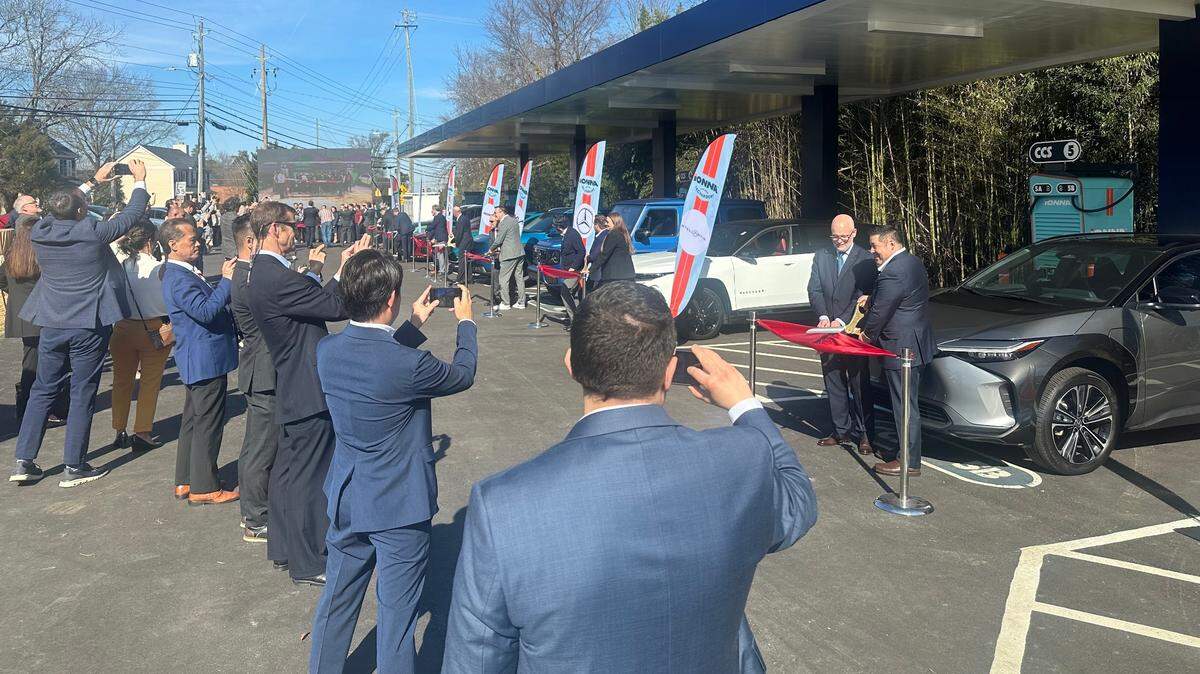
Years ago, the building on North Salem Street was a Phillips 66 gas station, where Apex Mayor Jacques Gilbert remembers his parents fueling up when he was a kid and maybe, if he was being good, buying him a honey bun.
On Tuesday, Gilbert helped celebrate the 21st century version of that fueling station. IONNA, a joint venture of eight of the world’s largest car companies, has turned the old gas station into what it calls a “rechargery,” one of the first of a planned nationwide network of electric vehicle charging stations.
“What we’re doing today is transforming this,” Gilbert said at a ceremony marking the EV station’s opening, which occurred in late December. “Today, this same site is being reborn, not as a relic of the past but as a beacon for the future.”
IONNA says it hopes to open more than 2,000 rechargeries by the end of 2030, with 30,000 plugs to fast-charge electric vehicles. A second Triangle station, at the N.C. 42 interchange with Interstate 40 in Johnston County, is set to open this spring.
The company, which is headquartered in Durham, was founded in 2023 by eight of the world’s largest auto manufacturers: BMW, General Motors, Honda, Hyundai, Kia, Mercedes-Benz, Stellantis and Toyota. At a time when EV maker Tesla was making its chargers available to other vehicles, the companies behind IONNA decided to develop and operate their own network of high-powered EV charging stations open to all brands.
One goal for IONNA is to help reduce the anxiety among car buyers about finding places to charge an electric vehicle, said Frank Diertl, a vice president at Mercedes-Benz USA, one of several auto executives on hand for the Apex opening.
“What’s important is that we have a more ubiquitous public charging infrastructure,” Diertl said. “And that’s what this is about. It’s not about Mercedes or Kia or Ford or Toyota. It’s about the whole industry really solving a problem that will benefit everyone and all EV drivers.”
IONNA is a little like auto manufacturers getting together to introduce their own brand of gasoline to try to provide enough places for their customers to fuel their products.
“For us to lean-in a little bit and to ensure that the customer has options — and an option that provides quality charging — was important to us,” said Chris Yang, Toyota’s group vice president of business development.
The station still has sticky buns
The 10 charging slots at the Apex rechargery are under a new canopy behind the old Phillips 66. The building, with a long awning that once shaded gas pumps, has been completely renovated, with bathrooms, vending machines and fresh snacks (including sticky buns) from Zulia RollUps Bakery.
Unlike a gas station, where customers can fill a tank in a few minutes and leave, EV owners can expect to spend 10, 20 or even 30 minutes fueling up. For those who don’t want to sit around, the Apex station includes cards with a map of the nearby downtown historic district and a QR code for the town’s tourism website.
IONNA wants to make people comfortable while they wait, said CEO Seth Cutler.
“What we want to make sure is that we provide customers a place they want to stop to refuel their cars,” Cutler said.
IONNA announced last year that it would move its headquarters from the Los Angeles area to Durham, lured, it said, by the region’s labor pool, quality of life and more than $3 million in state grants if it meets investment and hiring goals. State officials said IONNA would create more than 200 jobs between 2025 and 2029 at a minimum average salary of $128,457.
Durham County kicked in local incentives worth $170,000.
The state and federal governments have also played a role in expanding the nation’s EV charging network, with grants for stations in underserved areas. It’s not clear yet whether the Trump administration will curtail those efforts, but it wouldn’t change IONNA’s plans, which are backed by the car companies.
“There is a significant EV charging gap right now that poses an immediate need for our infrastructure buildout,” company spokeswoman Katherine Rankin wrote in an email. “In other words, we are still catching up on servicing current EVs on the road, let alone what comes in the future.”
Former Gov. Roy Cooper and other state officials hailed IONNA’s arrival as yet another sign of North Carolina helping lead the transition to electric vehicles. Other EV-related companies that have invested in the state include Vietnamese carmaker Vinfast in Chatham County, charger manufacturer Kempower in Durham and Toyota, which is building a battery plant expected to employ 5,000 people south of Greensboro.
Reid Wilson, the new state Department of Environmental Quality Secretary, echoed Cooper at Tuesday’s opening ceremony.
“From manufacturing electric vehicles, to their batteries, to charging stations, North Carolina has jobs in every link of the electric vehicle supply chain,” Wilson said. “Our state is committed to continuing to expand its clean-energy economy.”
This story was originally published February 4, 2025 at 5:04 PM.