Triangle startup says it has an answer to America’s rare earth magnet problem
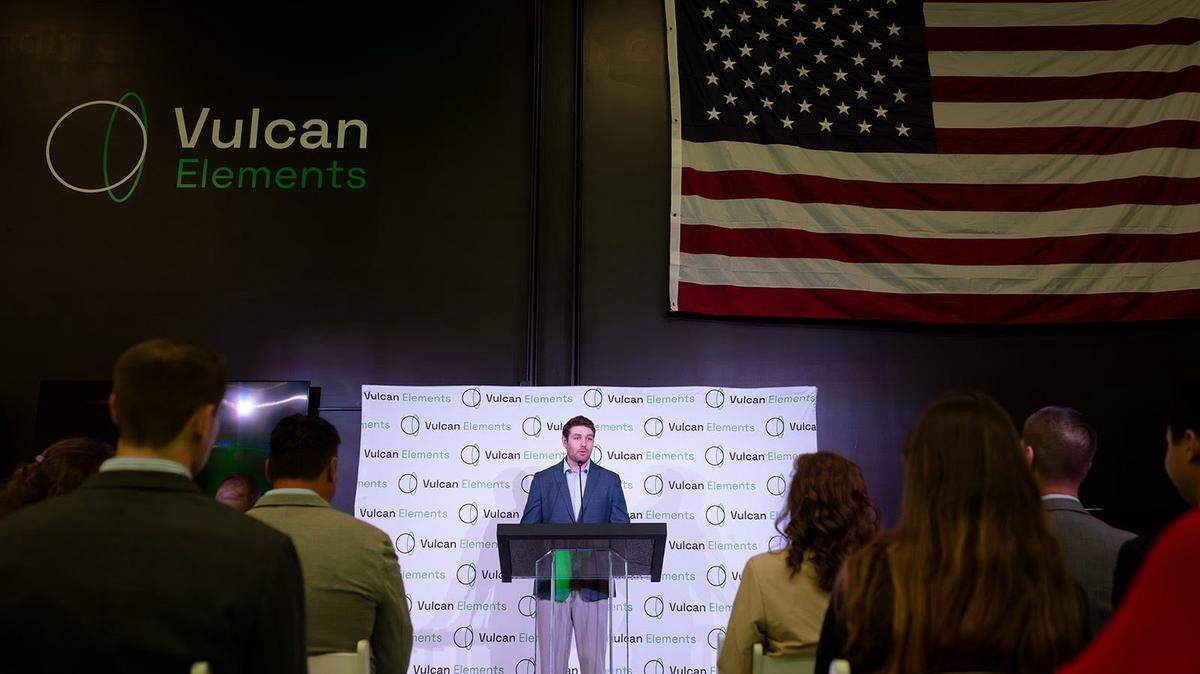
Beneath a large American flag on the eve of a trade war, John Maslin encouraged an audience of North Carolina officials, industry stakeholders and potential investors to consider rare earth magnets. It was March 31, and within a few days, these magnets would emerge as headlining concerns in an escalating battle between two world superpowers.
Maslin, 30, is cofounder and CEO of Vulcan Elements, a 2-year-old company that opened its first manufacturing facility in late March at its new headquarters in Research Triangle Park. For a young startup with fewer than 20 employees, Vulcan attracted several notable speakers to its debut event, including U.S. Rep. Pat Harrigan, Durham Mayor Leonardo Williams, and North Carolina Commerce Secretary Lee Lilley.
“When we talk to people, they get it within five minutes,” Maslin told The News & Observer during a facility tour the next day. “Because it matters.”
“It” is the production of rare earth magnets for high-tech and defense applications in the U.S., not China.
Rare earths are a collection of 17 lesser-known, harder-to-pronounce elements with unique luminescent and magnetic traits crucial to modern technologies. Wind turbines use dysprosium and praseodymium. Camera lenses use lanthanum. MRI machines use gadolinium. Yttrium is in rechargeable batteries and car catalytic converters. Scandium is in stadium lights and metal baseball bats.
And powerful rare earth magnets are in refrigerators, smart phones, car motors and advanced weapons systems. Rare earths produce permanent magnets, which keep their magnetic properties without an electrical current.
The United States once led global rare earth magnet manufacturing. Yet over decades, it ceded this position to China, which today dominates around 90% of the market. It’s a monopoly the country has flexed before; in 2010, China restricted rare earth exports to Japan over a territorial dispute. More recently, China retaliated on April 4 against President Donald Trump’s rising tariffs (now at 145%) with export controls covering materials containing seven rare earth elements: samarium, gadolinium, terbium, dysprosium, yttrium, scandium and lutetium.
“The Chinese Communist Party could cut us off at any moment,” Harrigan, a first-term Republican from Hickory, said during Vulcan’s opening event. “They can shut down our economy, cripple our military readiness, or worse, and much worse, use compromised components to track and target American forces.”
From mine to magnet
Maslin says his time as a financial manager for the U.S. Navy’s nuclear propulsion program highlighted the risks of relying on other countries, especially adversaries, for critical materials. He started Vulcan Elements with electrical engineer Piotr Kulik in 2023 while studying at Harvard Business School.
According to Maslin, the company was drawn to Research Triangle Park for the area’s talent pool, manufacturing-friendly climate, and proximity to suppliers and customers, including the military.
There are two common types of rare earth magnets, neodymium and samarium cobalt, and Vulcan Elements focuses on the former through a process known as the powder metallurgy method. The facility first receives raw materials, including pure neodymium, dysprosium, iron and boron. These are heated into molten metal and run through a strip caster to make thin alloy flakes. Hydrogen then chemically breaks the flakes into coarse powder. A jet mill then pulverizes the powder to a small particle size.
To put the magnet together, a press aligns the grains and compresses them into a block. A process called sintering fuses the particles inside the block, which finally gets heat-treated, shaped, and coated.
Equipment to do all this exists, though finding machines without links to Chinese firms took time, Maslin said. His company is working through these operational steps and aims to deliver customers finished magnets in the summer.
“(Neodymium magnets) cut across virtually every system or platform with a motor sensor, an actuator or a generator,” he said. “We haven’t done a good job of, in this specific industry, building in the United States with urgency and seriousness.”
Experts agree that while the federal government has prioritized U.S. semiconductor chips and batteries, it only recently began to forcefully back domestic magnet initiatives. Last May, President Joe Biden ordered a 25% tariff on Chinese rare earth magnets beginning in 2026. On his first day in office, Trump signed a presidential action calling for the U.S. “to establish our position as the leading producer and processor of non-fuel minerals, including rare earth minerals.”
Facing the ‘900-pound gorilla’
Industry experts say rare earth magnet startups face obstacles to break China’s stranglehold and carve out a niche among emerging American producers.
“You may have done a few things in a lab or on a pilot scale, but it’s a very different challenge to meet the quality requirements at scale,” said John Ormerod, a rare earths magnetic consultant based in Tennessee. “It’s a really difficult challenge to produce consistent results.”
Rare earth elements are actually quite abundant. They exist worldwide, even in many backyards. Yet single elements aren’t typically concentrated, making them less efficient to mine commercially. And rare earths are usually clumped with radioactive elements like uranium and thorium, which increases the complexity of extracting them.
With lower labor costs and environmental regulations, plus tremendous economies of scale, China can offer cheaper prices to ward off competitors.
“You’re going up against a 900-pound gorilla,” said Ed Richardson, president of the US Magnetic Materials Association. “There are a lot of carcasses along the way.”

Some domestic mining and processing companies are trying, like Las Vegas-based MP Materials, which last year received a $58 million tax credit through the Inflation Reduction Act to build a permanent magnet plant in Fort Worth, Texas.
Vulcan Elements, in its short history, has already secured separate funding from the U.S. Army, Navy and Air Force. The startup also raised around $9 million in private funding during an initial round last year.
“Whoever his investors are.... I want to say you made the right call,” Harrigan said at the company’s opening.
The U.S. flag hanging in Vulcan’s main manufacturing floor reflects one of the company’s biggest selling points. On past trips to Washington, D.C., Maslin has spoken to lawmakers about the importance of America manufacturing its own rare earth magnets.
It’s a pitch that has gained new meaning over the past two weeks.
The News & Observer’s Inside Look takes readers behind the scenes to illuminate the people and places in our community.
This story was originally published April 16, 2025 at 5:15 AM.