It promised a $1.4 billion NC factory. Now, Natron Energy is low on cash.
I’m Brian Gordon, tech reporter for The News & Observer, and this is Open Source, a weekly newsletter on business, labor and technology in North Carolina.
Bob Pike hesitated before saying that Natron Energy has paused building a $1.4 billion battery plant in North Carolina.
Pike leads the Carolinas Gateway Partnership, a public-private organization that recruits businesses to Edgecombe County, a rural region 60 miles east of Raleigh. Last summer, Edgecombe landed a historic project: The California startup Natron Energy announced it would create more than 1,000 jobs by establishing the world’s first sodium-ion battery “gigafatory.”
It was the state’s biggest jobs headline of 2024. Gov. Roy Cooper called Natron a win for clean energy, while Edgecombe leaders celebrated a tenant filling the long-dormant megasite in one of North Carolina’s poorer counties. The state awarded Natron $21.7 million in performance-based incentives, plus another $30 million toward upfront construction.
Among alternative battery materials, sodium-ion is more abundant than lithium-ion and thus potentially less expensive. Founded in 2012, Natron patented a unique battery from an electrode family called Prussian blue, which produces longer-lasting batteries when combined with sodium ions. Backup power to data centers has been an early use.
“We’re going to revolutionize the market for batteries going forward,” Natron CEO Wendell Brooks promised at the North Carolina factory announcement last August.
.jpg "Aerial (1).jpg")
Now, less than a year later, the Edgecombe site looks unchanged from above ground, Pike says, and the question is if Natron can continue financially. Pike said his team at Carolinas Gateway Partnership speaks with the alternative battery company weekly and hears of their liquidity issues.
“I don’t know how to describe something,” he said. “If you don’t have the money, you don’t have the money. It’s not paused because of the opportunities; it’s paused in terms of clarification of the financing.”
‘The money dried up’
I hadn’t asked Pike about Natron Energy on a whim. In late June, the tech-business industry news outlet The Information published a story saying the startup had little money.
“Natron is pretty much out of cash,” the article stated, citing “people familiar with the situation.”
According to The Information, many of Natron’s most recent investors have halted scheduled payments to the company. And though the battery maker has $25 million in booked orders, it can’t see this revenue until it gets certified from Underwriters Laboratory, an independent lab whose certification investors often require. Natron hopes to be “UL Certified” by the end of the summer, the article said.
The cost of launching factories in both Michigan and North Carolina, The Information also wrote, has “put Natron on an almost constant and increasingly difficult quest for cash.” This despite tax credits from the Biden-era Inflation Reduction Act, which are now being threatened by Republicans in Congress.
Responding to its cash crunch, Natron’s CEO Brooks “froze plans for the North Carolina plant.”
Analysts say the chief advantage of sodium-ion over lithium-ion, availability, has been undercut by lithium’s falling prices. “Lithium carbonate prices have crashed by more than 70% over the past several years, negatively impacting the business case for sodium-ion batteries,” S&P Global wrote in an article last month.
And Steve LeVine, the editor at The Information who wrote the article, told me the headwinds Natron faces are affecting all U.S. battery startups.
“It’s super expensive to scale up,” he said, explaining that companies with promising batteries can’t cross the so-called “valley of death” to become established mass manufacturers.
“The money dried up,” LeVine said. “Like Silicon Valley, private equity. They’ve been almost unwilling to finance battery companies.”
What’s next for Natron in NC?
Natron Energy did not respond to N&O questions about its finances or its plans in North Carolina. If the company has indeed halted its Edgecombe project, it hasn’t told the state Commerce Department.
“The company has not contacted us with any updates regarding their plans in Edgecombe County,” N.C. Department of Commerce spokesperson David Rhoades said in an email last Thursday.
The state’s incentive grant to Natron, Rhoades noted, does not begin until 2028. After that, the company will only benefit from payroll tax breaks if it meets hiring targets. Nor has any of the $30 million for site preparation been distributed.
“Release of program funds to the county is conditional on the company (Natron in this case) providing evidence of funding,” emailed Denise Desatnick, vice president of marketing and research at the Economic Development Partnership of North Carolina. “Natron is still lining up their capital, so none of the Program funds have been released at this point.”
In Edgecombe, Bob Pike still believes in Natron and the future demand for its “proven” batteries. LeVine, an industry expert who launched The Information’s vertical on EVs and batteries, also said Natron has an attractive product.
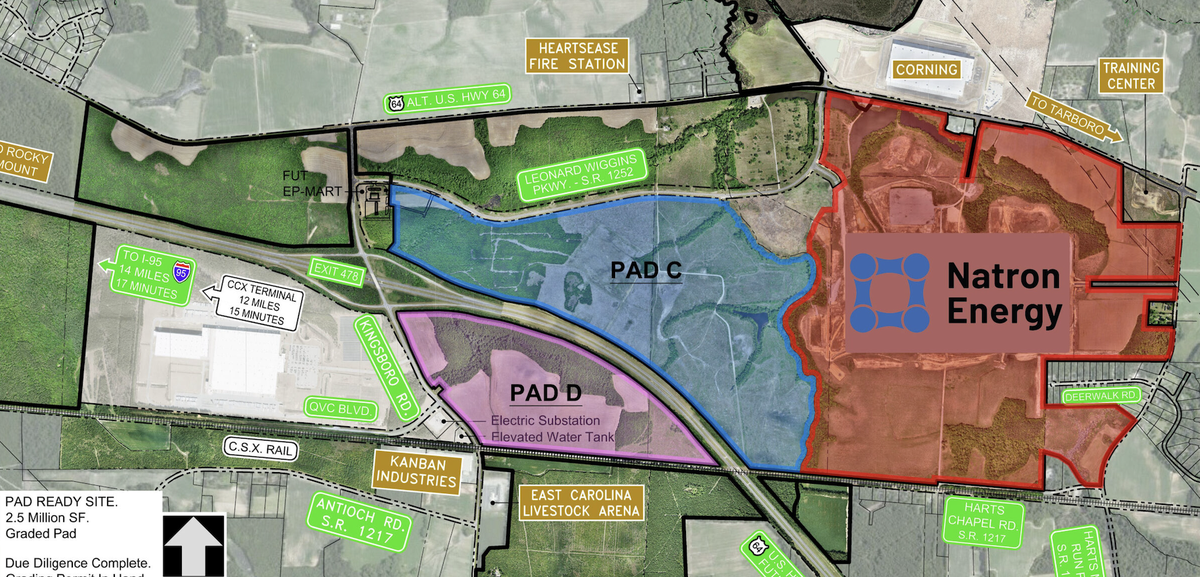
Worst case, Pike said the local Kingsboro megasite near the city of Rocky Mount will have other suitors; in 2023, a state-commissioned report identified Kingsboro as the most “pad-ready” megasite (defined as at least 1,000 contiguous acres) in North Carolina, meaning a company could reasonably begin to build on it right away.
“If there’s a point in time that it becomes evident things change for whatever financial (reason), it’s still a very marketable asset,” Pike said.
Yet others wonder whether North Carolina was right to partner with a company without an established robust revenue stream.
“Was this a venture risk?” Tony Copeland, who served as state Commerce secretary during Cooper’s first term, asked. “I really think we need to ask these questions.”
In an interview with The N&O in June, current state Secretary of Commerce Lee Lilly compared economic development to a hockey team taking “shots on goal.”
“We don’t take every shot, but we try to take the ones that we think are going to be most successful,” he said.
It’s too soon to call Natron a missed shot. But it has not been an ideal start. What is clear is that North Carolina, the reigning “No. 1 state for business,” will keep shooting.
In an N&O interview, Christopher Chung, CEO of the Economic Development Partnership of North Carolina, said the state is currently competing for 243 projects, of which 10 promise investments of over $1 billion.
Trump 2.0 and the Triangle
Six months down, 42 to go.
Whether the time left in President Donald Trump’s second term gives you a smile or a jolt of dread will vary. But the half-year mark served as a good occasion to look back at how the administration has affected the “research” part of the Research Triangle, which over the past 70 years has grown as both a place and a concept with consistent support from the federal government.
By looking back, I mean looking back — all the way to the first National Institutes of Health award Duke University received in 1946. This history of research around Raleigh, Durham and Chapel Hill illuminates what has been lost at the area’s pillar institutions — the universities, the foreign assistance nonprofits, and the federal campuses — since Jan. 20.
.JPG "RAL_PROTEST04-030725-EDH (2).JPG")
Clearing my cache
The Chinese tech company Lenovo, which has dual headquarters in Beijing and the North Carolina Triangle, told The N&O last week it is laying off 3% of its full-time U.S. workforce. Lenovo in recent years has shifted resources from traditional personal computer operations toward artificial intelligence hardware.
Around two dozen workers at the National Institute of Environmental Health Sciences campus in Research Triangle Park received an email last Monday notifying them that they would be laid off at the end of the day. This was part of much broader Health and Human Services job cuts made possible by a recent Supreme Court decision.
And in one of the largest North Carolina layoffs of the year so far, Daimler Truck North America is cutting 573 positions across two sites west of Charlotte. The company says it’s seen a marked slowdown in new orders for medium-duty, on-highway and electric vehicle trucks.
The Morrisville-based wealth management software firm Eton Solutions has raised $58 million in a Series C round.
Micropep Technologies, a French-American agricultural technology firm with U.S. headquarters in Durham, announced Georg Goeres as its new CEO.
Raleigh Founded, a prominent local coworking space provider, is closing its Gateway location.
.jpg "IMG-2966 (1).jpg")
National Tech Happenings
- The Defense Department will soon use Grok, the artificial intelligence chatbot from Elon Musk’s xAI. The Pentagon announced similar deals with Google, Anthropic and OpenAI — each with $200 million caps. This comes a week after Grok posted a series of blatantly antisemitic messages.
- Starbucks is requiring corporate workers to be in the office four days a week starting this fall — or take a separation buyout — as the coffee chain looks to reverse lagging U.S. sales. Its previous return-to-office rule was three days per week.
The U.S. Department of Justice and FBI has released nearly 11 hours of what they said was “raw” overnight surveillance footage outside Jeffery Epstein’s prison cell the day he died. A Wired analysis found part of the “raw” footage is 2 minutes and 53 seconds shorter than its original source video. The cut, Wired reported, begins right at the so-called “missing minute” — which has fueled conspiracy theories surrounding the financier’s reported suicide. Attorney General Pam Bondi has chalked up the “missing minute” to a daily surveillance system reset.
Thanks for reading!
This story was originally published July 18, 2025 at 9:28 AM.