Boom Supersonic’s $50 million Greensboro factory is idle, leaving NC with a choice
AI-generated summary reviewed by our newsroom.
- State allocated nearly $107M for Greensboro supersonic factory that remains idle.
- Lease allows termination if Boom has under 500 workers after Dec. 31, 2026.
- Officials monitor engine progress, hiring, tenant interest and protections.
Since 2022, North Carolina has spent more than $50 million in taxpayer dollars to build a “superfactory” at the Greensboro airport that today, nearly two years after its completion, sits dormant. It is not for a lack of companies wanting to occupy this long, rectangular hangar, says Kevin Baker, executive director of the Piedmont Triad Airport Authority.
“I have absolute confidence that we’d be able to fill this building anytime we need to,” he said. “There’s already been interest in this building.”
For now, at least, the facility is in the hands of one company whose inactivity in North Carolina will soon give Baker and state leaders a decision on how to protect their large public investment in a burgeoning aerospace center.
In January 2022, the Colorado startup Boom Supersonic selected Greensboro as the home for its first manufacturing and testing plant. Boom put forth an ambitious objective: to revive the kind of supersonic passenger travel not seen since the Concorde airliner stopped flying in the early 2000s. It envisioned its inaugural Overture aircraft would cruise at approximately 1,300 mph over water, roughly twice the speed of today’s commercial planes.
North Carolina sweetened its incentive package to attract Boom over a competitive Florida offer. In addition to awarding the jet maker tax breaks if it reached certain hiring and investment milestones, the North Carolina General Assembly (upon the urging of the state Commerce Department) allocated nearly $107 million for the airport factory upfront. This included $35 million for the N.C. Department of Transportation to connect a public road to the site, $15 million for the Piedmont Triad Airport Authority to grade and ready the site, and $56.75 million to reimburse Boom for construction costs.
In recent years, North Carolina has more aggressively approved site enhancement funds to land major economic projects, including for the car company VinFast in Chatham County and the California aviation startup JetZero at the Piedmont Triad International Airport. To protect its upfront Boom investment, the state entered a deal with the local airport authority that allows the latter to terminate Boom’s below-market lease if it doesn’t achieve certain hiring goals. And its first job creation deadline approaches.
Boom mum on current Greensboro headcount
If Boom employs fewer than 500 workers in Greensboro at any time after Dec. 31, 2026, the Piedmont Triad Airport Authority can end its lease and market the building to other companies. North Carolina has a similar buyback arrangement with VinFast, which has yet to build its promised auto factory southwest of Raleigh.
It’s safe to say Boom won’t meet this hiring mark in time. The company has yet to test or build any aircraft in Greensboro. It finished testing its X-B1 demonstrator jet after breaking the sound barrier in California early last year, and Overture remains unfinished — as does the “Symphony” engine Boom hopes will one day power its jet. After deals with engine manufacturers fell through, Boom is now creating Symphony in-house — which has contributed to delays.
.jpg "IMG_5657 (1).jpg")
“We look forward to beginning Overture test production in North Carolina as soon as possible,” a company spokesperson wrote in a statement to The News & Observer while reaffirming Boom’s aim to carry passengers by 2030.
The 12-year-old company declined to share how many, if any, workers it currently has in Greensboro. In late 2024, The Wall Street Journal reported that Boom had laid off about half of its 260 employees. “Changes were made to Boom’s workforce in order to accommodate the company’s priority focus on building the Symphony engine and Overture airliner,” a company spokesperson told The N&O regarding these cuts.
Boom committed to eventually employ 1,761 people at its Greensboro site. But how long North Carolina will give it to realize this goal is worth considering.
Not beholden to a ‘prescribed schedule’
What are Boom Supersonic’s odds of succeeding? In a recent interview, United Airlines CEO Scott Kirdy put it at “50/50.” United is one of the major airlines that has a nonbinding deal to purchase Overtures if and when the aircraft is ready.
Daniel Bubb, a former airline pilot who teaches aviation courses at the University of Nevada, Las Vegas, said he’s torn between his excitement for new supersonic commercial flight and an acknowledgement of the many hurdles Boom faces. “Give them a little bit more time, and a little bit more space, just to see if they can get this thing to go and do it right,” he said.
Other aviation companies could shape North Carolina’s decision on Boom going forward. In recent decades, the Piedmont Triad International Airport has positioned itself as a hub for aerospace firms, first with HondaJet, then with the promises of Boom and JetZero. Multiple aerospace businesses that specialize in maintenance, repair and overhaul, known as MROs, also operate there.
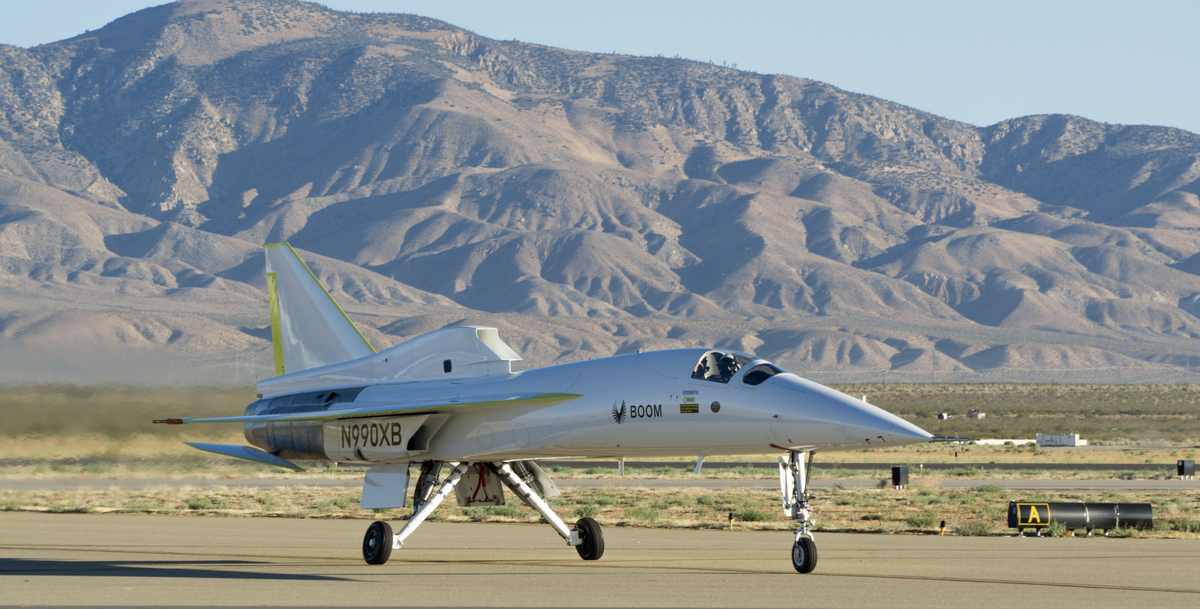
Baker said companies have already inquired about using the Boom building, either long-term or until the supersonic jet startup is ready to fill it. He noted the state had encouraged Boom Supersonic to design its factory in a way that improved its reuse capabilities.
Though confident the 179,000-square-foot production hangar could be filled, Baker is still bullish on the current tenant’s ability to revolutionize air travel from North Carolina. “In an area that is investing in future technologies, you have to understand that these things can get delayed,” he said.
“What area of the entire world would want to chase a new company away who might ultimately be making one of the coolest, most modern airplanes ever flying just because they didn’t get it done on some prescribed schedule?” he added.
What NC wants to see from Boom
The Piedmont Triad Airport Authority is a quasi-public body that oversees the airport. While it is technically empowered to decide the fate of Boom’s lease come next year, Baker said any decision would be made in coordination with the state.
Baker said he has a standing quarterly call with Boom Supersonic CEO Blake Scholl and routinely speaks to other Boom representatives. The next major development Baker says his team will monitor is the company’s engine. “We’re going to be watching all this year to see what happens with this engine,” he said. “They’re expecting strides with this engine this year.”
In December, Boom Supersonic announced a new initiative to power data centers from its Colorado campus. A company spokesperson said this effort won’t disrupt its North Carolina timeline further. “We expect (the turbine) to accelerate the path to supersonic passenger flight,” the spokesperson wrote in an email, “by providing a key source of engine reliability data and by accelerating Boom’s path to profitability.”
Baker acknowledged the need to safeguard the state’s investment. He said Boom has already used the bulk of its $56.75 million allotment to reimburse what it paid contractors to build the factory. That is money put into an inactive aerospace site in a hot aerospace region.
“That’s kind of the beauty of the whole thing,” he said of the state’s lease termination contract. “The whole thing has been hedged all the way along.”
This story was originally published March 23, 2026 at 6:30 AM.