Glass ceilings and stereotypes beware: Veridea’s project manager is coming for you
AI-generated summary reviewed by our newsroom.
- Sam Roth, 25, is a project manager on Phase I of the $3 billion Veridea project.
- Roth manages three active sites across roughly 170 acres and over 120 workers daily.
- Construction management saw women rise from 6.7% in 2015 to 10.5% in 2024, per IWPR.
At 7:12 a.m., the Veridea job site is already teeming with activity on Apex’s southern edge.
Excavators crawl across the red clay. Survey crews trace the edges of newly poured roads. Machinery hums over the 1,100-acre site between U.S. 1 and N.C. 540 where New York-based RXR is building an entirely new district from scratch.
And somewhere in the middle of it, walking briskly across the gravel in steel-toe boots, is 25-year-old Samantha “Sam” Roth.
As a project manager for Greensboro-based Samet Corp., she’s steering Phase I of the $3 billion project. On any given day, this self-proclaimed “old school” Gen Z’er oversees $100 million in active construction across three sites — roughly 170 acres of newly cleared woodland — and more than 120 workers. She manages budgets, schedules, subcontractors and the daily choreography of a project that changes by the hour.
“It’s fast-paced,” she says, walking with an easy confidence during a recent site tour, wearing blue jeans, a neon-yellow vest and hard hat with her name printed neatly across the front. Her pink-streaked hair peeks out from underneath.
“It’s a lot of pivoting and high-pressure decisions. You have to make the most of every 30-minute block.”
She pauses, then adds with a smile: “It’s like getting a Lego set without the directions.”
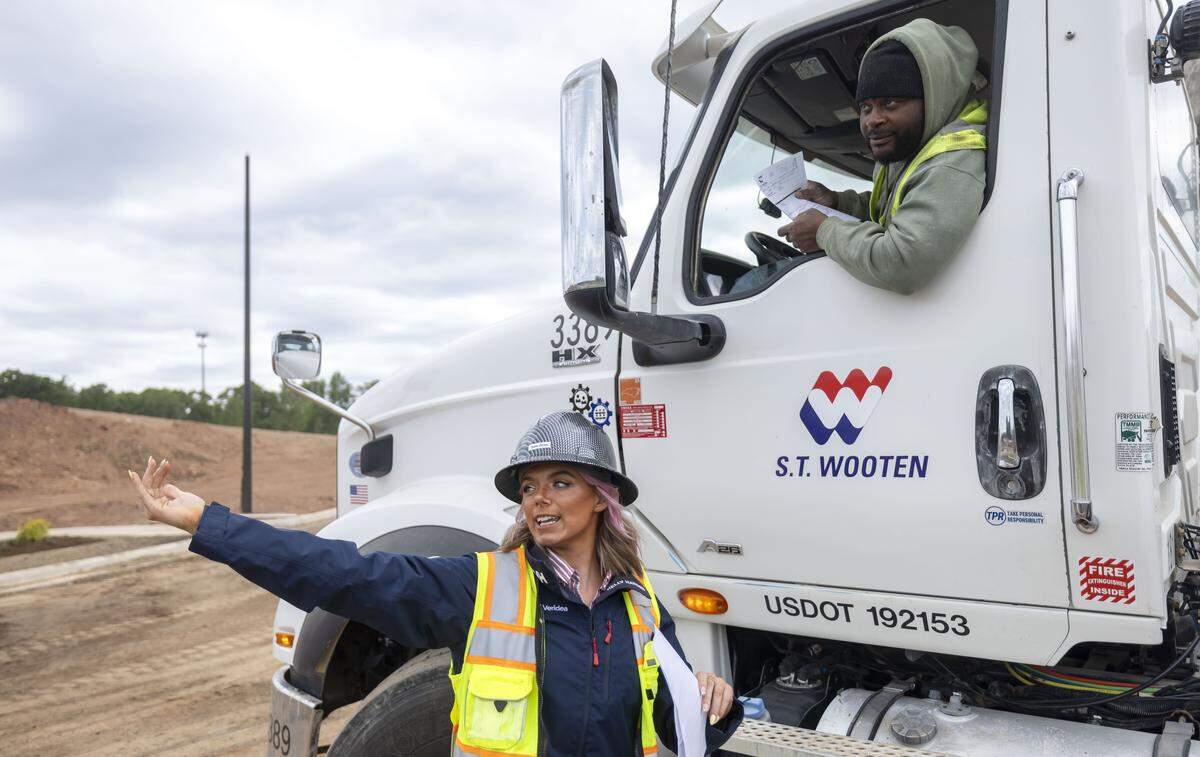
At a moment when the Triangle is racing to keep up with its own growth, Roth represents a new kind of builder stepping into roles once reserved for people twice her age. Her rapid rise in a male-dominated industry facing a national labor shortage offers a glimpse of who will shape the next decade of construction in North Carolina — and how quickly the field is changing.
Construction managers specifically have seen a major increase in women — from 6.7% in 2015 to 10.5% in 2024, according to the Institute for Women’s Policy Research.
“It’s not the ‘good ol’ boys’ network anymore,” said Joe Graziose, RXR’s executive vice president of development, in a phone call. He’s been in the construction industry for over 40 years and has overseen billions of dollars in projects from Long Island to North Carolina.
Over the last two decades, he’s seen a steady rise of women stepping into top construction jobs.
“I see it on my teams and in my mentorship programs. Half of them are women,” he said. They’ve carved out space for themselves, he adds, and the industry has taken notice. “They’re educated and highly regarded.”
Roth is part of that shift. “Women now make up a third of our project management associates,” said Adam Fouse, Samet’s senior project executive. The firm is working on 20 large-scale residential projects across the state. Women are playing “a vital role in our region’s growth,” he said.
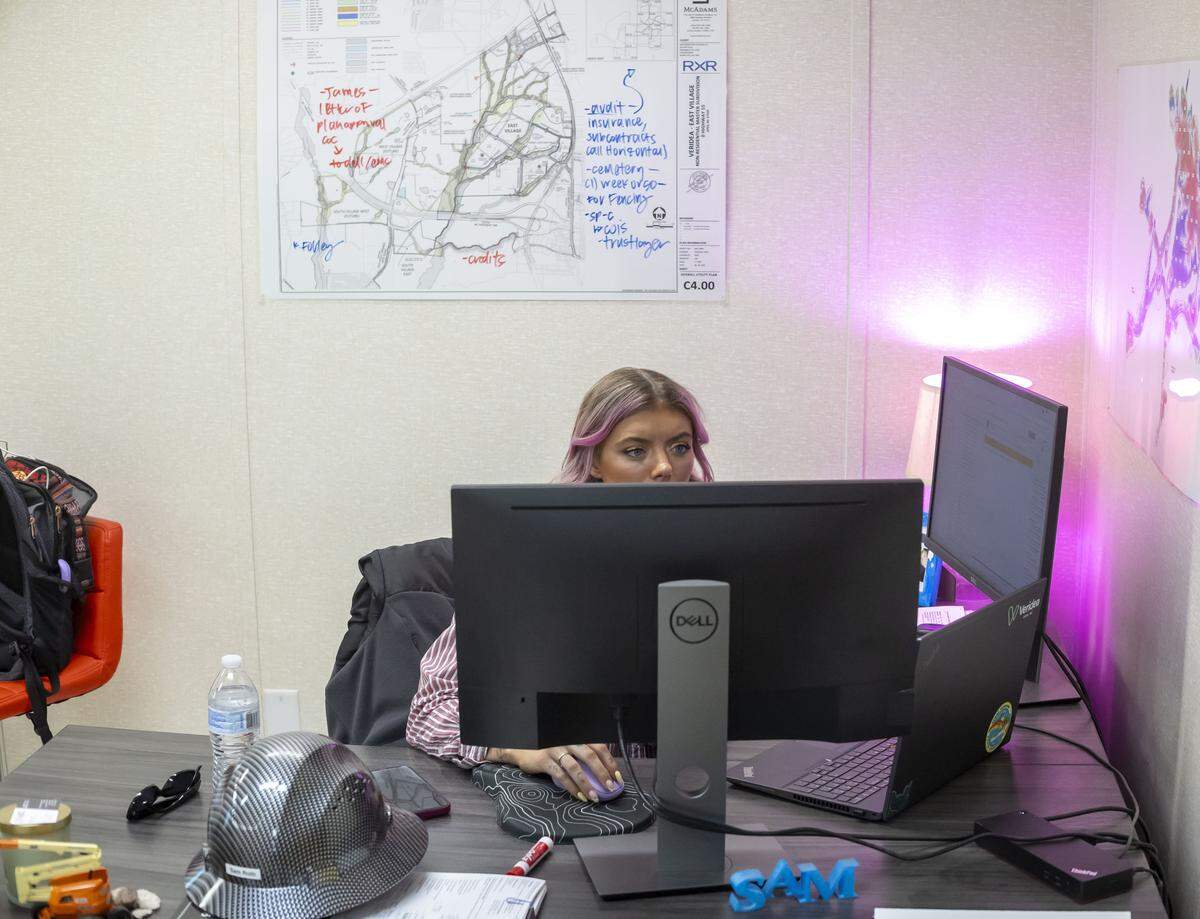
On the Veridea site, Roth works from a corner office inside a trailer. Her walls are covered with digital mock-ups and renderings, which she deciphers throughout the day. She’s unapologetic about her tattoos (13 and counting — “I’m finishing my half sleeve this summer”) or her ambitions.
“I want to disrupt the industry,” she says. “There aren’t many women in operations running general contracting teams. I want to change that.”
A leap of faith
Roth was born and raised in Petersburg, a quiet rural stretch of northern Kentucky near Cincinnati, where she was adopted as a baby and grew up far from the world of large-scale development she now helps manage. Brought up with her younger brother, she spent most of her childhood outdoors — snowboarding, playing tennis, exploring open fields.
“My parents never taught me to play life small,” she says.
Roth began college studying biomedical sciences, working in genetics labs and earning straight A’s. But something felt off. “Switching majors was a trust fall,” she recalls. “People thought I was crazy. But most of the time when you take a leap, you don’t know what’s going to happen. You have to believe in what you can’t see.”
She enrolled in construction management, a field she knew almost nothing about. But one experience had stuck with her: a high school visit to Babcock Ranch, the solar‑powered community in southwest Florida built around an 870‑acre solar farm.
Roth says the appeal came from watching raw land transform into something far larger. For her, development isn’t just about construction — it’s about “helping decide how it gets built” before the first shovel ever hits the soil.
At Northern Kentucky University, Roth was one of only two women in her graduating class and worked full-time — managing hospital renovations by day and attending classes at night. Later, at the age of 23, she joined Samet Corp. at as an assistant project manager. She was promoted to project manager last year.
Veridea — a planned district with homes, offices, retail, parks and miles of new infrastructure — is the largest project she has ever worked on. By 2035, it’s expected to bring up to 8,000 residential units; 3.5 million square feet of retail, hospitality and civic space; 12 million square feet of commercial space; and a new public elementary school. Plans also call for a 34-acre Wake Technical Community College campus and a 230-acre North Carolina Children’s Hospital, announced last July.
“Veridea is the project of a lifetime,” she says, though she dodges talk about compensation. It’s “somewhere in the six-figure territory,” she hints. (According to Glassdoor, Roth likely earns between $95,000 and $125,000 annually.)
Leading the site
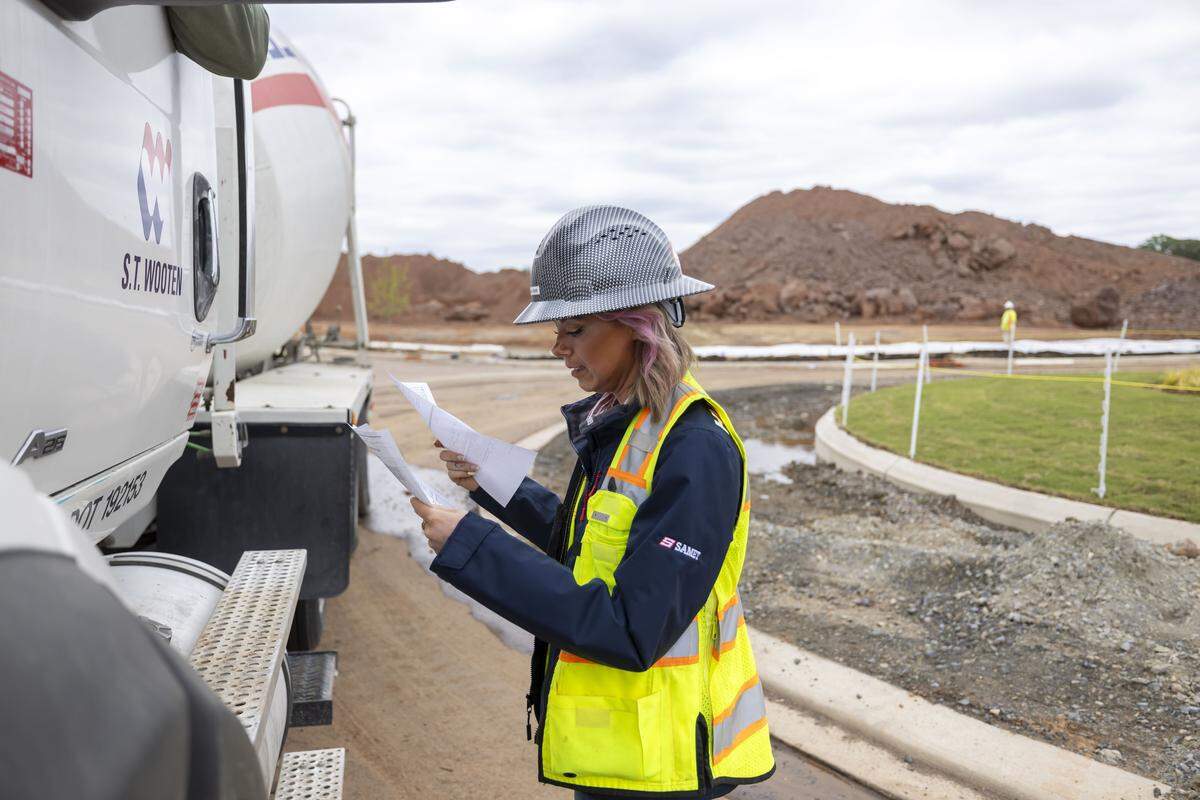
Her days start early. She wakes at 4 a.m., journals, goes to the gym, and arrives on site by 7 or 7:30. She lives eight minutes away in Apex — a strategic choice: “If I work late or want to get in early, it’s right down the road.”
Her mornings begin with emails and a priority list. Then come meetings with design partners, subcontractors, bidders and owners. In between, she handles payment applications, monthly reports, site walks and pre-construction for new work.
Most of the people Roth manages are older than she is — sometimes much older. She’s honed her ability to lead with a firm sense of self. “You can’t lead with ego, but you also can’t let people walk all over you,” she says. “Your presence matters. Your knowledge, your energy, how you carry yourself. People pick up on that.”
Over time, she’s also learned how to confront bias directly: “As a female, you do have to work twice as hard. People assume the guy in the room knows more — you have to shut that down.”
When comments cross a line, she has a go-to response: “Would you say that to your daughter?”
“It stops people in their tracks,” she says, unflinching.
But Roth doesn’t pretend she’s unbreakable. In a recent LinkedIn post, she wrote about the years that tested her: the cross-country moves, the heartbreaks, the mental-health battles, the family illnesses.
In a moment of rare vulnerability, it underscored the kind of leader she’s trying to become: “Someone in your life who can speak up when times get tough.” Compassion and kindness in the workplace, she concludes, can make a “significant difference.”
Looking ahead
By 30, Roth wants to be in executive leadership. She also wants to show young women the opportunities waiting for them in construction.
She currently serves on two boards, one of them the Raleigh Durham affiliate of the ACE Mentor Program, which introduces high school students to architecture, construction and engineering. She mentors students weekly and recently helped one win a national scholarship.
Roth doesn’t know where her career will take her. But she’s not afraid to think big. “I want to teach a college class one day. I even want to write a book,” she says.
For now, she’s focused on Veridea — on the roads being cut, the utilities being laid, the foundations taking shape. On the city rising from the clay.
“Back in 2024, it was all trees,” she muses. “We were flagging three miles of sanitary sewer through the woods. To see it now — and know it’s still just the beginning — is pretty remarkable.”
This story was originally published May 14, 2026 at 5:00 AM.