
Citrix Systems injects new blood into Raleigh's Warehouse District
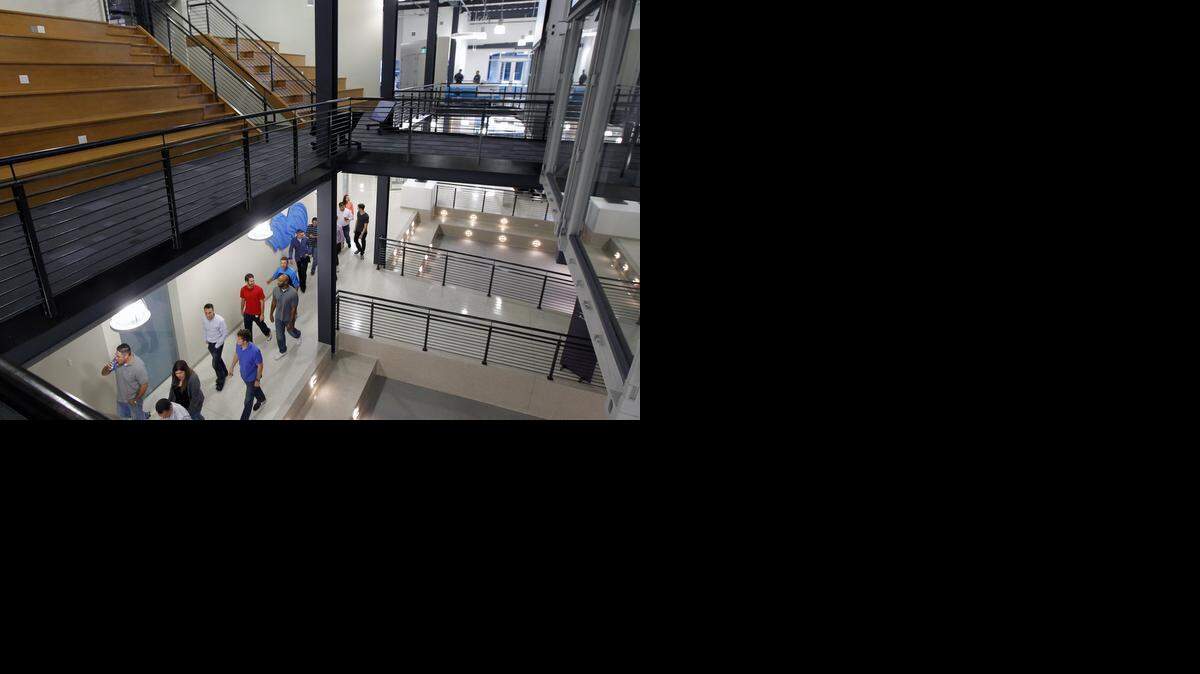
Citrix Systems’ sparkling new offices pay homage to the building’s industrial legacy with touches such as giant shipping containers transformed into meeting rooms. But many believe the official unveiling of the software company’s new digs on Thursday signals a bright future for the downtown Warehouse District.
The Warehouse District is nestled between the heart of downtown and Glenwood South, but the renaissance that has transformed those areas has, to a large degree, bypassed this one-time industrial zone.
However, the influx of 600 Citrix workers at the intersection of West and Hargett streets – including 20 new employees who started work just last week – is seen as triggering a wave of new development. An invitation-only ribbon-cutting ceremony, expected to feature Gov. Pat McCrory and Mayor Nancy McFarlane, is set for Thursday morning.
“Citrix is a big catalyst,” said Greg Hatem, a Raleigh real estate developer and restaurateur. “I think it is driving all the economics in that area.”
An influx of restaurants, bars and shops catering to Citrix employees is anticipated. An upswing in demand for office space also looms.
Hatem – who owns 10 properties in the vicinity, including the building that houses his barbecue restaurant, The Pit – said he is in talks with an out-of-state information technology company that is considering relocating 450 or more employees to the Warehouse District.
“Success breeds success,” he said.
Hatem also is developing plans to build a tower up to 30 stories high on the 1-acre vacant lot he owns at 600 W. Hargett Stt. The building Hatem envisions would include first-floor retail shops, topped by offices and residential space.
“We’re not doing feasibility studies,” he said. “We’re moving forward with design and so forth.”
Hatem and his company, Empire Properties, made its mark on downtown by acquiring and renovating vacant buildings.
But in December, Empire broke ground on the $16 million L Building, at West Davie and McDowell streets on the fringe of the Warehouse District, that is set to include 83 apartments and 10,000 square feet of ground-floor retail space. Hatem first committed to the L Building in 2007, but the recession scuttled his financing.
Indeed, the L Building’s saga is a reminder that while optimism springs eternal in real estate, reality sometimes gets in the way. During the recession, downtown Raleigh’s resurgence hit the pause button on several projects.
‘A revolution’
But Tom Darden, CEO of Raleigh’s Cherokee Investment Partners, sees a ready market for Hatem’s vision for a Warehouse District tower on Hargett Street.
“I think if he builds it, he’ll lease (it),” said Darden, who describes Citrix’s move into the district as “a revolution.”
Cherokee and its partner, The Crown Companies of Dobson, own the Citrix building and together have invested “many tens of millions of dollars” into transforming the former Dillon Supply warehouse to Citrix’s liking. They recently put the building up for sale, but Darden isn’t saying how much he expects it will fetch.
In the near future, Citrix employees will have a new travel option nearby that also is expected to enhance the area’s profile.
The $73 million Union Station train hub – which is being funded by a combination of federal, state and city dollars – is scheduled to begin construction in March at 510 W. Martin St. Union Station is expected to be ready for its own grand opening in 2017.
The transformation of the old Dillon Supply Viaduct building into Union Station also will feature restaurants, shops and a civic plaza.
“This is more than just a train station,” architect Steve Schuster said last month. “This is truly one of the next great public spaces for our downtown.”
The advent of Citrix is a tipping point, developmentwise, that will be accelerated by Union Station, said David King, CEO and general manager of the Triangle Transit Authority. Triangle Transit owns the Union Station property and hopes to someday operate commuter rail out of the station; it also is the previous owner of the Citrix site, which it sold for $3.28 million in the fall of 2012.
Citrix, a Florida company whose software enables a company’s employees to work from anywhere online, swaggered into the Triangle in 2011 when it acquired Raleigh startup ShareFile for $54 million.
‘Being near the action’
When the company’s fast-growing contingent of local employees necessitated finding more space, the company “made a decision early on that we wanted to move downtown instead of potentially being farther out from the city,” Jesse Lipson, who was founder and CEO of ShareFile and is now vice president of Citrix’s cloud documents business, said in an interview last month.
“Our employees were really excited about being near the action and being closer to where they ... liked to go after work,” Lipson said.
When Citrix chose to move downtown, it received commitments for state and local incentives worth more than $9 million. Those incentives contingent on meeting its five-year hiring targets – which the company already has blown past even though just 28 months have elapsed. However, those incentives didn’t require Citrix to set up shop in the Warehouse District.
When Citrix was scouting locations, Lipson said, he saw the Warehouse District as a “fun, interesting, up-and-coming neighborhood with the Contemporary Art Museum and some good retail.”
Indeed, while the immediate vicinity surrounding Citrix has been mostly passed over until now, the southern end of the Warehouse District has been in revival mode in recent years.
“I really think the Contemporary Art Museum was the original anchor,” said Deborah Ross, general counsel of the Triangle Transit Authority and a former state representative. “Give a little credit to the pioneers. Give a little credit to Designbox and Raleigh Denim ... and Humble Pie and The Pit.”
Citrix might not have been attracted to the Warehouse District, she added, if such pioneers hadn’t been willing to take some risks.
Likewise, Ken Bowers, the city’s interim director of planning and development, views Citrix’s entry as building on the “smaller-scale” development that has been percolating in the Warehouse District.
“It’s an area with an enormous amount of character to it,” Bowers said. “So I think people are attracted to the fact that it looks a little different than the rest of downtown because of its industrial heritage.”
However, square footage isn’t abundant.
“The spaces over there are quirky,” said Raleigh real estate developer David Meeker. “There is space available – 2,000 square feet here, 4,000 square feet there. But there’s not a big (space) anywhere.”
The buildings are mostly no higher than two stories or three stories.
But, in Meeker’s opinion, the Warehouse District’s momentum can overcome that obstacle.
“I think people are starting to look at putting land together to build higher,” he said. “I think that will come pretty quickly.”
This story was originally published October 8, 2014 at 8:22 PM with the headline "Citrix Systems injects new blood into Raleigh's Warehouse District."