Why are so many people moving to southeast Durham? And can the county slow them down?
Residential development has exploded in Southeast Durham in recent years and elected officials at the county level are trying to figure out if there’s anything they can do to slow it down.
The number of residential units approved in the past two years — 3,625 — has exceeded the total from the entire decade before — 3,251, according to planning department data. More than 2,100 more units are pending approval.
At least that was as of Monday morning, when planners presented the data to the Durham County Board of Commissioners.
In split votes Monday night, the Durham City Council moved two new developments in the area, totaling 305 townhomes, into the approved column.
An attractive place to develop
Planning Director Sara Young said the Leesville Road area is an attractive location: close to downtown, Research Triangle Park and major highways.
“It’s a really well-situated and attractive location just from a real estate market perspective,” Young told the Durham County Board of Commissioners on Monday.
Beyond that, the city has made investments in water and sewer infrastructure that make development easier there.
Those improvements lead most developers in the area to petition the city for annexation as they craft their single-family and townhome neighborhoods, often leaving the county commissioners out of decision making.
Commissioner Nimasheena Burns acknowledged Durham needs housing.
“There has got to be a socially responsible way to do it,” Burns said. “So I do hope that some of our other colleagues on other bodies have been paying attention to this. I do hope that folks who are trying to move here are paying attention to this. Because we’re paying attention to it. And while we’re limited somewhat in what we can do, our voices are very loud.”
Little Lick Creek is impaired
Little Lick Creek, which flows through the Leesville Road area before pouring into Falls Lake, is on the state’s list of impaired water bodies.
City staff say the creek has high bacteria and nutrients levels and is not as clear as it should be.
Those fighting development have zeroed in on the turbidity of the water.
Pam Andrews and the group Preserve Rural Durham, who regularly attend public meetings to caution against development in the area, call the muddy water “tomato soup.”
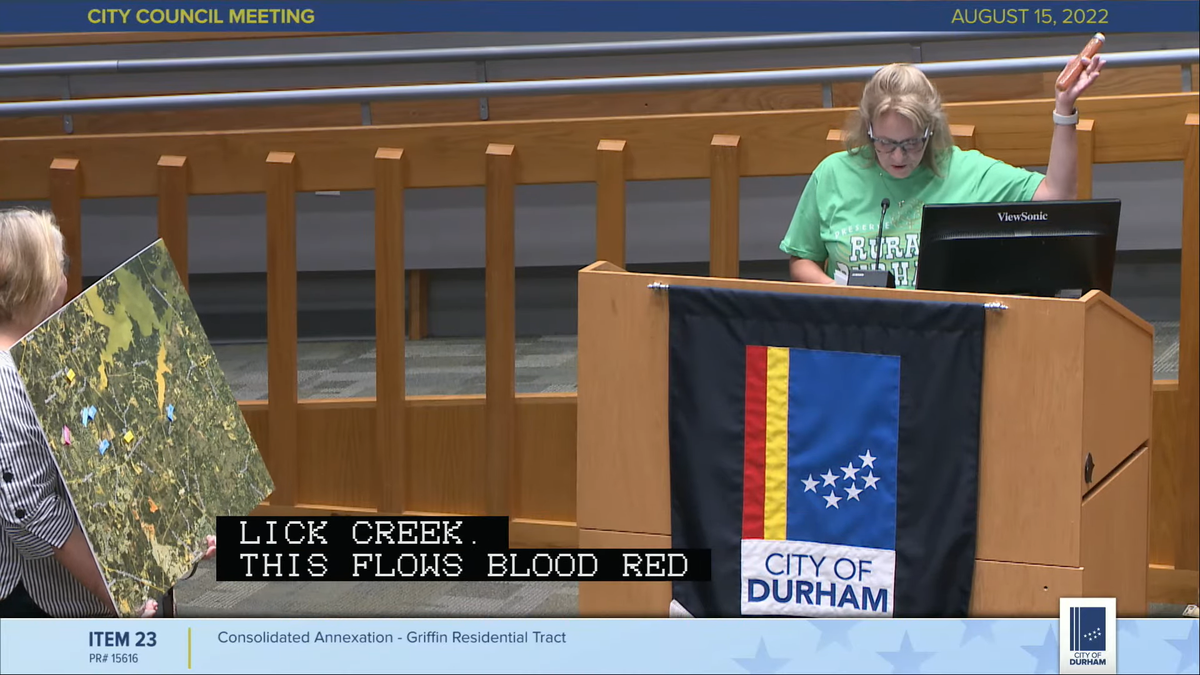
“We have well over 600 acres currently under development in this watershed with these Triassic soils that produce that red color,” said Ryan Eaves, who manages the county Stormwater and Erosion Control Division.
Eaves said with so much land under active construction, the basins can’t drain quickly between rain storms. Sediment in the water could potentially threaten plants and animals in the stream, he said.
“We certainly have concerns,” Eaves said. “At the same time, these are fairly small particles that will eventually drop out and settle into the stream bed over time.”
City stormwater staff say state turbidity standards are regularly exceeded in Little Lick Creek and other Durham streams, a problem that precedes recent development.
“Very fine clay particles will stay suspended in water for days,” a recent memo from the department stated.
The waterway received a “C” grade in the city’s annual water quality index for 2021 and 2020, an improvement over the “D” grades it received the previous three years.
What can the county do?
Young said it’s hard to regulate how fast a real estate market moves. She compared the boom in Southeast Durham to the one that occurred not far away when The Streets at Southpoint mall was built 20 years ago.
“Both areas were intended to develop at suburban densities. However, in Southwest Durham, it was much more gradual over a longer period of time. And what we’re seeing now in Southeast Durham, is just it’s really compressed in a short period of time,” Young said.
They do have some tools in the tool belt, however.
Planning staff are writing an amendment to the development code to limit how much land can be graded at one time. Grading clears and levels a site so it’s ready to build upon.
“It would basically tie how much land you grade with other requirements. It would increase tree preservation, and some other things that help to keep the land stabilized, and actually, honestly just provide better development overall,” Young said.
That matter will come to the Joint City-County Planning Committee on Nov. 30.

Commissioners Chair Brenda Howerton has pushed the JCCPC to give county officials more information about pending development on the City Council agenda.
Young said they will begin sharing commissioners’ written comments on annexations with council members considering developers’ petitions.
“I think it’s really important that our board also has a chance to weigh in after the Planning Commission, because they are the ones who are going to look at this in detail,” Vice-Chair Wendy Jacobs said.
There’s also the possibility Durham could strengthen its erosion-control ordinance. Any changes will have to be approved by the state Sedimentation Control Commission. The county’s on the agenda for Nov. 15. Full approval could happen as early as February.
The county could offer well-water testing for the 392 known wells in the watershed, at an estimated cost of $150,000. They cannot take enforcement actions based on the results.
“The environmental health folks want to make it clear that their sampling is only for informational purposes,” Eaves told commissioners.
Some developers use dynamite to clear the land, another source of complaints from residents. Young said the county could consider changing its blasting regulations.
“Other than issuing a permit and being able to revoke the permit for non-compliance, they are really limited in terms of their ability to regulate these companies,” Young said.
This story was originally published November 7, 2022 at 5:03 PM.