
Wake County is losing farmland. A Wendell property may show the path to saving some.
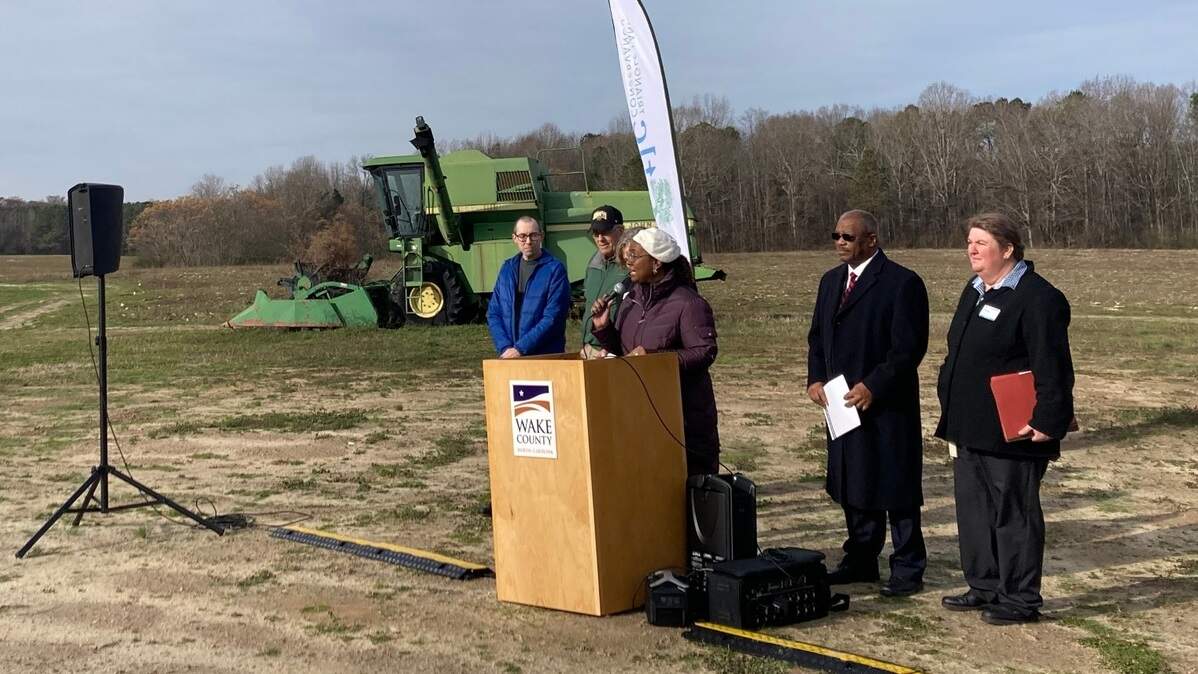
The first place Teresa Furr worked to conserve soil and protect water after being hired at Wake County was a Wendell farm, the same place Furr returned to on Friday to announce the farm’s permanent conservation.
Furr recalled working with the previous owner, Cedric Todd, to install diversions and grassed waterways to protect nearby Buffalo Creek over four months. Furr said Todd only took breaks when he saw her struggling to keep pace, only telling her near the end of the project that he was 88 years old.
“It was clear during our time together with Mr. Todd that he loved this farm and he loved this land. He took so much pride in protecting the natural resources on this farm, and he wanted all the others to enjoy it as well,” Furr said.
On Aug. 31, 2007, Furr wrote a note to Todd about farmland preservation. On Friday, Wake County officials announced that the farm is the first to be fully protected under the Wake County Soil and Water Conservation District’s Agricultural Conservation Easement Program.
That program was designed to help preserve farmland that may otherwise be developed. It allows landowners to retain and keep working on farms while restricting the land’s future uses to agriculture, forestry or horticulture.
“This agreement ensures that fields that are producing sweet potatoes here today will be used to nourish Wake County for generations to come. It also ensures that the woods that provide shelter to the native wildlife now will ring with birdsongs way after everyone’s forgotten what we’re talking about here today,” said Shinica Thomas, chair of the Wake County Board of Commissioners.
The Triangle Land Conservancy helped with technical aspects of the deal and will hold the conservation easement. Land Conservancy officials will check the land annually to make sure it is being used in accordance with the easement.
“Conservation easements are really the best tool we have for ensuring that family farms like this one can continue to sustain local food systems by growing zucchini, squash, sweet potatoes instead of just houses. We need them both,” said Sandy Sweitzer, the conservancy’s executive director.
Wake County farmland preservation
Between 2013 and 2022 in Wake County, 22,964 acres of farmland or forests were converted to another use.
In response, Wake County leaders developed a program that would create conservation easements using deferred tax payments. Farmland is eligible for tax breaks, but when it stops being farmland the landowner has to pay the current year plus three additional years taxes. The new Wake County program puts those tax payments in a fund that will be used to purchase easements that will conserve existing agricultural land.
Right now, that fund has nearly $3 million in it, Furr told The N&O.
“It’s kind of a good and bad situation. The good news is that we have the money. The bad news is there’s a lot of money and that means there’s a lot of land being taken out of production,” Furr said, noting that about $4 million in deferred tax payments are made annually.
Another eastern Wake County farm, Oaky Grove farm, will conserve 112 acres using the program’s funds. Furr said that agreement hasn’t closed yet because it includes state and federal funding in addition to the county program.
Furr said that 10 more landowners have applied to participate in the program. Wake County officials are asking for additional funds from the N.C. Agricultural Development and Farmland Preservation Trust Fund, as well as U.S. Department of Agriculture funding.
“They know how they worked to buy it and to farm it and to keep it. They want to make sure that they leave that legacy for their future generations, and so we have a lot of people that want to do that. As more land sells and more development happens and starts approaching, a lot of the farmers are starting to worry about it,” Furr said.
Wake County is providing about $1 million to purchase the Wendell easement, while James, Karen and Matthew Bailey, the property’s owners, donated the rest of the easement. That donation is estimated to have a value of about $1.5 million.
“We wanted to do what’s best for this farm. We wanted to see that wildlife was protected, plant life protected, forestry protected, soil protected,” James Bailey said.
Neighboring land owner support
From their neighboring property, Curt and Sally Phipps watched Cedric Todd work the Liles Road farm for generations, working well into his 80s.
“We always just knew that when he passed, this would be a housing development. How many other 125-acre places are there in Wake County?” Curt Phipps told The N&O.
The Phippses’ house is just across a small pond from the farm whose conservation was announced Friday. They also live on a farm, one that has been working land for more than 100 years.
And Curt and Sally Phipps were joyful Friday when asked about the land’s conservation.
“You won’t find anybody any happier about it than we are,” Curt Phipps said. Sally Phipps is happy the farm will stay in use and is also pleased there won’t be additional traffic on Liles Dean Road and Wendell Boulevard.
Curt Phipps added that he and Sally are “dead serious” about talking with Wake County officials to see if a conservation easement could work on their land.
This story was produced with financial support from the Hartfield Foundation and Green South Foundation, in partnership with Journalism Funding Partners, as part of an independent journalism fellowship program. The N&O maintains full editorial control of the work. If you would like to help support local journalism, please consider signing up for a digital subscription, which you can do here.
This story was originally published January 16, 2024 at 5:30 AM.