What is a restrictive covenant? And how are they used today in NC?
A Raleigh developer wants to build 12 four-story townhouses at 524 and 528 Barksdale Drive in east Raleigh’s Woodcrest subdivision.
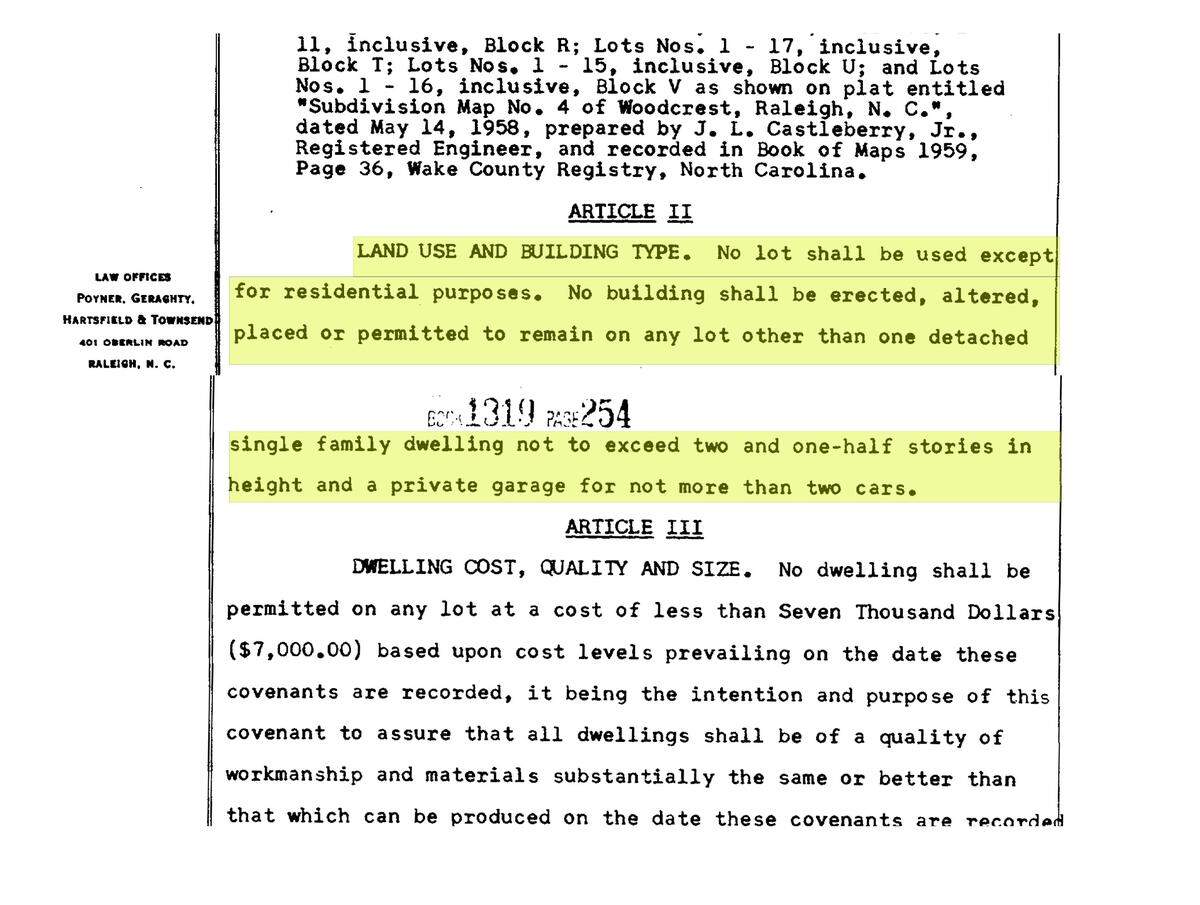
The city has approved the project but Steve Sypher, owner of Steve Sypher Designs, faces another hurdle: the subdivision’s 1958 covenant tied to his properties that restricts the land’s use to single-family homes.
To proceed, Sypher needs to get the clause removed. He’s now suing anyone whose property is subject to Woodcrest’s covenant, roughly 60 households spread across four streets — the latest in a string of lawsuits triggered by the city’s 2021 “missing middle” reforms.
But what exactly is a restrictive covenant? And how are they used in North Carolina today?
Here’s a two-minute guide:
What is a restrictive covenant?
In real estate, a restrictive covenant is a rule or condition placed on a property that outlines what homeowners can and cannot do with their land.
These covenants are legally binding and often found in deeds or leases. They’re enforced by homeowners’ associations (HOAs) and are intended to preserve property values.
Some communities have many restrictions, some have only a few and others have none at all.
Common restrictions include limits on what types of structures can be built, exterior colors, number of occupants, pet breeds, parking, business operations and property modifications.
What’s the history of restrictive covenants?
Restrictive covenants have a complex and sordid history.
From the 1920s to the 1960s, racially restrictive covenants became a common tool to prevent racial, ethnic and religious minorities from buying, leasing or occupying homes in certain areas. More often than not, covenants barred home sales to African American families.
The 1968 Fair Housing Act made them illegal.
Although deeds and mortgages today don’t contain racially discriminatory clauses, a historical search of a property’s chain of title may uncover restrictive covenants recorded from the 1920s to the 1960s (or even earlier).
Do restrictive covenants hold up today?
Restrictive covenants are still widely used. However, their purposes and applications have evolved.
The North Carolina Marketable Title Act, enacted in 1973, aims to clarify property titles and remove outdated restrictions that may interfere with future development.
In general, covenants that have not been preserved by re-recording within 30 years of their first application will be extinguished by the act, Andrew Atkins, an attorney with Raleigh law firm Smith Anderson, told The News & Observer.
But there is an exception for covenants applicable to a “uniform scheme of development” that restricts the property to “residential-use only.”
The case law surrounding exceptions is relatively new, he added, despite the law being in existence for over 50 years.
However, based on a 2022 ruling in the N.C. Supreme Court, it appears that exceptions will be “narrowly construed,” which will lead to redevelopment, he said.
“If that is not the desired result, it seems likely that there would need to be action by the General Assembly or, on the local level, the city council to limit development through zoning,” Atkins said.
This story was originally published September 18, 2024 at 5:00 AM.