Triangle office market 2025: Back from the bottom or a year of reckoning?
At 69, Woody Coley has lived through three commercial real estate busts, including the savings and loan crisis in the 1980s and early 1990s (where he “almost” lost his home) and the global financial crisis in 2008.
Heading into 2025, the college basketball star-turned-property developer is likely facing another moment of truth.
As senior vice president of development and investment at Texas-based Trammel Crow Co. (TCC), he’s the driving force behind downtown Raleigh’s new high-rise 400H, the swanky, 20-story, mixed-use tower at 400 Hillsborough St. delivered in mid-2023 and “built on spec” — with no tenant commitments.
Valued at around $200 million, it features 150,000 square feet of Class A office space, 242 luxury condos and 16,000 square feet of ground-floor retail space at the intersection of the Warehouse, Glenwood South and Capital districts.
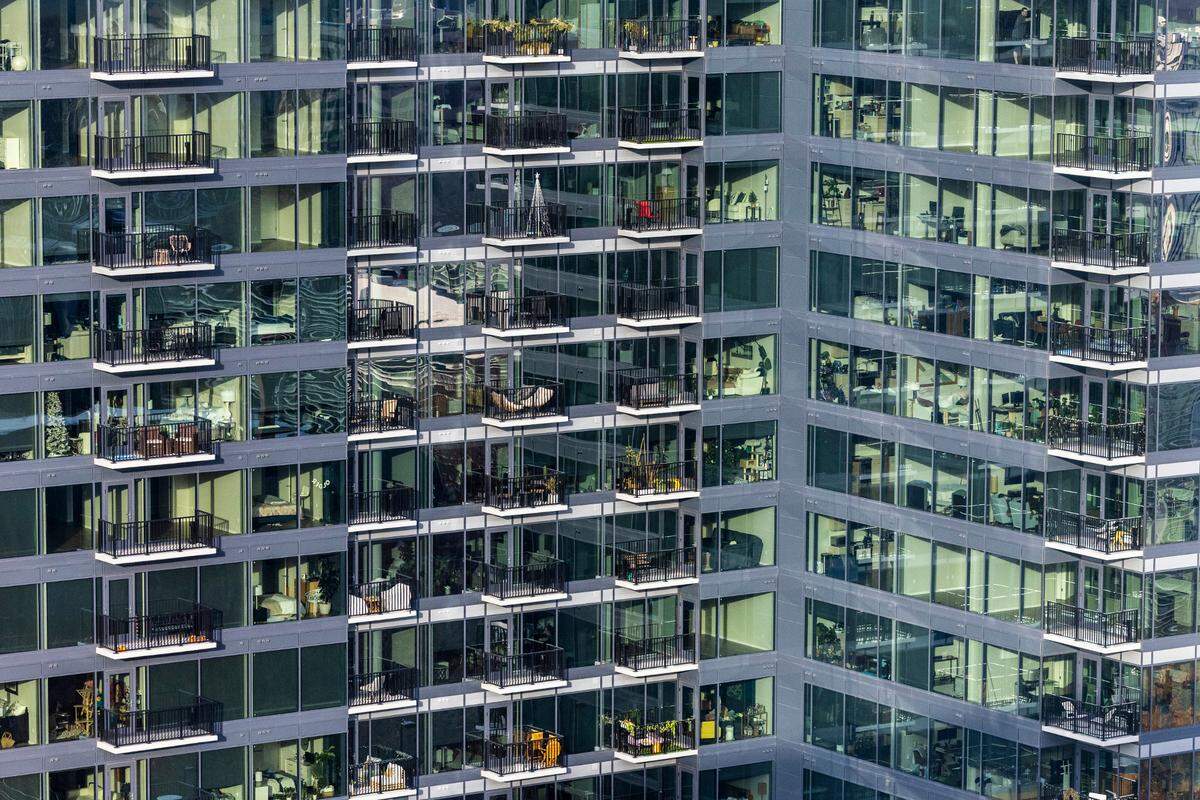
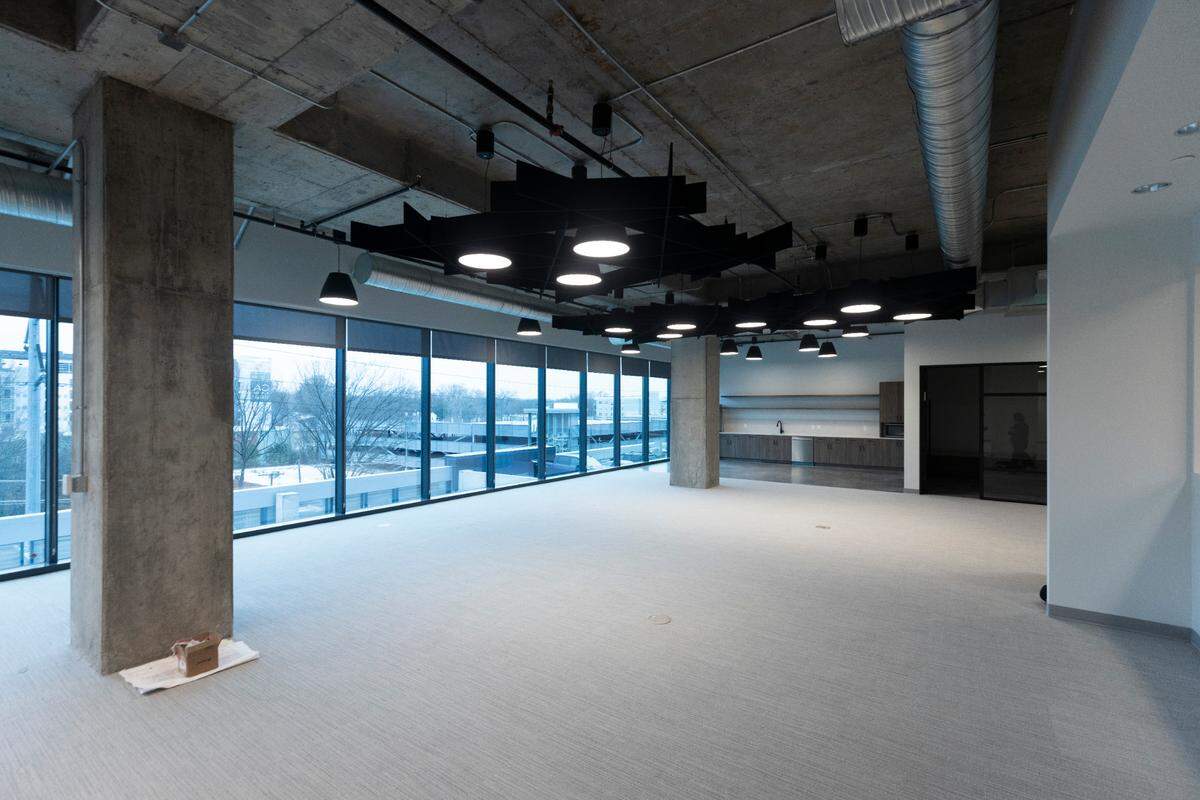
In recent months, he’s locked in a handful of office tenants. But the building’s office space is still only 10% leased, he said. (The retail and residential spaces have fared better. Press Coffee, Cocktail and Crepes and Brass Tap opened on the ground floor. The apartments are 90% leased.)
“We did the math before COVID-19, and it looked like it was going to be a shining star,” Coley recalled. Then, in March 2020, the pandemic hit. Coupled with higher interest rates and rising construction costs, “it was like a punch in the gut. The math changed. It was challenging to get it all finished.”
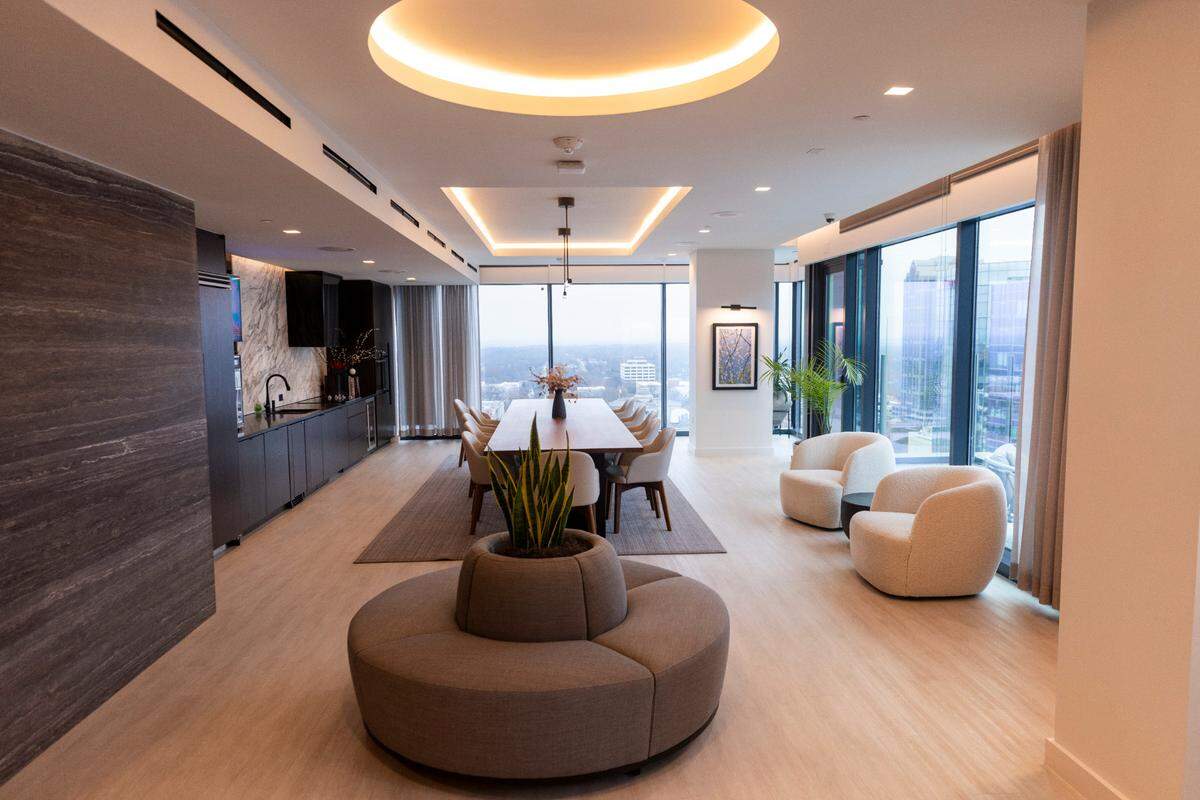
Despite headwinds, they refused to budge on quality, he said. On a recent Thursday morning, he offered a peek inside 400H, marveling at its high-end finishes — including a 90-foot hand-painted mural of North Carolina’s marshes in the lobby and a kinetic art installation that captures visitors’ motions as they walk by.
Coley acknowledges that investors — AECOM-Canyon Partners and HM Partners LLC — are “not where we thought we would be.” Nearly five years since the pandemic toppled in-person work routines, “office leasing has lagged,” he said. “New-to-market deals have dried up; in-market deals didn’t replace them.”
But they’re committed to their investments, even in the face of market uncertainties. “Raleigh is still a relative bargain,” Coley said, noting that out-of-state users from places like Chicago are used to paying $72 per square foot. In Raleigh, it’s more like “$45 per square foot,” he said. Around the corner, 301 Hillsborough St. is already 98% leased.
“We become the next obvious place,” he said. Residential income will serve as a buffer until office occupancy rates stabilize, he said. “Could it go on until 2030? Probably not.”
If Coley is worried about his prospects, he refuses to show it.
“I’ve done this three times in bad markets,” says the 6-foot-7 former UNC forward who played under legendary coach Dean Smith and co-captained the 1977 NCAA finals team before entering commercial real estate.
“You live with these highs and lows,” he said. “Our day is coming. We just have to stay the course. A big user could solve a lot in a hurry.”
One of many unfilled Triangle office buildings
400H’s plight underscores the real pain building in the U.S. commercial real estate sector, both in the Triangle and nationally. Plunging property values, high interest rates, the rise of hybrid work and weak tenant demand since the pandemic have pushed the nation’s office vacancy rates to a new record 20.4% in the fourth quarter — the highest since at least 1979, when Moody’s Analytics began tracking.
In the Triangle, it’s even higher at 21% — up from 20.6% in the previous quarter and from 18.9% a year ago, according to CBRE’s 2024 fourth-quarter market report, beating out records set in 1986 and 1991.
Across all corners, office buildings, new and old, are sitting empty.
Roxboro at Venable in Durham, delivered in 2022, has no tenants. Raleigh Iron Works is 60% occupied. 1000 SOCIAL at The Exchange is 56% occupied. Tower 5 at the North Hills Innovation District in Midtown Raleigh is 17% occupied. Meanwhile, Smoky Hollow in Glenwood South has some 93,000 square feet of space still waiting to be claimed, according to its website.
Other prominent buildings — if slightly older — are also vacant. The entire IQVIA tower, just off Interstate 40, has been up for sublease since early 2023. Citrix’s former headquarters in Raleigh’s Warehouse District has been up for direct lease since 2023.
Around mid 2024, Raleigh-Durham had some 12.7 million square feet of office space sitting empty, equating to $380.5 million in lost rent per year, Switch On Business calculated. The online business publication compared occupancy rates against market rates from Cushman & Wakefield’s 2024 MarketBeat first-quarter report. Charlotte’s losses were even higher at $462.1 million. New York City had the highest value of vacant office space equating to $7.61 billion in lost rent per year.
Until now, the motto has been “Survive until 2025” for commercial landlords. But as the losses mount, fears are rising that a long-awaited reckoning could finally be upon us.
More than $1 trillion in commercial real estate loans are expected to come due over the next two years. Economists warn that “extend-and-pretend” practices — used during economic downturns like the 2008 financial crisis where lenders extend the majority of a loan to avoid recognizing a loss — have concealed credit losses.
About 14% of all commercial real estate loans and 44% of office loans are currently in “negative equity” or underwater — meaning properties are worth less than the debt behind them — estimates the National Bureau of Economic Research. If interest rates remain elevated and property values don’t recover, default rates could potentially “reach or exceed levels” seen during the Great Recession, researchers said.
It’s too early to know the true extent of the crisis, but it’s unlikely the Triangle will be spared, said Sarah Dickerson, research economist at UNC’s Kenan Institute of Private Enterprise.
“Smaller and mid-sized banks are especially vulnerable,” she said. “We may encounter higher foreclosure rates, job losses and an oversupply of commercial properties.” On the plus side: “We’re ultimately better positioned than many other cities in the U.S.” because of the Triangle’s ability to “attract and retain” top talent, she said.
Investors like Josh Dix, principal of TCC Raleigh, have downplayed the threat of a ”full-blown financial crisis.”
“It’s easy to claim that the sky is falling,” he said. “We don’t believe that to be the case. We’ve encountered headwinds before.. We’ll do so again. The macroeconomic factors that led us to first believe in Raleigh’s office market have not changed.”
As a secondary market, the Triangle has also been insulated from “the drastic ups and downs” seen across the country, said Kathy Gigac, managing director of Avison Young’s Raleigh-Durham office. “We anticipate the market will see a rebound to ‘normalcy.’”
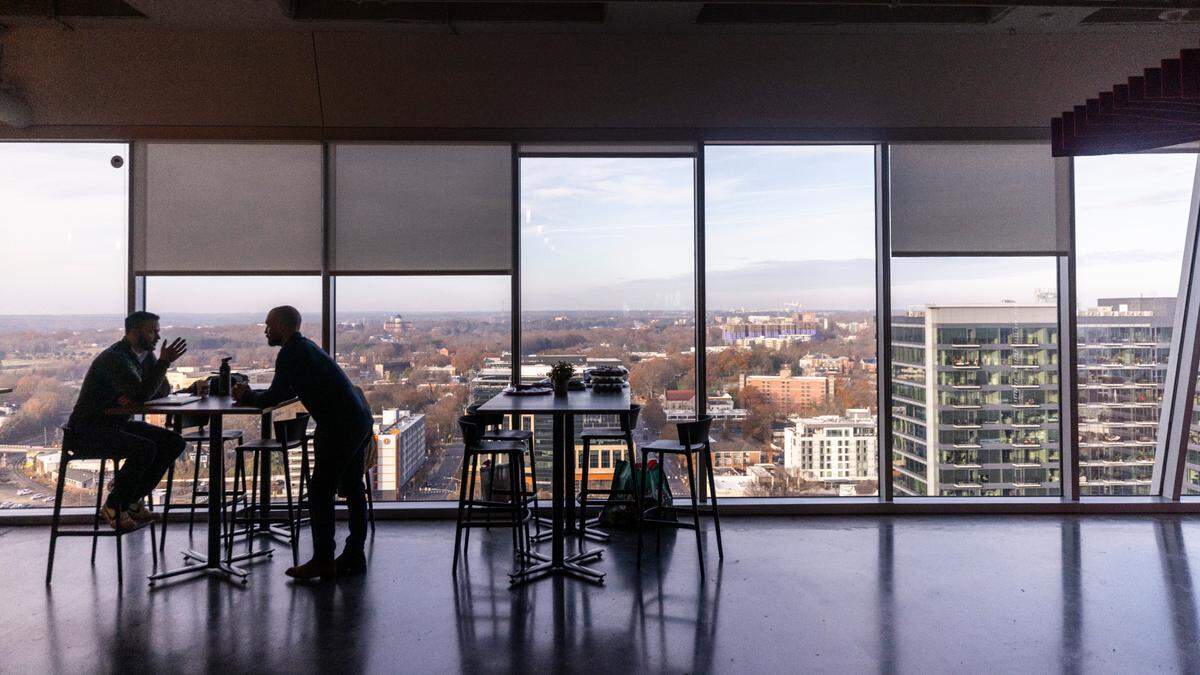
Has Triangle office market bottomed out?
With the Trump administration now in place, the industry is closely watching how policy shifts could impact taxation, capital markets and property valuations. The president’s “return-to-office” push may also boost demand, some say.
About one-fifth of the region’s inventory — some 11.8 million square feet of space — is currently empty, according to CBRE’s latest estimates. That’s roughly the equivalent of 205 football fields, including the end zones.
A large portion includes “best-in-class” properties, like 400H. Vacancies in this class, the top 10% of the market, jumped to 37%, CBRE found, compared to Class A (24%) as the region’s construction pipeline emptied. Deliveries included Horseshoe at Hub RTP and Tower 5 at the North Hills Innovation District in Midtown Raleigh.
As companies continue to reevaluate their needs, analysts say the predominant trend continues to be tenants shrinking their footprints upon renewal or relocation. But “green shoots” have also emerged. Leasing is on the uptick. Net absorption (the change in physically occupied space within a given period of time) totaled 52,211 square feet in the fourth quarter, marking the first period of positive demand for the year, CBRE said.
And for the first time since 2011, the region’s construction pipeline is empty.
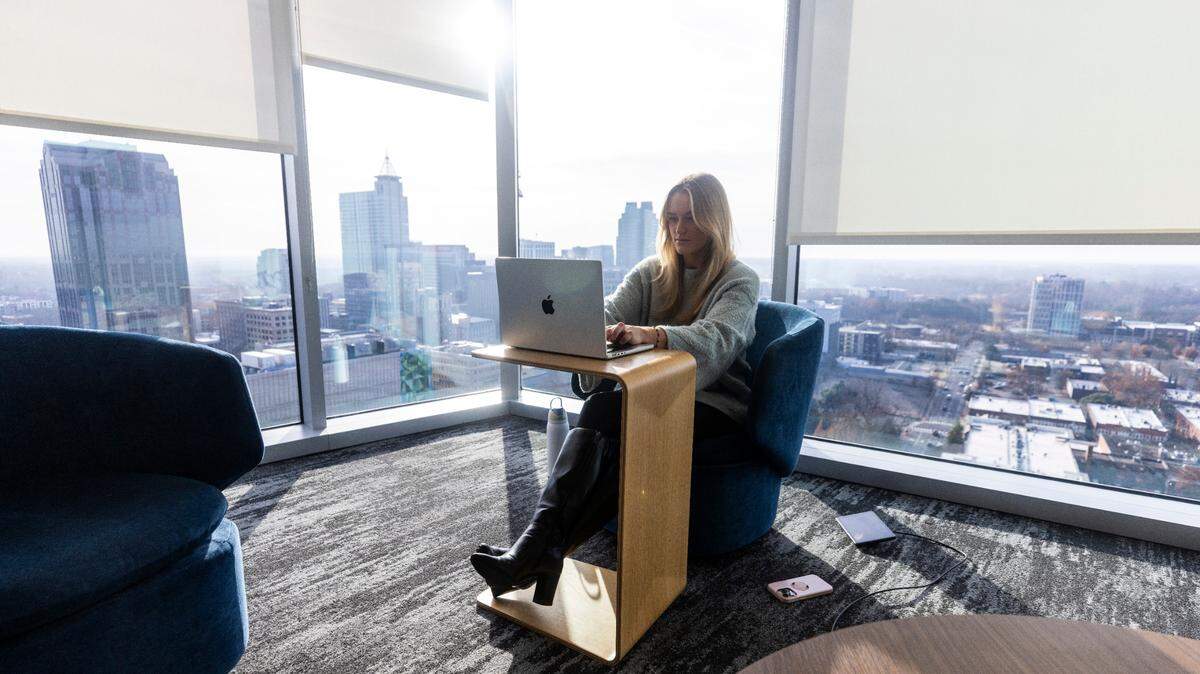
These shifting dynamics likely mark “the bottom” of the market, said Elizabeth Gates, a CBRE Raleigh senior analyst. “In terms of leasing activity and tenants in the market with active requirements, we’ve already turned the corner,” she said.
Take, for example, downtown Raleigh’s Fayetteville Street corridor. Law firm Smith Anderson recently renewed and expanded its long-term lease in space formerly occupied by City Club Raleigh at 150 Fayetteville Street. In the RTP/I-40 Corridor, the Federal Emergency Management Agency signed a short-term lease for Danbury Hall. Durham Tech also signed a lease at 41 Moore Drive.
“With no new supply slated in the near term and demand expected to increase, fundamentals should begin to improve in 2025,” Gates said. “Vacancy for top-tier buildings is expected to fall rapidly, with competition for space likely to become fierce by 2026.”
Meanwhile, momentum is building for in-person work. In recent weeks, large companies like Amazon have mandated in-person work five days per week. Local software companies, like Pendo, have also given the nudge. Along with Tuesdays and Wednesdays, staff were told to pick a third day, “at their individual discretion.”
“More and more startups will be created who focus on in-person collaboration,” said Todd Olson, Pendo’s founder. “We’re already seeing that for AI companies in San Francisco that’s shifting the narrative back to in-person.”

Amid a “flight to amenities,” investors are prioritizing Class A properties. “Asking rents for Class A and trophy product have remained steady or slightly increased due to the cost of tenant improvements,” said Arnold Siegmund, principal of office leasing in Avison Young’s Raleigh-Durham office. The market’s “bread and butter” of smaller leases (10,000 to 15,000 square feet) will continue to drive office leasing this year, he added.
A reckoning is still on the cards
That doesn’t mean the pain is anywhere near over for investors or landlords. In a bifurcated market, the region’s landscape remains split between newer, amenity-rich buildings attracting the lion’s share of demand and older suburban properties at risk of becoming obsolete.
While Class A buildings have likely bottomed out, analysts warn Class B and Class C properties, underutilized and decades-old, still have room to drop.
And distressed sales have been cropping up.
In December, Raleigh investor Andy English, with his Perkins Fund, purchased a 160,000-square-foot building in West Raleigh for $6 million, Triangle Business Journal reported. Just five years earlier, the previous owner, Atlanta-based Bridge Commercial Real Estate, paid $33 million for the building — an 80% drop in price.
And last June, Atlanta-based Bridge Commercial Real Estate sold a pair of Class A office buildings on Falls of Neuse Road for $12.25 million combined, TBJ reported. That’s more than $17 million below what they paid in 2020 when the combined price was nearly $30 million.
Increasingly, developers are also pushing to tear down buildings for housing. In Cary, Raleigh-based Highwoods Properties has proposed rezoning the three-story, 79,434-square-foot office building, also known as Highwoods Center, at 7001 Weston Parkway, to make way for townhomes.
“The market has changed,” said Skip Hill, senior vice president and Raleigh market lead for Highwoods. In today’s environment, office buildings without walkable amenities are “becoming extinct,” he said.
These deals could just be the start of the tipping point, said Eric Maribojoc, a UNC professor and associate director of the Wood Center for Real Estate Studies. While certain pockets are doing better than others, market conditions will remain “depressed,” he said. “The occupancy isn’t coming back. As banks come to grips with the changes in valuation, we’re going to see [more distressed sales] in 2025 and 2026,” he said.
Doubling down and staying bullish
Despite these headwinds, some investors are doubling down.
Since early 2022, Roxboro at Venable Center has sat empty at 380 East Pettigrew St. in Durham. The eight-story office building offers 202,000-square-feet of Class A space and is estimated to be worth $37 million, according to Durham tax records. In recent months, Trinity Capital Advisors and SLI Capital have invested another $8 million to build a range of speculative lab suites in a bid to attract life science companies. Overall vacancy rate for biotech space is significantly lower than traditional office space at around 15.3%, CBRE found.
It’s expected to be available this summer.
SLI’s Bryan Kane remains bullish. “Roxboro will benefit from the ‘flight to quality’ in office we’ve already seen in Raleigh and other markets nationally,” he told The N&O this week.
CBRE executive vice president Brad Corsmeier, the property’s leasing agent, said speculative suites will “broaden our tenant pool.”
“Hopefully, it changes the whole trajectory of things,” he said. At the same time, he’s also realistic. The market “isn’t going to turn on a dime,” he said.
This story was originally published February 6, 2025 at 5:00 AM.