New coronavirus cases surge across North Carolina, as many people work from home
Health officials announced new cases of coronavirus across North Carolina on Wednesday as the virus continues to spread despite the closure of schools, offices, restaurants, bars, and some hotels and retail stores.
Some residents have retreated to their homes, while others work and shop despite the risk.
As of Thursday morning, North Carolina has 116 known cases of the illness, including 16 new cases in Durham County; five new cases in Wake County, bringing the county total to 22; and 16 new cases in Mecklenburg County that bring the total there to 30.
Buncombe County announced its first case of the virus. County health officials said the person is in isolation in Macon County. Lincoln, Hoke, Moore, Union and New Hanover counties also announced their first cases, and Watauga County reported its second case.
The Moore County case involves a Southern Pines Women’s Health Center obstetrician and gynecologist who had traveled to Germany, according to The Pilot. Dr. John Byron, who is in quarantine, last saw patients on March 13 and started to have symptoms Tuesday, The Pilot reported.
“We believe that Dr. Byron would have been in an early incubation period and less likely to be infectious during contact with patients and staff,” Dr. Paul Jawanda, an infectious disease expert with FirstHealth, told The Pilot.
The state announced its first known case of the virus on March 3. The virus has now been found in 23 of the state’s 100 counties.
With the spread of the illness picking up speed, state and federal officials have reached out to the N.C. Baptists on Mission to ask for help in case it’s necessary to set up kitchens to help feed people who are isolated by the coronavirus or whose source of food has been interrupted.
The Baptist group is a Cary-based non-profit disaster-relief agency that has responded to natural calamities across the country and around the world. It draws on thousands of volunteers from throughout the United States and can set up mass-feeding operations on short notice.
“Does your church have a kitchen? Can your church help in other ways?” the group asked on its website. The virus “has the potential to touch every community in the country,” the notice said. ”The CDC and Emergency Management have reached out to us to prepare to help in providing for the needs of those who are isolated, sick with the virus, or whose lives have been severely impacted by the closing of schools and businesses.
“This is not a call to action, but a call to plan and prepare,” the organization said.
The state has set up a new information line for people who need assistance or have questions about coronavirus, called NC 2-1-1. Mike Sprayberry, the state’s director of emergency management, said, “People with questions about COVID-19 can dial 2-1-1 and based on the nature of their question, they will be routed appropriately for an answer. 2-1-1 can help people with needs like food assistance support for families and other basic needs.”
On Wednesday, UNC Health hospitals and some other clinics in the state began using a test for COVID-19 developed by scientists at UNC after receiving federal approval. The test will expand the state’s capacity to diagnose the illness.
Increased restrictions, triage centers
North Carolina has been under increasing restrictions in the hope that social distancing will slow the spread of the illness and prevent a sudden spike of cases, especially severe cases that would require hospital care. So far, health officials say most of those diagnosed with the infection have been able to recuperate at home.
At least two Triangle hospitals — UNC and Duke — have begun to set up triage centers outside their main facilities to handle an influx of patients if the illness begins to spread more quickly and cases become more severe.
Dr. Joseph Rogers, chief medical officer at Duke Health Systems said in an interview this week with The News & Observer that potential coronavirus cases are “going to put an incredible strain on the health care delivery system” that’s already operating at nearly full capacity. He reinforced calls for personal actions such as social distancing to reduce the virus’ spread.
North Carolina hospitals don’t have enough beds to care for the severe cases that could stress the health care system as infection spreads, a Harvard University analysis has found. At an infection rate of 20%, Wake County would need twice as many hospital beds in six months as are available according to the analysis by the Harvard Global Health Institute and the Harvard T.H. Chan School of Public Health.
ProPublica and The New York Times were the first to report the study.
The U.S. Centers for Disease Control and Prevention has said those most at risk of severe symptoms with COVID-19, the illness caused by the novel coronavirus, are people over age 65 and those who have existing health issues such as lung or heart disease, diabetes or weakened immune systems.
On the website for the N.C. State Parks, an invitation to apply for seasonal jobs such as lifeguarding has been superseded by an announcement that all park offices, visitor centers, picnic shelters and overnight accommodations have been closed. The website said those with reservations would be contacted later.
The parks’ trails, restrooms and parking lots remained open Wednesday, but the website encouraged visitors to use the restroom at home before coming to the park to avoid having to wait in line. It also told visitors not to pose for group pictures that would violate social-distancing recommendations, not to use other people’s cameras to take pictures of them and — especially hard for some park users — not to pet other people’s dogs they meet while out for a hike.
Drive-through, takeout and delivery
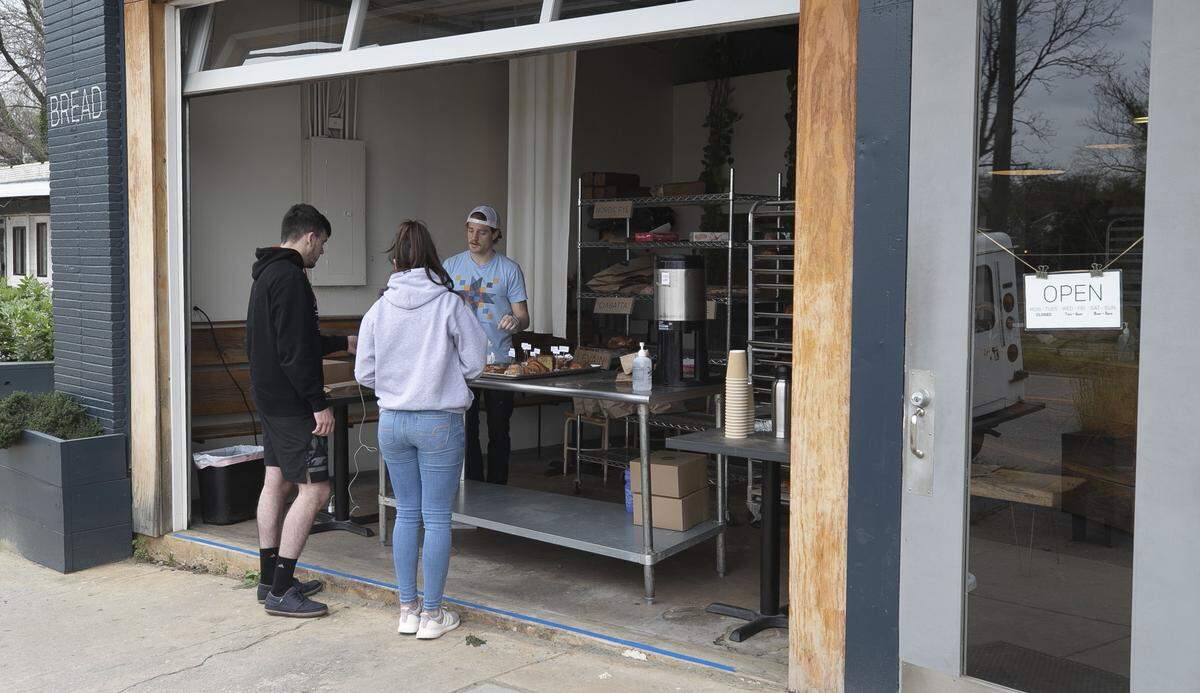
Residents began the first full day Wednesday under an order by Gov. Roy Cooper that closed all bars and restaurant dining rooms Tuesday at 5 p.m. Restaurants still are allowed to provide drive-through, takeout and delivery services.
Some hotels in the Triangle are also starting to close, including local resorts The Umstead in Cary and Fearrington House Inn in Pittsboro. Most hotels, though, remain open, including boutique hotels like the Carolina Inn, the Franklin, The Durham, Longleaf Hotel and the Unscripted. Occupancy, though, has dropped dramatically.
Jay Patel, who owns Hampton Inns in Johnston County off of Interstate 95 and in Robeson County, said traffic from travelers can’t be counted on right now.
“The occupancy is really volatile,” Patel said. “We can’t forecast how many guests we’ll have. We have to manage day by day. We’re implementing enhanced cleaning methods.”
Many local governments have closed their offices and canceled public meetings but continue to do business. State employees who can work from home have been asked to clear out of their offices.
A visitor ban imposed on Dare County’s Outer Banks on Tuesday has spread to neighboring Hyde County, to take effect Thursday at 5 a.m., according to a county press release. Neither county is under an evacuation order, meaning visitors already there can stay. The restriction does not apply to workers, permanent residents, property owners or vendors, who will be allowed through checkpoints with entry passes.
While the restriction should help limit the risk of exposure for residents of Ocracoke Island, off the Hyde County mainland, it comes at a difficult time for the community, much of which was inundated with water as a result of Hurricane Dorian. Islanders who rely on tourism have been looking forward to the return of visitors and have worked for months to rebuild hotels and rental properties, restaurants and other amenities.
Buncombe County health officials are screening and testing for COVID-19 at two drive-through sites for people who have fever combined with a cough or shortness of breath, or have been in close contact with someone who has those symptoms. The county is holding the drive-through clinics at a church in Arden, just outside Asheville, and in a parking lot on the UNC-Asheville campus. The county asked people not to come to the testing site if they don’t have a reason to be tested.
Tests will be done as long as the equipment is available, the county said, and anyone who needs to be tested will be, regardless of whether they can afford to pay.
“This is an unprecedented public health event in our community and it will take all of us working together to stop the spread of COVID-19,” a note on the county’s health department website said.
Cone Health in Greensboro also is conducting drive-through coronavirus testing. The health system said no one would be tested without an order from a doctor. Mecklenburg County also has drive-through testing.
Staff writers Drew Jackson, Lynn Bonner and Lucille Sherman contributed to this report.
This story was originally published March 18, 2020 at 11:12 AM.