Coronavirus fuels calls from Triangle renters for freezes on evictions and rents
As workers face unemployment and reduced income from COVID-19’s economic toll, Triangle renters are calling on local and state governments to help them keep their housing.
To help slow the spread of coronavirus, State Supreme Court Chief Justice Cheri Beasley placed a 30-day suspension this week on courthouse activity across North Carolina, including eviction and foreclosure hearings.
Advocacy organizations say this isn’t enough. They’re asking for stronger concessions for cost-burdened renters, such as a state-sanctioned moratorium on evictions, utility shut-offs and rent increases until year’s end.
NC United for Survival and Beyond, a coalition of over 60 social advocacy groups and nonprofits, has called for lawmakers to consider a number of additional measures aimed at vulnerable populations during the pandemic, The News & Observe reported this week.
“In the middle of this pandemic, no one should be homeless, and in a program that’s provided for homeless people and low income and disadvantaged people,” said Barbara Lyons, in a online press conference.
Lyons, a Durham public housing resident who has experienced eviction, expressed concern for future evictions in the McDougald Terrace public housing complex and criticized the Durham Housing Authority for continuing existing eviction proceedings.
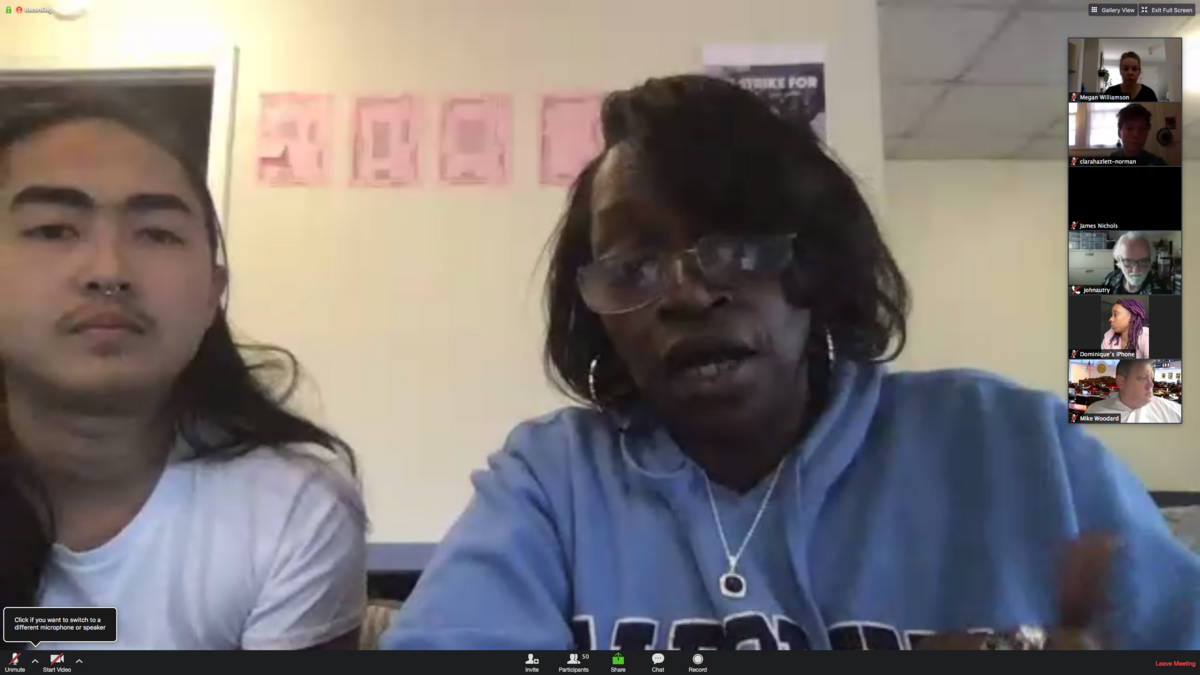
“No one should have to be on the street. And how dare they padlock or put someone on the street when no one’s supposed to be on the street at this point?” she said.
The DHA had announced that no evictions will be filed for the remainder of March on their website.
“DHA recognizes that many of our working residents will see a drop in income because of closings, layoffs or lost hours due to school closures,” they said in a statement.
But no actual evictions in DHA public housing will move forward for “the foreseeable future,” said Carl Newman, General Counsel of the DHA, in an updated statement. Nonpayment complaints for tenants from February went to small claims court will not move to evictions either, said Carl Newman, General Counsel of the DHA.
DHA residents still received 14-day nonpayment notices after late rent on Mar. 9, but the complaints won’t move forward.
Lyons said NC Central University law professor Scott Holmes told her about one of his clients receiving an eviction notice from the DHA. Holmes posted about it on Facebook, writing that he hoped landlords could reconsider the “humanity of their actions.”
Renters in the Triangle were already hustling to meet high rents before the virus’ impacts. Real estate data firm RealPage Inc. reported that the Raleigh and Durham metro areas had the nation’s sixth-highest rate of growth in rents in 2019.
According to the Harvard Joint Center for Housing Studies, the Durham metro had more severely cost-burdened renter households than Raleigh did, defined as renters spending more than half their income on housing.
The rental industry’s response
But landlords and property managers have to pay bills, too, says the Triangle Apartment Association.
The state’s temporary hold on new eviction filings and any moratorium demands should come with emergency rental assistance for tenants, the group said. Large and small property managers will not be able to make mortgage, utility and tax payments as a result, putting them and their employees out of work, the group said.
“This is about keeping renters in their homes and keeping them healthy and safe and happy,” said Dustin Engelken, the Triangle Apartment Association’s government affairs director.
Engelken said the association is in talks with local governments about streamlining rental assistance programs as the pandemic continues to prevent straining the rental industry.
In Charlotte, Mecklenburg County Sheriff Garry McFadden called on courts to halt 75 ongoing evictions to avoid adding to the city’s homelessness problem, he said this week.
More than 16,500 Wake County households faced a possible eviction in 2019, according to the North Carolina Housing Coalition, while more than 460 families faced a possible foreclosure, the N&O reported previously.
The Wake County Sheriff’s office told The N&O it would follow the courthouse restrictions on new eviction filings but did not comment on halting ongoing evictions in the county.
“There’s been a lot of back and forth,” the Durham County Sheriff’s Office said in a statement on evictions. “We’re consulting with the N.C. Sheriffs Association legal team, with the judiciary and the public health department. But we haven’t been able to get a clear answer as to what we should do at this point.”
EDITOR’S NOTE: An earlier version of this story incorrectly stated the nature of previous eviction filings in residences of the Durham Housing Authority. No evictions will move forward for residents.
This story was originally published March 20, 2020 at 2:51 PM.