This NC basketball team was one win away from a perfect state championship season. Then everything changed.
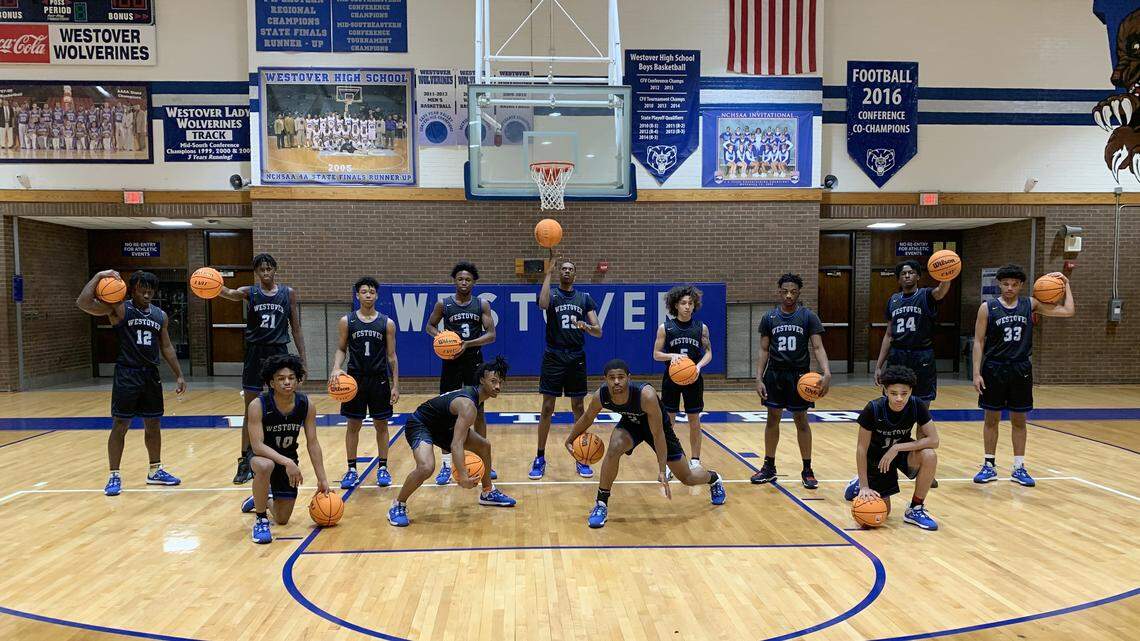
Before everything changed, in the not-so-distant past when tomorrow still seemed as much of a guarantee as yesterday, a group of teenagers celebrated a playoff victory. The boys basketball team at Westover High, on the western edge of Fayetteville, had won its 30th consecutive game.
“We were all going crazy,” D’Marco Dunn, a junior, said of the scene afterward.
Few teams in North Carolina high school basketball history had ever achieved a 30-0 record but there the Wolverines were, and with one game yet to play. They were headed to the 3-A state championship at N.C. State’s Reynolds Coliseum.
“We were dream-chasing, basically,” said Isaiah Bridges, one of the team’s senior leaders.
Now Bridges has a difficult time falling asleep, he said during a phone interview Wednesday. The nights drag on. Before he closes his eyes and in those moments when he’s still drifting off, haunting thoughts of what could have been play in a loop his head.
In fewer than two weeks, the COVID-19 pandemic has upended life in America. The broader effects of the attempts to slow the spread of disease have become well-known. Throughout the country and in NC, restaurants and bars and other public spaces have been closed. City streets are quiet. School is out, indefinitely, and people have been urged to stay home.
Amid the larger changes are smaller ones that those affected feel more personally: the postponements of weddings; canceled birthday parties; family gatherings that don’t happen. And, in Fayetteville, a high school basketball team that never had its chance to play for a state championship, despite winning every game it played.
“All we needed was two more days, you know?” Dunn, Westover’s leading scorer, said Wednesday.
Such was the cruelty for Westover and the other 15 boys and girls teams that reached NC’s state championship basketball games: they’d come so far, to the brink of a moment they’d sought for months, and sometimes longer, only to be denied by cold fate.
In North Carolina, those state championship games — four games for each of four classifications, for both boys and girls — were to be played on March 14, a Saturday. By the morning of March 12, the games were in doubt.
By then, the NBA had postponed its season. College basketball conference tournaments around the country were about to be postponed. In Fayetteville, a group of high school players tried to remain hopeful while a sense of inevitability began to settle in: “If they do this to the NBA, what are they going to do to us?” Dunn recalled thinking.
George Stackhouse, Westover’s head coach for 12 years, found himself in the unenviable position of breaking the news to his team. Like a lot of things related to the pandemic, though, that news changed often. First it was that the state championship game would go on, but with limited attendance. Then it was that each player could bring only two people.
And then, finally, it was off.
“I told them, let’s focus on the blessings that we had this season, and how great a season it was,” Stackhouse said during a phone interview this week. “It was special.”
He didn’t see any tears, he said. Around the room, though, Dunn said he could look into his teammates’ eyes and understand their thoughts.
“Real emotional,” he said.
Suspended in time
In a technical sense, the championship games have only been postponed. The NC High School Athletic Association has not officially canceled them. Stackhouse, though, doesn’t see how or when they can be played — not with public schools closed until at least May 15, and not with players without any place, or opportunity, to practice in the meantime.
“They want us to kind of stay put,” Stackhouse said, referencing the social-distancing guidelines amid the pandemic. “And I agree with that. So I just don’t know if it’s going to be practical to come back after such a long lay-off” and play a championship game.
He and his players, then, are proceeding as if their season is over, which it most likely is. Without school to attend, at least in the physical sense, Stackhouse’s players are trying to find structure in a world that suddenly lacks it. Stackhouse, meanwhile, said he has kept busy seeking opportunities for seniors he hopes might still be able to play in college.
Bridges, the Westover point guard, is one such senior. His teammates call him “Ike,” or “Chicago,” which is where he’s from. He arrived in North Carolina before his junior year, when he followed his older brother to Fayetteville. The brothers lived together until C.J. Bridges, who is in the Army and based out of Fort Bragg, was deployed to Afghanistan.
Before Westover’s most recent game, a victory against Northwood High in the state semifinals, Isaiah Bridges went through the player introductions with his teammates. Then, moments before tip-off, came a surprise: his brother, wearing his military uniform, was back from Afghanistan. The two shared a lengthy embrace, and then the younger Bridges helped Westover to victory.
Afterward, C.J. Bridges told the Fayetteville Observer that he wanted Isaiah “to end his high school career on the note that he wants.” Now the younger Bridges thinks he has played his final high school game. With his brother in the military, Isaiah Bridges already owned a perspective more mature than some of his peers. The abrupt end of his senior season brought lessons, too.
“We weren’t the only seniors that got that moment snatched from us,” he said. “There were a bunch. ... Take every practice like it could be your last. Take every game like it could be your last. Take every day like it could be your last. Because it really could be.”
Two weeks ago, the Wolverines learned that was true.
Before, amid those 30 consecutive victories, routines could be taken for granted: classes, practices, games. Repeat. Stackhouse, 50, who has been a basketball coach for nearly all of his adult life, has tried to use the past two weeks as another teachable moment, something his players can carry with them. Basketball is full of those things, anyway, he said.
At Westover, especially, the game can deliver meaningful structure for students who come from challenging backgrounds. Nearly half the school’s incoming students are what the state describes as “economically disadvantaged,” according to NC Department of Public Instruction data. Only about one-in-five students enter the school academically proficient, according to the DPI.
“At our school and our community, our kids get a lot out of the game,” Stackhouse said. “The discipline of it. And we have high standards for our kids and our school and our athletic program. And I think it develops some ability to work together. ...
“We also talk about the importance of life after basketball -- doing things that would benefit your community, your brothers.”
Life after basketball
For those seniors who won’t play on an organized team again, life after basketball has already arrived. It has arrived, indefinitely, even for those who will continue on, if only because no one can be sure when things might feel normal again. Dunn, the junior shooting guard, has received scholarship offers from East Carolina and Vanderbilt, and most recently from Wichita State.
Ordinarily, the summer basketball camp and tournament circuit would allow him the chance to improve his college prospects. Now he’s not sure he’ll have such an opportunity. He said he’s been lifting weights at his uncle’s house and playing pick-up ball in a neighbor’s driveway. Bridges, meanwhile, had been hoping to talk more with smaller schools about opportunities, but that’s on hold, too.
Stackhouse isn’t sure when he’ll see his team back together again. He has been hoping that the NCHSAA would make it official and cancel the championship games. In Virginia, the teams that reached state championship games were named co-champions, and Stackhouse isn’t opposed to that idea. Either way, he’d prefer some finality.
“We would like to have some kind of closure, so we can kind of go back and celebrate what we’ve done and what we’ve accomplished,” he said. “Maybe we can get to that point here soon.”
Then he thought about it for a moment and wondered about how, in this new world, the Wolverines might be able to celebrate. They became the first boys’ basketball team since 2013 to finish a season undefeated, and the eighth in the past 30 years.
Yet they didn’t get a trophy, or even the chance to play for one. The season just ended.
“Right now, probably all we can do is have a Skype celebration,” Stackhouse said with a laugh.
When championship Saturday came and went, members of the 30-0 Westover High Wolverines were left to fill in the rest of their story. Some, like Bridges, already had it figured out: “Oh, I know we would have won,” he said. “Hands down. We would have won.”
Mostly, though, Bridges and his teammates were left to cope with the surreal reality of a long-awaited moment vanishing in thin air. They were left to make sense of an ending that reflected both the triviality of a game and its power to help them through these times.