To ease the move to online learning, Cengage offers free access to its platform
In an effort to help the sudden transition of most education in this country to online learning, the textbook publisher and educational software company Cengage, which has a large office in Raleigh, is offering free access to its digital learning platforms for those affected by COVID-19.
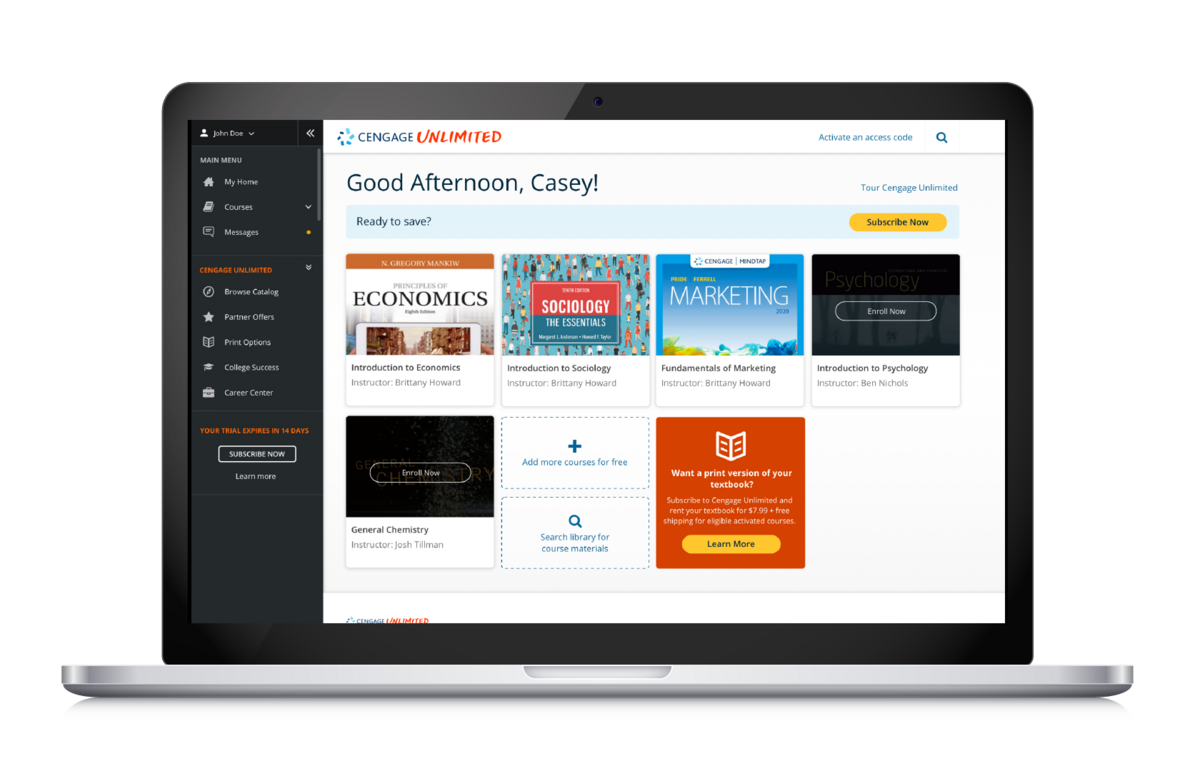
The Boston-headquartered company will give college students on campuses that have closed free access to e-books and its platforms, like Cengage Unlimited, which gives students the ability to use a variety of different educational resources and study tools.
And for faculty, the company is hosting free webinars on how to best lead online instruction.
Cengage says around 10 million higher-education students in the U.S. use some form of its services each year, many of them renting e-books from the company. That is about half of the nearly 20 million higher-education students in the U.S., according to the U.S. Department of Education.
More than two million students have bought subscriptions to Cengage Unlimited platform since it launched in 2018, the company said. That platform gives students access to more than 22,000 products, including e-books, online homework access codes and study guides for one price of $119.99 a semester.
The company expects to help an additional one million students across the country during the transition of most classrooms to online education. Already, in the first days of the company’s efforts in getting ready for the mass transition it has helped 25,000 students.
In North Carolina, the company says it supports faculty at more than 100 higher-education institutions, including UNC-Chapel Hill, East Carolina University and Central Piedmont Community College.
Cengage has had a significant presence in Raleigh since 2016, when the company acquired the N.C. State University spinoff WebAssign. WebAssign is an online grading and assessment tool used by millions of students, primarily in STEM subjects — science, technology, engineering and math.
Cengage absorbed WebAssign and kept its workforce on N.C. State’s Centennial Campus, where it now has about 160 employees. The company is waiting on the Department of Justice to make a ruling on its potential merger with publishing giant McGraw-Hill.

“Clearly this is an additional hit for us on revenue, above and beyond what we were already seeing from COVID-19,” Cengage CEO Michael Hansen said in an interview. “But we felt it was the right move for the country.”
Hansen said he thinks most colleges and professors are not prepared for this sudden transition.
“Most colleges are not actually prepared,” he said. “They were just not prepared to help students go online, and right now individual faculty members are struggling and they are our customers.”
The company is transitioning many of its employees into support and educational roles to help train teachers on Cengage’s online platforms. He added that it’s important to get this right, because students need to earn credits toward their graduations and not create massive disruptions to the summer and fall semesters.
Admittedly, Hansen said, he believes this is going to be a rough transition for many. For most students, he said, it will feel adequate at best, and only a few students will likely think it is great.
“We have a very good platform and content but the Achilles heel is we need to train people on it,” Hansen said. “Zoom is very intuitive. But the reality in higher-ed is that faculty have not spent the time and effort to make their courses user friendly.”
Hansen said it is still unclear what the ultimate impact from COVID-19 on Cengage’s business will be. Though, he noted it is going to be an incredible learning moment for the entire educational system.
“What we go by right now,” he said, “is if you do right by your customers, particularly during a time of crisis you will be OK.”
This story was produced with financial support from a coalition of partners led by Innovate Raleigh as part of an independent journalism fellowship program. The N&O maintains full editorial control of the work. Learn more; go to bit.ly/newsinnovate