
Nine days in a COVID-19 coma gives this NC businessman a unique perspective
Like a lot of business owners, Linwood Sanders is happy to see North Carolina lifting the restrictions that shuttered businesses and ordered people to stay home to try to prevent the spread of coronavirus.
Ray’s Hair Center, the barbershop Sanders owns in Dunn, reopened last weekend after being closed more than two months. His other business, Quality Time Towing, is about back to normal, after revenue dropped by 50% as the banks, insurance companies and dealers he moves cars for curtailed their activities.
But Sanders’ hopefulness about economic recovery is tempered by hard-won caution about the contagious disease that nearly brought it all to a halt this spring.
Sanders became Johnston County’s first confirmed case of COVID-19 in the second week of March. He ended up spending 18 days in the hospital, including nine in an induced coma while a ventilator machine pumped oxygen into his lungs as his body fought off the infection.
Sanders, 49, is all but fully recovered. But he worries people might be rushing too fast to resume their normal lives, in part because they haven’t experienced COVID-19 firsthand or know someone who has. As of Friday, less than 26,500 people had tested positive for coronavirus in a state with more than 10 million residents.
“That makes a whole lot of difference, ‘cause if people don’t know nobody, they ain’t taking it real serious,” Sanders said. “But if they know a loved one or somebody they know personally who passed from it or caught it, they take a different outlook on it.”
It felt like the flu
Sanders started feeling sick on the evening of March 4, the day after he returned from a long weekend trip to Idaho. He felt achy and was sneezing a lot. He thought it might be the flu, so he bought some Mucinex and a lot of Gatorade and prepared to nurse himself back to health.
The seven drivers who work for Quality Time Towing would come by each morning to pick up their trucks from Sanders’ home, but he’d just leave the paperwork they needed on the porch. “I didn’t want them to catch nothing,” he says.
Sanders wasn’t getting better. He developed chills and a fever, and after five days, on March 9, he went to the emergency department at Johnston UNC Health Care in Clayton. He says he was told it was too soon to test him for the flu and was prescribed Sudafed and other medications and sent home.
Two days later, Sanders returned, feeling weak. He had lost his appetite and had eaten nothing more than a six-piece Chicken McNuggets and a chicken leg in the previous week and a half. This time he was tested for the flu and for coronavirus. The flu test was negative; he was told he’d get a call about the coronavirus test when the results came back.
He says he got the call on Saturday, March 14. He had COVID-19 and was asked to return to the emergency department in Clayton. By now, he felt feeble, and just getting dressed was a challenge.
“It took me about 45 minutes to put on sweatpants, shirt, shoes and socks, I was that weak,” he said. “I put on a sock, rest. Put on another sock, rest. Each piece of clothing I put on I had to rest.”
His daughter drove him to the emergency department in Clayton, where they were met in the parking lot. Still sitting in the front seat of his Tahoe, Sanders was given oxygen and hooked up to an IV while an ambulance was summoned. It took him to UNC’s hospital in Smithfield.
Sanders’ daughter also tested positive for coronavirus, but never got sicker than a common cold. She self-quarantined from her job for 14 days and recovered.
Must have gotten it in California
Sanders was aware of COVID-19, but at the time he began to feel ill there had been only one confirmed case in North Carolina. He had passed through the airport in San Francisco on the way home from Idaho the day before. He must have picked it up there, he thought.
Sanders says he felt good after the IV and the medications he received in the hospital. But without the additional oxygen through a mask, the oxygen levels in his blood would drop. Concerned, doctors did an MRI, where they could see the fluid building up in his lungs.
“They was like, ‘Oh, your lungs are garbage,’” he said. “They said, ‘We’re going to have to intubate you.’”
That meant putting Sanders under while a tube was put down his throat to get the oxygen he needed directly to his lungs. It was a Tuesday, and when he woke, he assumed it was Tuesday afternoon. He was shocked when the doctors told him it was the following Thursday.
Sanders says he felt good but weak and unsteady.
“They had to feed me for the first day and a half because I couldn’t grasp nothing. I didn’t have no strength in my fingers,” he said. “I couldn’t find my mouth, I was shaking so bad.”
Nurses and therapists helped him regain his strength, and on the third day, he took his first steps with the help of a walker. Meanwhile, he was worried about his businesses and began catching up by phone from his hospital bed.
Sanders tends to business
While he was in the coma, the state had ordered all kinds of businesses, including barbershops, to shut down to prevent spread of the virus. Car auctions had been suspended, and banks stopped repossessions, reducing revenue to Quality Time Towing by $3,000 a week.
“I work by my phone,” he said. “I worked from the hospital bed the whole time I was in there, making sure things were on the right track.”
Sanders says he was able to keep his seven drivers on the payroll. The two barbers and two beauticians at Ray’s Hair Center were able to collect unemployment, but he gave each $500 to help tide them over, says Jackie Smith, a long-time friend and barber at the shop.
“I wasn’t looking for that,” Smith said. “He’s a good guy, man. He look out for you. He do stuff that other people don’t do.”
Smith says he’s known Sanders for 30 years and has worked at Ray’s Hair Center since Sanders bought the shop nearly a decade ago. He’s sure what Sanders went through has changed him in some way, but outwardly “he’s the same guy.”
“He look out for people,” he said.
Sanders says the barbers and beauticians wear masks that they change daily and gloves they discard after each customer. Cuts are by appointment to reduce the number of people in the shop, and everything gets wiped down and disinfected regularly.
He says his drivers wear masks, too, and have Lysol and Clorox wipes to disinfect door handles, steering wheels and gear shifters on every car or truck they handle.
“Because you don’t know who’s been touching them,” he says.
As for his health, Sanders says he still has some weakness in his arms, which was apparent when he took his boat out on Jordan Lake for the first time last weekend. He last saw a doctor in late April who said he looked good and that his kidneys and liver are functioning remarkably well for someone who had been in a coma for nine days.
“She said only thing I can say about you is that you’re blessed and highly favored,” he said. He doesn’t have to see her again until sometime in June.
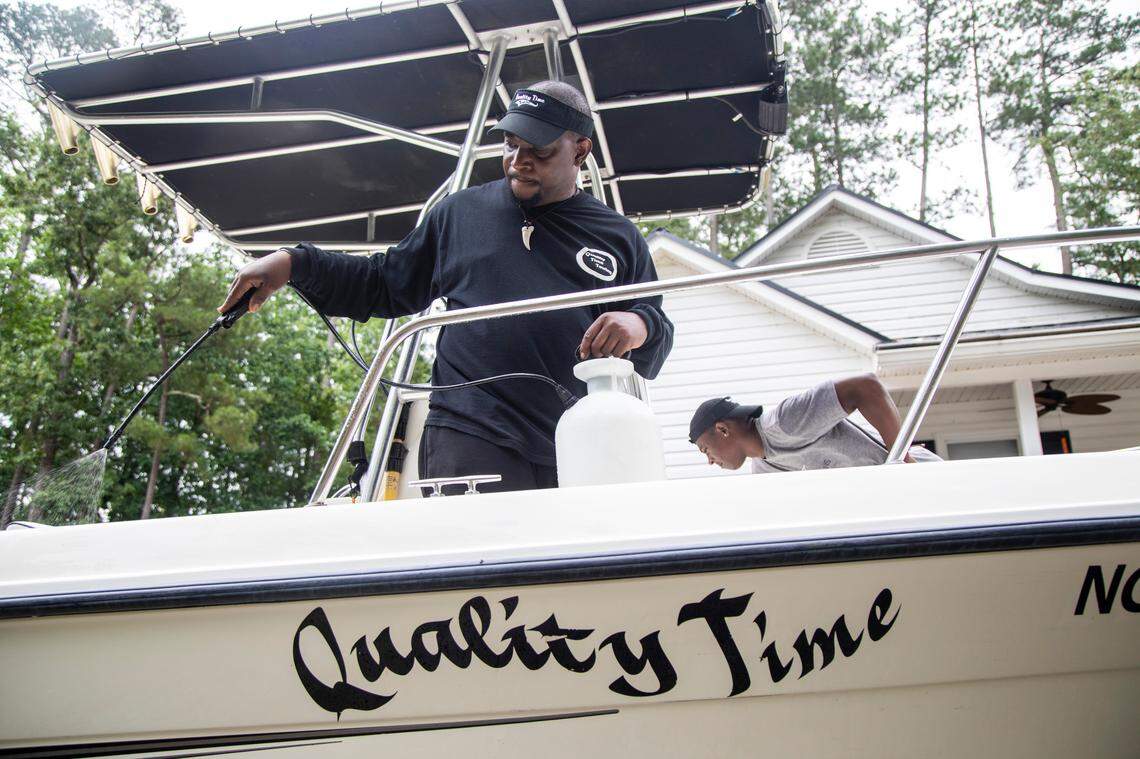
Sanders says he doesn’t count on the fact that he’s had COVID-19 to somehow make him immune to getting it again. He’s still cautious around other people, keeping his distance. When he visited a car dealer in South Carolina recently, the man jumped up and moved to give him a hug, but Sanders just waived him off.
Where he thinks he got coronavirus
About two weeks after he got out of the hospital, Sanders says he heard DJ Jazzy Jeff on the Tamron Hall Show talking about how he had contracted coronavirus during a ski outing in Sun Valley, Idaho.
Like Sanders, DJ Jazzy Jeff had been in Sun Valley for the annual gathering of the National Brotherhood of Skiers or NBS, an African-American ski and snowboard organization with local chapters across the country. Sanders had never skied before but thought he’d give it a try and joined more than 600 skiers at the resort for the NBS summit.
By some accounts, more than 125 people who attended the event developed coronavirus symptoms and at least four later died of the disease, according to the Guardian newspaper. As with other outbreaks at conventions or resorts, people got sick after they went home and may not have immediately connected their illness with Idaho.
Sanders was at a party where DJ Jazzy Jeff played music that week. Tamron Hall also interviewed others who had contracted the virus at the event. Sanders now figures that’s where he got it, too.
Sanders never did go skiing in Idaho. When he got there, the snow on the beginner slopes was icy, and he decided they weren’t the best conditions to strap on skies for the first time. When he fell he didn’t want to fall on ice.
“They said you’ll be sore for days,” he said. “I said I ain’t trying to get hurt. I got to go back and run a business. Instead, I come back with the COVID.”
This story was originally published May 30, 2020 at 8:00 AM.
