Four NC counties reach COVID-19 ‘tipping point,’ data show. Here’s what that means
Update as of July 2: Harvard updated its map tracking coronavirus risk in the U.S. on Thursday. New case numbers pushed Mecklenburg and Lee counties into the red zone while Stanly and Duplin dropped back into orange.
As metrics measuring the spread of COVID-19 in North Carolina continue to climb in the wrong direction, new data released by Harvard University show four counties where the risk has peaked.
And Mecklenburg County is right behind them.
Harvard University experts released a tool Wednesday that charts coronavirus risks by state and county according to the number of new cases per 100,000 people over the last seven days — a metric better suited to comparing areas with widely varying population sizes.
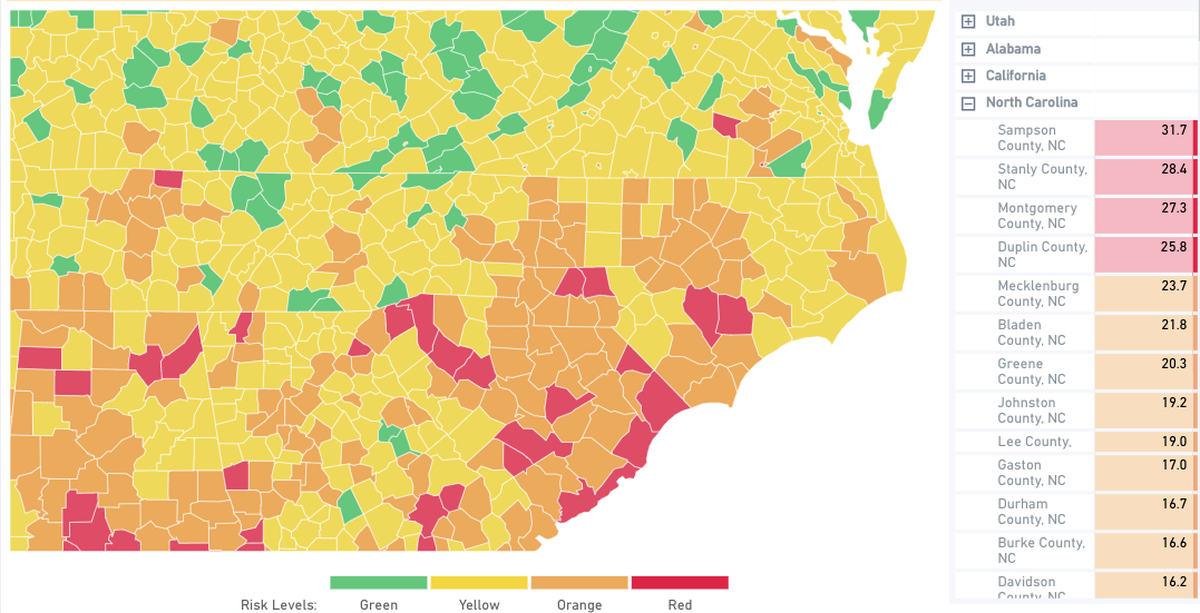
In North Carolina, Samspon, Stanly, Montgomery and Duplin counties are shaded red, meaning they’ve reached a “tipping point” for the coronavirus.
“We need to consistently apply data-driven testing of hotspots, combined with contact tracing based testing, especially in states where case numbers are rising rapidly,” Ashish K. Jha, director of the Harvard Global Health Institute, said in a news release. “It is what we need to get the virus level so low that we don’t have large numbers of people getting sick and dying and that we can open up our economy.”
How the map works
The map uses four colors to illustrate risk levels in every county: green, yellow, orange and red.
- Green: Less than one case per 100,000 people and containment is on track. Use contact tracing and testing to monitor.
- Yellow: One to nine cases per 100,000 people, indicating community spread and the need for rigorous testing and tracing.
- Orange: Ten to 24 cases per 100,000 people, showing “accelerated spread” and stay-at-home orders are advised.
Red: 25 or more cases per 100,000 people, meaning the county is at a “tipping point” and stay-at-home orders are necessary.
North Carolina — which averages 12.7 new cases per 100,000 people, according to Harvard’s data — is orange. On Wednesday, the N.C. Department of Health and Human Services reported its largest daily increase in COVID-19 cases, “adding 1,843 new cases and pushing the state’s total since March to 66,513,” The News & Observer reported.
According to Harvard’s map, the majority of counties across the state are yellow and orange — but a few are green.
Clay, Cherokee, Avery and Transylvania counties — all in western North Carolina — have less than one new case per 100,000 people.
Where it’s the worst
Sampson County
Situated between Fayetteville and Jacksonville in eastern North Carolina, Sampson County has been flagged in recent weeks as a possible coronavirus hotspot.
Last week, data collected by The New York Times put Sampson County on a list of 100 counties across the U.S. with the highest number of recent coronavirus cases per resident, McClatchy News reported. It’s the state’s top agriculture county, ranks second in hog production and is home to the country’s largest pork processing plant.
As of Wednesday, The N&O reported its COVID-19 case rate was 166.8 per 10,000 people. The county has reported 1,060 cases to state health officials, and six people have died.
At the end of April, Assistant County Manager Susan Holder told North Carolina Health News at least 21 cases in Sampson County had been linked to a smaller Smithfield Foods packing plant in Clinton. An updated figure was not immediately available Wednesday.
Southwood Nursing and Retirement Center in Sampson County has additionally reported at least two COVID-19 cases but zero deaths, according to N.C. DHHS.
Two other facilities classified by state health officials as “other” were also included in the report.
An unnamed facility in Faison on Burch Road has reported 37 cases among staff and zero deaths. A second facility on Mount Moriah Church Rd. in Clinton reported five cases among residents, according to the report.
Stanly County
Stanly County sits just 20 miles east of Charlotte. As of Wednesday, The N&O reported it had a per capita case rate of 62.7 per 10,000 people. The county has reported 394 cases and five deaths.
The recent uptick in cases is largely attributed to an outbreak at Albemarle Correctional Institution, where 60 inmates have tested positive for the coronavirus, The Charlotte Observer reported last week.
Prison officials said they are in the process of testing all 750 inmates. But none of the inmates who already tested positive were showing symptoms, prison spokesman John Bull told the Observer.
The Albermarle facility is not listed on the state’s weekly outbreak report for Stanly County.
Three nursing homes and residential care facilities are, however, on the report. No more than two or three cases and zero deaths have been reported at each of them, according to N.C. DHHS.
Montgomery County
Just east of Stanly sits Montgomery County with a per capita case rate of 116.7 per 10,000 residents as of Wednesday, according to The N&O.
Montgomery has reported 317 cases and seven deaths.
But only one outbreak is recorded on the N.C. DHHS report at Autumn Care of Biscoe, a nursing home with 12 COVID-19 cases and one death among residents and staff.
Duplin County
Duplin County in eastern North Carolina was also featured alongside Samspon County on The New York Times’ list of 100 counties in the US with the highest number of recent coronavirus cases, McClatchy News reported.
Duplin had the highest per capita case rate in the state as of Wednesday with 253 cases per 10,000 people, according to the N&O. The county has reported 1,486 cases to state officials, with 27 deaths.
It’s the largest hog producing county in North Carolina, and at least one of its producers — Villari Foods — has a confirmed COVID-19 outbreak, WITN reported.
Butterball turkey plant also has an outbreak with more than 50 cases reported in April and some Latino immigrant workers complaining about a lack of protections, The N&O reported. Cases in the Butterball plant’s zip code had tripled to 304 from May 1 to June 11, according to the N&O, but 56 of the cases were attributable to outbreaks at two nursing homes.
Kenansville Health & Rehabilitation in Duplin County has reported at least 82 cases and seven deaths among residents and staff, according to N.C. DHHS. Warsaw Nursing and Rehab Center has six cases and zero deaths, and Wellington Park Assisted Living reported 39 cases and one death.
Duplin County Jail also has 10 cases, N.C. DHHS’s twice-weekly report on confirmed outbreaks states.
Mecklenburg County
Public health officials in Mecklenburg County have warned of rising case numbers and hospitalizations in recent weeks.
On Wednesday, the county reported its second-highest daily increase in new coronavirus cases since March with 364 new cases, The Charlotte Observer reported. The total number of cases in Mecklenburg is now 11,534 with 150 deaths.
The percentage of positive test results is 11.3% in Mecklenburg County, according to the Observer, and most local cases — about three in four — were adults ages 20 to 59 years old.
At least 15 outbreaks at nursing homes, five at residential care facilities and one at a correctional facility have contributed to the county’s troubling numbers, according to N.C. DHHS.
Peak Resources, a nursing home in Charlotte, has reported 130 cases among residents and staff as well as 22 deaths, according to the outbreak report. Royal Park Rehabilitation & Health Center had 86 cases and 10 deaths.
Mecklenburg County Detention Center reported five cases and zero deaths, the report states.
A look across the U.S.
Across the country, Arizona (42.2), Florida (29.1) and Mississippi (25.4) ranked highest in new cases daily per 100,000 people, and each state was in the red category.
Another 13 states — mostly in the South and West — were in the orange category. South Carolina, Texas, Georgia, California, North Carolina and Idaho are among them.
Only two states, Vermont and Hawaii, were in the low-risk green category with one new case a day per 100,000 people.
This story was originally published July 1, 2020 at 7:06 PM with the headline "Four NC counties reach COVID-19 ‘tipping point,’ data show. Here’s what that means."