UNC thought it was ready for COVID-19. It left students heartbroken and a campus quiet.
They stood next to the cars they’d loaded with the things from their dorm rooms and said goodbye. They tried to act happy while they gave each other hugs or tapped elbows. They said they’d see each other soon. They’d arrived about two weeks ago for the start of their first year at UNC-Chapel Hill and now, already, they were leaving.
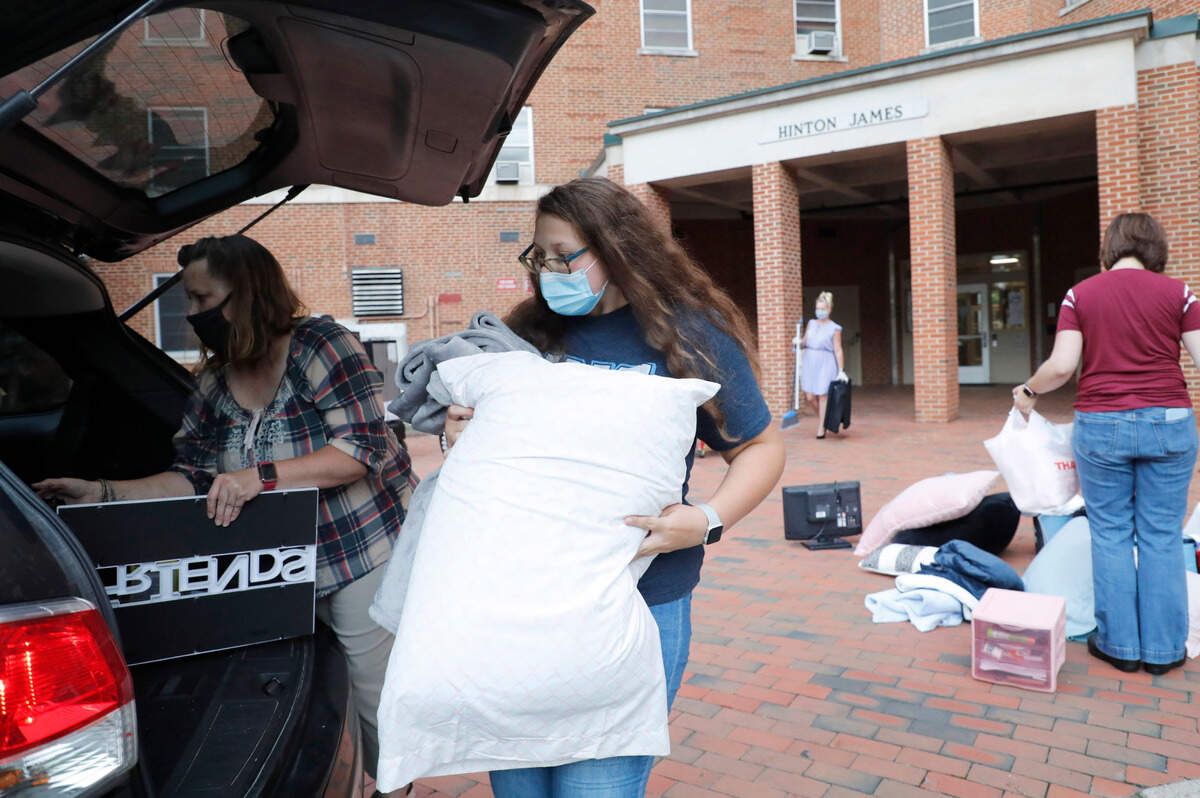
It was a little past 5 p.m. on Tuesday outside of Hinton James, one of the university’s largest residence halls — a faded brick high-rise on the southeast end of campus, a short walk from the Smith Center. It was less than 24 hours after UNC decided to move its fall classes online, and less than 48 hours after the university identified its fourth on-campus cluster of COVID-19.
“I think we joked that it wouldn’t last long,” Kevin Schmidt said while his daughter, Emily, went inside to turn in her keys. He’d broken a sweat while loading up the last of her things. “But we figured it would last through August, at least.”
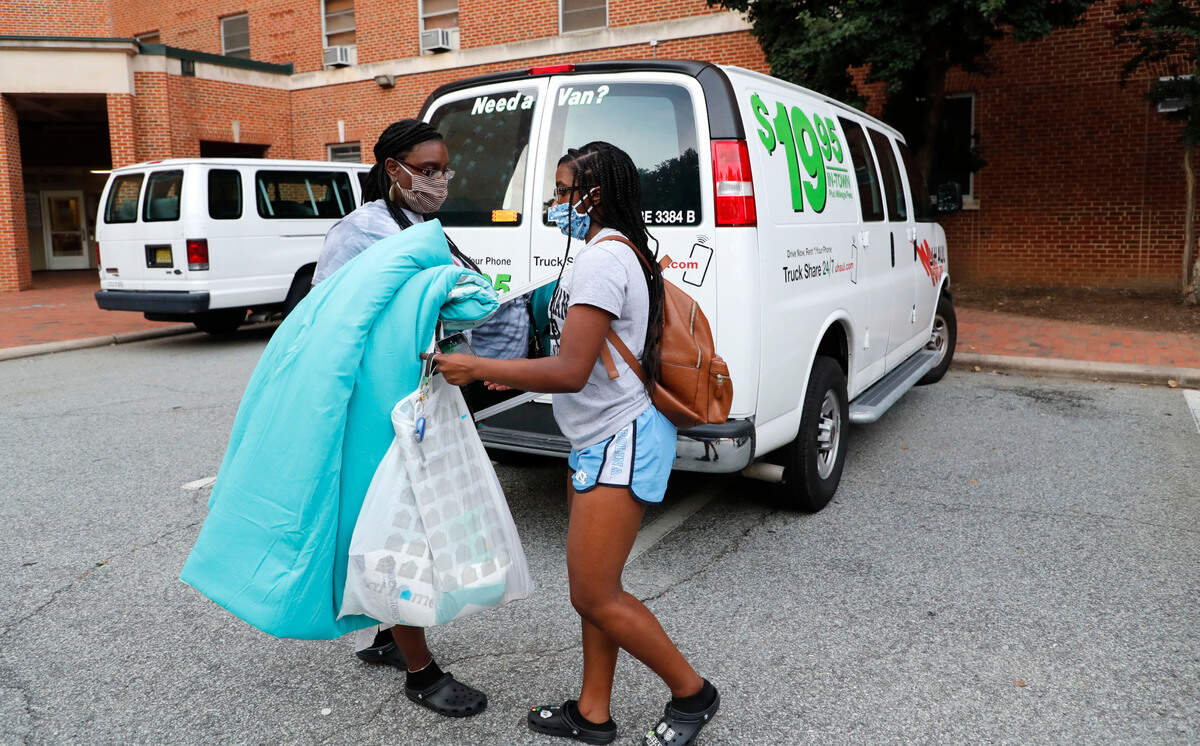
Now the parking lot outside of the dorm was filling with parents arriving in minivans or SUVs. One family rented a U-Haul cargo van. Soon students emerged. One carried a mattress topper in her arms. Another pushed a plastic set of drawers, on wheels, across the pavement. They carried boxes of food they didn’t have time to open, and the things they thought they couldn’t live without when they left home. Vicente Tamayo loaded his bike on the back of his parents’ car.
“The first week here, everybody was super excited to move in,” he said, but that was before the outbreaks, and before the university identified a cluster inside of the building he was now departing. “We got to meet new people. ... We got to make some new friends,” and now one of them was helping him carry his things out of his dorm.
Mostly, Tamayo said he remained in his room, concerned after the first outbreaks. His parents had come to take him back home, to Fayetteville.
New friends, new freedom
Across the parking lot, Charisma Sumpter helped load the U-Haul her parents had rented. Sumpter, from Raleigh, had been on campus long enough to make some new friends, at least. They’d walked one night to Franklin Street, for sushi.
Now that had become her favorite memory of her abbreviated stay on campus, she said — “getting to experience that little taste of freedom.” She thought about remaining at Hinton James. The university wasn’t necessarily forcing students to leave, though leaving was encouraged. Maybe, Sumpter thought, campus would become a safer place if fewer stayed.
“But then I was like, well if everybody’s gone, then what am I doing here by myself?” she said.
The traffic remained steady for hours, parents arriving with empty vehicles while others drove off with the mini-refrigerators and boxes of clothes and computer monitors they’d brought just two weeks ago. The packing up was easy, relative to the turmoil that came with it. Hope Gambill cried when she learned UNC had moved its classes online, because she knew she’d be leaving.
She’d come to Chapel Hill from Alleghany County, in western North Carolina. Before she left she’d joked with her boss at the coffee shop where she works, in her hometown of Sparta, that she might only be gone for a couple of weeks. She hadn’t really believed her time here might be so short. In one way, she found herself mad at the people who’d spread the virus around campus.
She’d heard about the parties some students attended. She’d heard one had a slip-n-slide.
“It is disappointing that people were out there and were doing those things even though we are in the middle of a pandemic — but I understand the feeling of wantin’ to,” she said, and her mountain drawl made her sound especially sympathetic. “Because I’ve wanted to, but I haven’t, because I’ve put my health and other people’s health above it.
“But I definitely understand the feeling of wantin’ to go out there and have fun with everybody.”
Her mom had come to help her move out, and so had the vice principal of her high school. They had a two-and-a-half hour drive west ahead of them. Maybe, Gambill thought, she might return to campus for the spring semester. Then again, the possibility of a repeat — the thought of coming back in January, just to leave after two weeks — was too much to bear.
“I don’t think I could stand going through that again,” she said.
Masks and social distancing required
The departures on Tuesday and those that continued after told but one part of one story of UNC’s ill-fated attempt to power through the novel coronavirus pandemic. Five months into a public health crisis with no end in sight, the university decided to try to open, at least on a limited basis. It allowed students to return to on-campus housing. It tried to hold in-person classes, with the requirement that instructors and students wear facial coverings and practice social distancing.
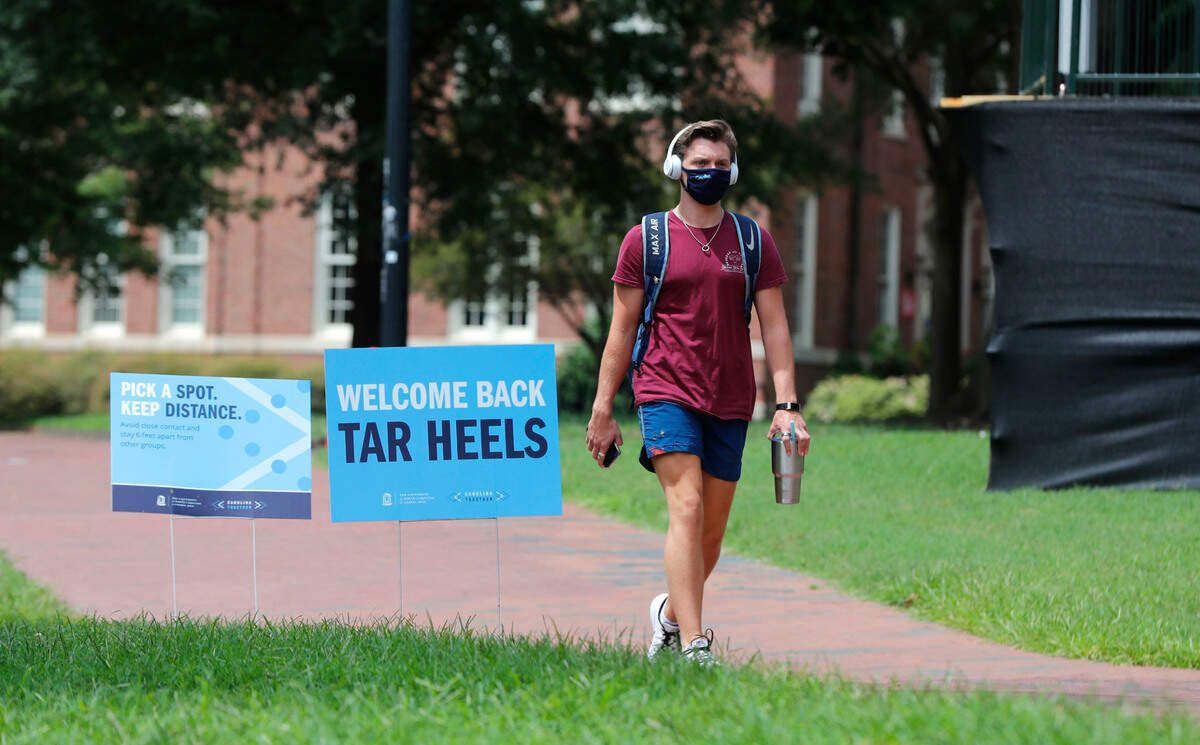
All around campus, there are signs reminding people to wear masks and to space out. Notices are taped onto the doors of every building, residential or academic, and those notices designate where to enter and where to exit. Inside some of those buildings, arrows on the floors tell people where to walk. The university tried to make accommodations for life with COVID-19. The virus, though, wasn’t as courteous.
It took about a week for UNC to identify four clusters of it, and for the university to run out of space in the on-campus housing units it had set aside for students who needed to be quarantined. On Wednesday, the university identified two more clusters. At the same time, it paused athletics activities — practices and meetings, for those teams hoping to play this fall — for 24 hours.
The virus-related developments and changes, which have not relented since students began arriving earlier this month, have created something of a daze on the campus of the nation’s oldest public university. In varying moments during interviews this week, students expressed a mix of sadness and heartbreak, frustration and anger. A lot of them wonder why the university attempted this experiment in the first place, given the likelihood of the outcome.
“I’d say it’s mostly disappointment,” Garrett Tucker, a sophomore from outside of Charlotte, said on Tuesday afternoon while the university’s bell tower chimed in the background. “And almost embarrassment. I mean, it’s pretty common knowledge now that it’s made international news that UNC is the first school to go out there and fail.
“We’re kind of like the first example of what not to do.”
Tucker was in a library when word began traveling on Monday that the university was moving classes online. He was studying with a friend, Michael Metcalf. They are roommates in the Carmichael residential hall, across the street from Kenan Stadium and near the middle of campus. Dismayed by university leadership, Tucker and Metcalf decided to speak out.
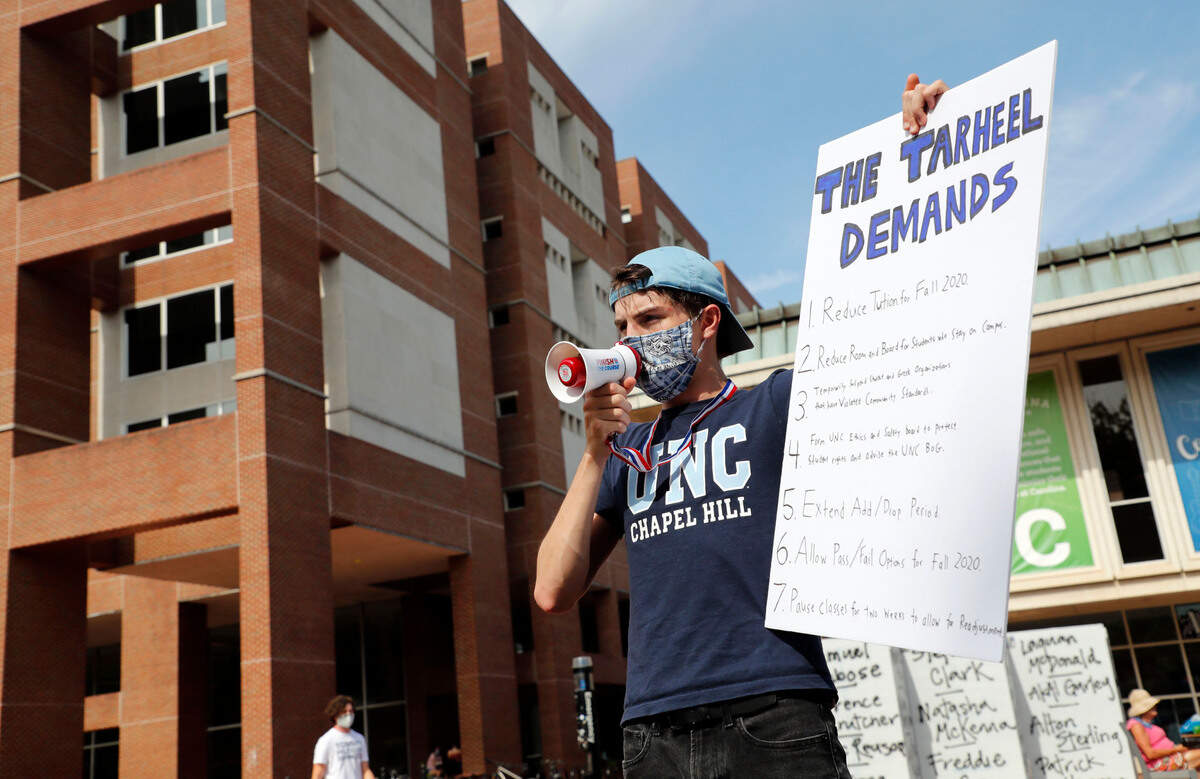
They created a petition demanding that the UNC Board of Governors “provide reparations for the UNC community,” according to their posting on change.org. Among their seven demands are a reduction in tuition for this semester, the extension of the period in which to add and drop classes and a two-week pause in the semester to allow students to readjust to online-only classes.
Tucker and Metcalf wrote the demands on a piece of white posterboard. They went to a Dick’s Sporting Goods in Durham, Tucker said, and bought the last two bullhorns the store had in stock. Then, along with another one of their friends from Carmichael, they went to the The Pit, in the middle of campus near the student union, and tried to start a movement.
“Almost all students we talked to over the summer were like, this is going to happen,” said Metcalf, who is also from outside of Charlotte. “We were just making our predictions on when we’re going to be sent home. And it happened.”
The third member of the group, Adalgeovany Caceres, another sophomore, was more blunt.
“We’re a laughingstock right now,” he said, while a few students who walked past picked up a flier from the stack Tucker and his friends had placed on a chair, under a bottle of hand sanitizer. By Wednesday afternoon, nearly 3,000 people had signed their petition online. Caceres continued his thought: “... We’re supposed to be the best public university in North Carolina, and we’re just a laughingstock. Internationally, and nationally.”
An eerily quiet campus
By then, on Tuesday afternoon, campus already felt deserted. Signs everywhere welcomed students back, but not many of them were around to see the message. Any other Tuesday during the second week of the fall semester, and the sidewalks would have been crowded between classes; the campus’ popular meeting spots, like The Pit and the main quad bordering the Wilson Library, would have been full of life. Now the cicadas offered an eerie soundtrack to the emptiness.
While Tucker and his two friends shouted mostly into a void, a photographer from UNC’s student newspaper, The Daily Tar Heel, arrived to document the moment. The day before, on Monday, a scathing editorial in the newspaper had lambasted the university for its handling of the pandemic, and for its decision allowing students to return. The headline of the editorial used profanity, attached to the word “cluster,” to describe the situation on campus.
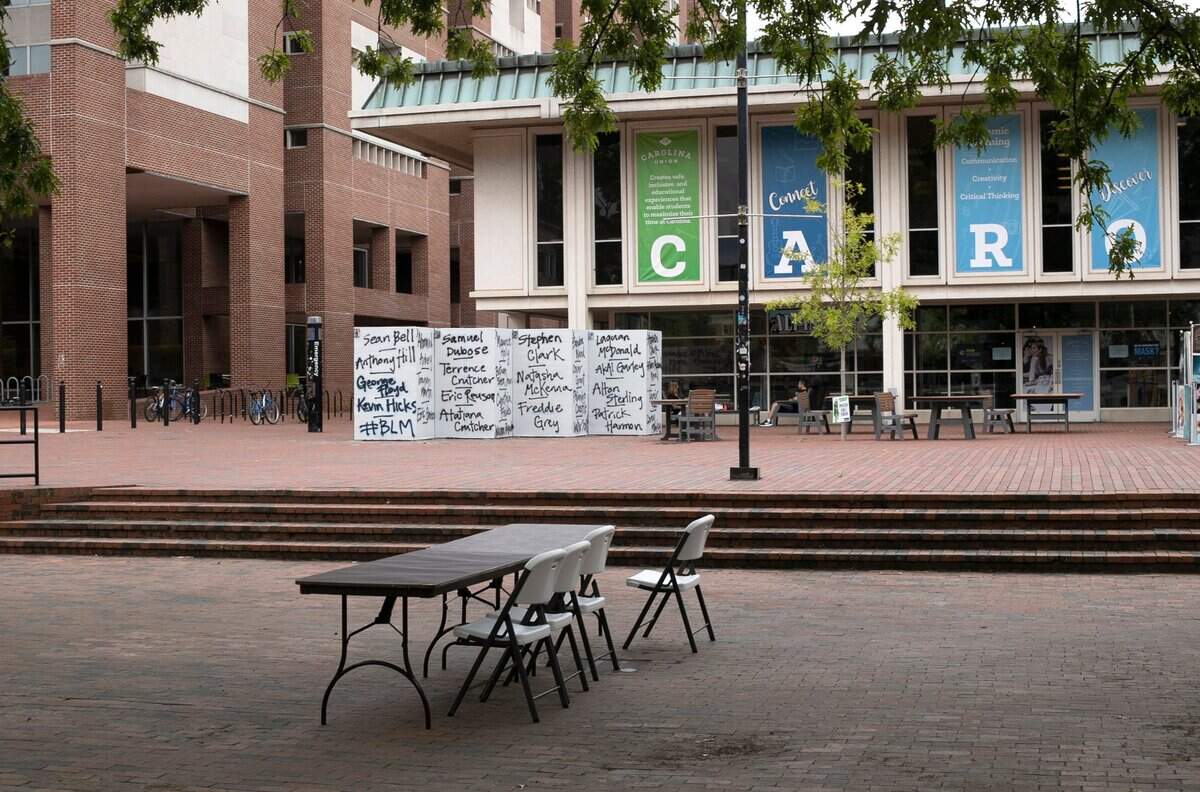
If it took such a statement to make people pay attention, “then so be it,” said Angelina Katsanis, The DTH photographer. She and her fellow student journalists felt an obligation “to get information out into the world” about life on campus amid the pandemic, she said, and yet she also felt empathy for her classmates who longed for the college experience — the parties and the events that might be ripe for transmission of the virus.
Katsanis, a sophomore, had just returned from meeting a friend, a UNC freshman, for coffee.
“And she’s like, I don’t know how to meet people, I don’t know where to go, I don’t know what to join on campus, I don’t know what there is to join on campus,” Katsanis said. “Because we’re running into the situation where there’s no one to connect with. But at the same time, the thing that’s comforting is that everyone is — it’s a level playing field. Everyone is on the same page.”
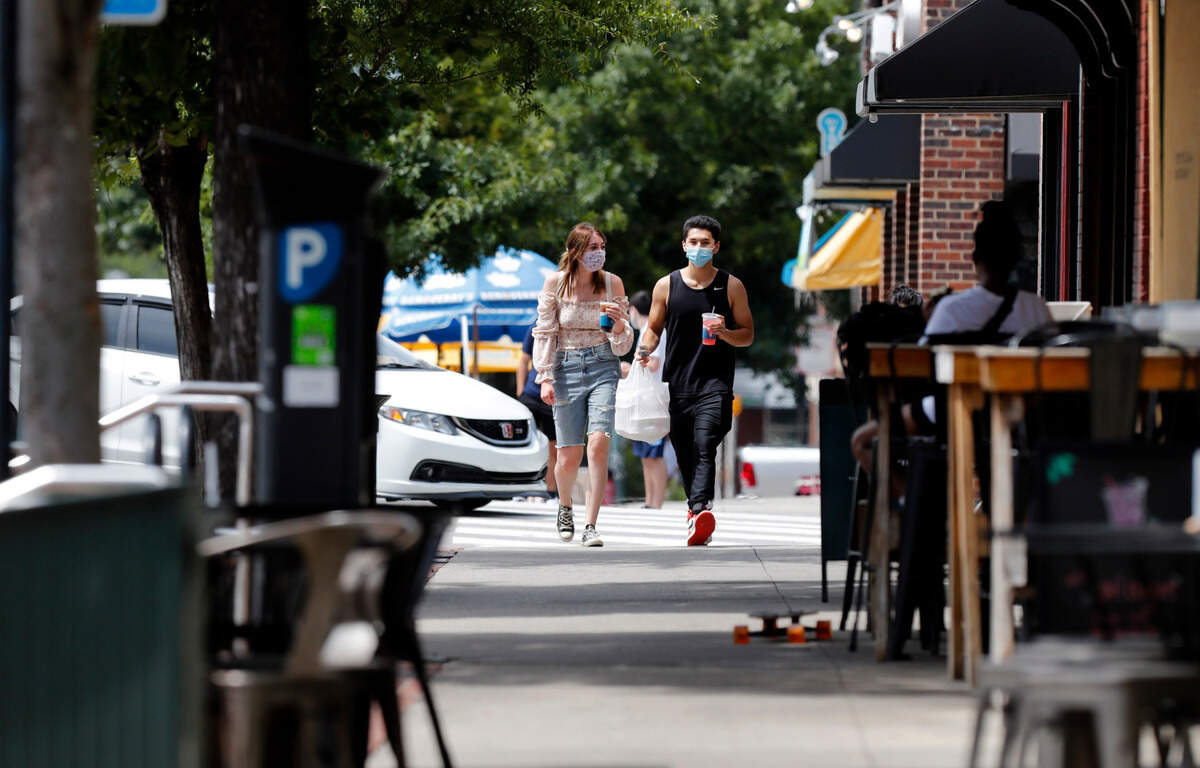
About a 10-minute walk north, Franklin Street was nearly empty. It might have been an odd sight on any other school day except for the ones transpiring now. The street borders the oldest part of campus, and while its vibrancy has declined in the past decade or so it’s still home to popular gathering places, clothing and memorabilia stores; nostalgia might be the street’s chief export.
Now there were signs on the doors of places that had closed. Others offered snapshots of the times. At Julian’s, the high-end men’s clothing store, two framed photos of Roy Williams, the UNC basketball coach, sat on prominent display in a storefront window. Williams is known for wearing Julian’s suits and ties. In the photos, he wore Julian’s face masks that were for sale.
Some people saw it coming
Around lunchtime on Tuesday, only a few people ate at tables outside restaurants that are dependent upon a thriving campus community, and everything that comes with it — the football games on Saturdays and the summer sports camps and all the rest. Last week, in the days after students had first returned, there’d been a line for a table at Sup Dogs, a hot dog and burger place known for hanging creative banners before UNC-Duke basketball games.
By Monday, after the emergence of the four clusters indicated the virus’ spread, Sup Dogs was “dead, dead” said Hannah Willcox, a restaurant manager who graduated from UNC last spring. She has kept her college job, she said, while she waits for the economy to improve.
“The older people kind of knew that this was going to happen,” Willcox said of the deteriorating conditions on campus. “I foresaw closing down very quickly, just because we knew the policies weren’t what they needed to be, and you can’t really control freshmen that have just broken out of their house. They’re ready to have some independence.”
Like Tucker and his friends who bought bullhorns and headed to The Pit to speak out against the administration, Willcox described an undercurrent of distrust between students and the university’s leadership. That relationship had already been strained in recent years, especially during the prolonged saga surrounding Silent Sam, the Confederate monument that stood on campus until protesters tore it down two years ago. Now, like then, students have embraced the opportunity to criticize administrators, and the UNC system Board of Governors.
“I don’t think I’ve talked to a single person that agrees with the way the university did it,” Willcox said of the reopening, before questioning the university’s financial motives. “ ...To everyone, that seems like, ‘We’re going to get this money and then we’re going to tell them that their education is going to significantly decline.’
“So I think it was very intentional, and Carolina has had a history of being greedy with money with students, and not caring as much about their well-being, before their pockets.
“I don’t think anyone is surprised.”
In a phone interview on Wednesday, Chuck Duckett, who since 2013 has been a member of the UNC Board of Trustees, said he understood the anger from students, and others. Members of the Chapel Hill community this week have also expressed their discontent with the university; Pam Hemminger, the town mayor, delivered a letter that admonished UNC Chancellor Kevin Guskiewicz and other leaders for decisions that Hemminger said placed the community at risk.
Duckett, meanwhile, defended Guskiewicz and the university’s leadership.
“People going out and not following the protocols are why we’re here where we are,” Duckett said. “They didn’t get this in the classroom. There’s shared responsibility. The university tried very hard, worked very hard with public health officials” to bring students back.
“It was a risk,” Duckett said. “It was a risk worth taking. ... I’m not going to apologize for trying.”
He acknowledged the community’s concerns surrounding the spread of the virus, and spoke from experience. Duckett, who will turn 60 next month, said he was diagnosed with COVID-19 in mid-March. He wondered if he contracted it while attending the ACC tournament in Greensboro, but he couldn’t be sure. He experienced “a lot of the symptoms,” he said, and he still hasn’t regained his full sense of smell.
Disinfectant wipes for empty desks
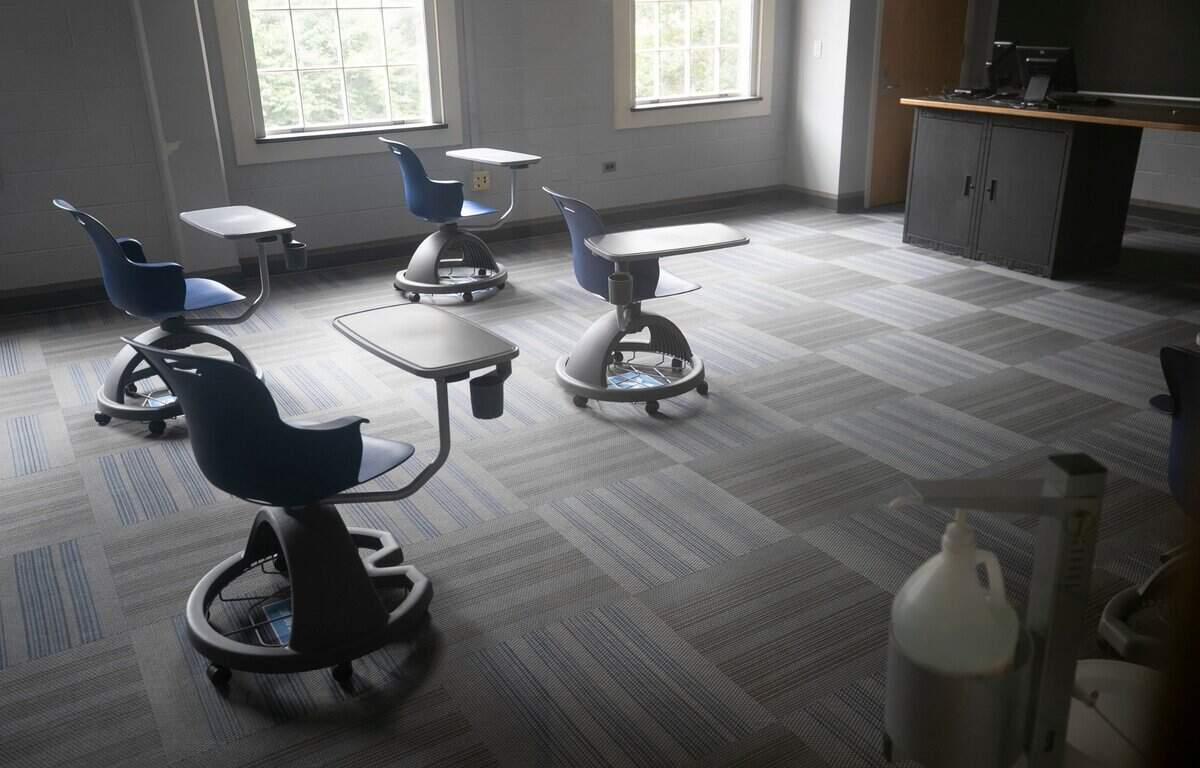
Back on campus on Wednesday afternoon, about a dozen students studied under a large canopy that had been erected in the quad between Wilson Library and the South Building, the headquarters of the university’s administration. Under the canopy, rows of desks had been spaced six feet apart. Hand sanitizer and disinfectant wipes were waiting for those who walked up the ramp in search of a place to sit. Most of the desks were empty.
Campus was quiet, too, except for the soft hum of music somewhere in the distance, and the occasional thunder from a far-off storm. The bell tower sounded on cue as the minutes passed, but most of the other familiar sounds of campus life had faded away, drowned out by the near-daily reports of the virus’ spread, and the fear that ensued.
The university confirmed two more clusters on Wednesday, and by then, according to the school, more than 2,500 students had requested cancellations of their campus housing. Others had until Aug. 25 to do the same. The university had requested those leaving to move out by Aug. 30. Some didn’t wait to leave.
“Everybody knew that it was going to happen, but we weren’t sure when,” said Tamayo, one of the freshmen who’d moved out of Hinton James on Tuesday. Nearby, his family waited to take him home. “I think we were just unprepared, honestly. Because they tried their best. They say they tried their best. We could see people were pretty unprepared (for) the situation.
“I can’t blame them for it, for trying.”
Two weeks into a journey he’d long anticipated, he wasn’t sure when he might return.
“Hopefully the spring should look a little better,” he said, but it sounded more like a question.
Staff photojournalist Ethan Hyman contributed to this report.
This story was originally published August 20, 2020 at 5:30 AM.