Stuck in COVID quarantine: NC resident visits family in NY, and is kept on a short leash
For four days last month, the State of New York sent me a text message each afternoon asking if I had any symptoms of COVID-19.
When I replied no, the state’s contact tracing program sent an immediately reply. “Thank You, R.S. (Age 55)!,” it began. “Everything sounds good today.”
These daily checks were a condition of my recent visit to a small town in upstate New York to see my parents and my brother. I had also agreed to remain in quarantine for 14 days to ensure I wouldn’t spread the coronavirus.
New York requires visitors from North Carolina, 35 other states, Guam and Puerto Rico to register upon arrival and to remain quarantined for 14 days. The mandate also applies to travelers from every country and territory in the world except for 31 mostly small, out-of-the-way places such as American Samoa, Anguilla and Bonaire. (You’ll find the full list here: coronavirus.health.ny.gov/covid-19-travel-advisory)
New York says it uses data from websites of all 50 states and compiled by the COVID Tracking Project to determine where the coronavirus is spreading at a significant rate. The state assumes anyone coming from those places is contagious. It’s as if the entire state of North Carolina was a raging party where someone tested positive and the rest of us are presumed to be, too.
From the beginning, the nation’s response to the coronavirus pandemic has been led by governors and state health departments, and the strategy and public attitudes vary from place to place. I was traveling from a state where many people still resist wearing masks in public to one, based on this quarantine policy, that was much more imposing.
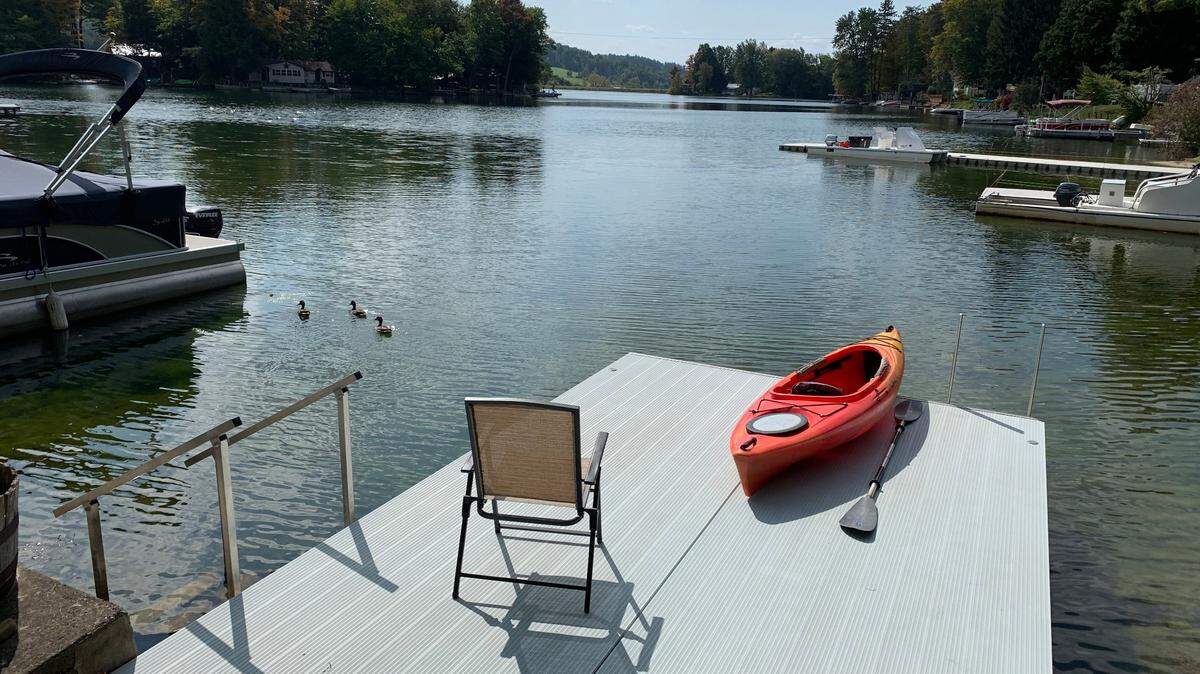
I didn’t hesitate to make the trip, but I did wonder how strictly the quarantine would be enforced. Would I still be able to go for a walk in the woods or take a kayak out on the lake? Would I feel everyone watching me as my Subaru with North Carolina license plates stopped at traffic lights on my way north?
New York’s vigilance against coronavirus is understandable. While COVID-19 hot spots continue to flare up around the country, no place has experienced what New York went through last spring, when hospitals in the metropolitan area were overwhelmed with patients. New York’s COVID-19 death toll of more than 33,000 is still at least twice that of any other state.
As part of New York’s efforts to control the disease, Gov. Andrew Cuomo teamed up with Connecticut and New Jersey and issued an executive order in June requiring visitors from certain states to fill out a “traveler health form” upon arrival and to quarantine. The form asks about your recent health and for an address where you’ll be staying during your visit and how to contact you.
The form is given to arriving passengers at airports, but it’s more of an honor system for those driving in to the state. There were no signs about the form or the quarantine requirement when I crossed into New York on Interstate 81.
I had filled out the form before I left Raleigh that morning. I provided my cell number and the address of the house my parents own on a lake outside the small town where my father grew up, which would be my place of quarantine for the three days I would be in New York.
Quarantine order arrives by email
The morning after I arrived, I received a call from the state’s contact tracing program, confirming I was still in good health and had arrived at the agreed-to address. She asked who else was there with me (three family members) and if we had enough food (we did). She then asked if I would prefer a daily phone call or text message inquiring about my health.
Soon after her call, I received an email from the county health department ordering me to quarantine at the lake house “as a result of having been exposed to a communicable disease.”
The county’s email said I could contest the order in court, with an attorney paid for by the county if I couldn’t afford one, but it didn’t mention the penalty for violating the quarantine. Cuomo’s executive order says violators face a civil penalty of up to $10,000.
A spokeswoman for the New York Department of Health told me the overwhelming majority of those who fill out the form respond to the daily calls or text messages. In a small number of cases where a person can’t be reached, their name and address is referred to the local health department for “additional compliance enforcement including in-person checks,” she said.
But the state health department wouldn’t say what portion of visitors they think are registering in the first place. The state says law enforcement agencies are not stopping drivers simply because they have out-of-state license plates.
It’s also not clear if anyone has been fined for violating the quarantine. Several news organizations in New York have tried to find examples of people who have been punished, without success.
The expectation seems to be that people will do the right thing. In a memo answering questions about checkpoints, the office of the New York City Counsel to the Mayor says it knows people will abide by quarantine requirements in the interest of public health, but warns that ”truly exceptional cases of noncompliance” may be subject to fines.
How North Carolina made the list
Cuomo’s executive order said states make the travel advisory list based on one of two measures averaged over the previous seven days: Either a positive coronavirus test rate higher than 10 per 100,000 residents or higher than 10% of total people tested.
North Carolina’s test positivity rate has been well under 10% for weeks. But with about 13,000 news cases over the last week, the state has averaged more than 18 positive tests per 100,000 residents each day. That’s better than 23 other states, according to data compiled by The New York Times, but still too high for New York’s liking.
The Times data shows how well New York has been able to contain COVID-19 after a horrific spring. After peaking at more than 10,000 new cases a day in early April, the state’s coronavirus case load dropped to less than 1,000 a day in early June and remained below 800 most of the summer before a recent uptick. Surely Cuomo’s restrictions on travelers contributed.
But they’ve also had a devastating impact on a state economy that relies heavily on visitors for business and tourism, particularly in New York City. Last year, airlines flew 34 nonstop flights from Raleigh-Durham International Airport to the three airports in metropolitan New York, making it the most popular destination from RDU. Now that number is nine flights a day, and presumably everyone who boards one must register.
Tourism contributes $45 billion to New York City’s economy and supported about 300,000 jobs, the Times reported in July, and that doesn’t include the rest of the state. My wife and I canceled a trip to this same lake house and the Adirondacks in July after Cuomo issued the travel advisory.
This trip was different. It was timed to coincide with a memorial service for my father’s cousin, who died after contracting COVID-19 in March. The service was canceled, out of continued concern about spreading the virus, but I decided to go anyway.
My quarantine was as easy and pleasant as any possible. I spent my time reading, eating, catching up on sleep and with my parents and my brother and other relatives from town who came out to the lake for socially distanced chats on the lawn. I watched the leaves begin to turn from green to red, orange and gold. The lack of WiFi at the house kept me off my laptop.
And I did venture out for walks and daily paddles around the lake. These may have violated the letter of the quarantine order but not the spirit, I reasoned.
On the fourth day, I left New York. The daily texts from the state offered me the option to type “STOP” to discontinue the messages. After I did, I received another call from an employee of the contact tracing program, asking why. I informed her that I was safely back in North Carolina, no longer a threat to the people of New York.
This story was originally published October 14, 2020 at 12:35 PM.