COVID-19 vaccine to be limited at first. How many may be available in each NC county?
Estimates vary for when the coronavirus vaccine will be ready, and each state’s plans for widespread distribution are even less certain.
But a new tool by a team of data scientists and epidemiologists at one of America’s top hospitals and Harvard University is helping to shed light on that. It’s called the Vaccine Allocation Planner for COVID-19.
President Donald Trump said the U.S. should have a coronavirus vaccine “within weeks” during the second and third debates leading up to the Nov. 3 election. Epidemiologists, however, have said that kind of a turnaround is unlikely.
“In the midst of the pandemic, we will face a scarce supply of the COVID-19 vaccines,” said Dr. Rebecca Weintraub in a news release announcing the tool. “...Unfortunately, too often scarce resources go to the most privileged. We built this tool for leaders with the data they will need on available vaccine doses, priority populations, and at risk communities to plan for effective and equitable vaccine distribution.“
Weintraub is the director of vaccine delivery at Ariadne Labs and an associate physician at Brigham and Women’s Hospital in Boston.
Ariadne Labs — a joint venture with Brigham and Women’s Hospital and the Harvard T.H. Chan School of Public Health — and the nonprofit Surgo Foundation worked to create the Vaccine Allocation Planner.
How it works
The Vaccine Allocation Planner allows users to toggle results by state according to who it wants to vaccinate first, how many doses will be available and how it wants to allocate the vaccine in any given county — whether by population size or those most vulnerable.
It does so by prioritizing vulnerable populations according to recommendations by the National Academies of Sciences, Engineering, and Medicine, which suggest allocating the vaccine to those people in phases.
- Phase 1A: High-risk workers in health facilities; first responders
- Phase 1B: People with significant underlying health conditions; people living in congregate care settings
- Phase 2: Critical workers in high-risk workplaces (public transit, grocery stores, etc.); teachers and school staff; people with moderate underlying health conditions; older adults; people living in homeless shelters or group homes; incarcerated people and jail staff
- Phase 3: Young adults; children; remaining critical risk workers
- Phase 4: Everyone else in the U.S.
The recommendations largely align with what the U.S. Centers for Disease Control and Prevention told states in early September.
Users can then select whether the vaccine will require one or two doses. Ongoing clinical trials have shown candidates receiving the vaccine in more than one dose, “meaning the real thing will likely be administered the same way,” McClatchy News previously reported.
The Vaccine Allocation Planner for NC
According to the last U.S. Census in 2010, North Carolina has a population of roughly 9.5 million. If the U.S. manufactured 10 million doses of the coronavirus vaccine to start, the Vaccine Allocation Planner estimates North Carolina would be given about 314,000 doses.
If the vaccine requires two doses, as scientists have predicted, that means there will be 157,000 courses available for the 1.67 million people in North Carolina who qualify for the vaccine under phase 1A and 1B, according to the planner.
Proportional to population, Mecklenburg, Wake, Cumberland, Guilford and Forsyth counties would receive the highest number of vaccine courses.
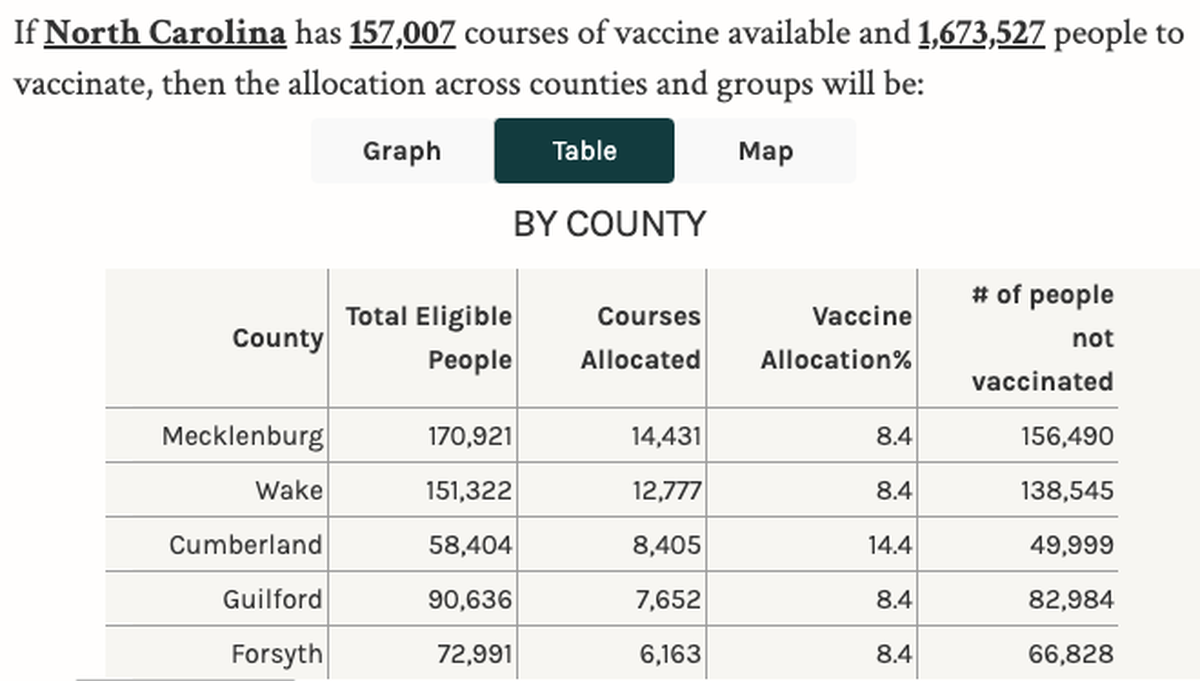
But the planner shows just a small portion of eligible residents in those counties under phase one would receive the vaccine.
Broken down by category, that means 9% of first responders, older adults, high-risk health care workers and people with significant underlying conditions across the state would receive a vaccine to start.
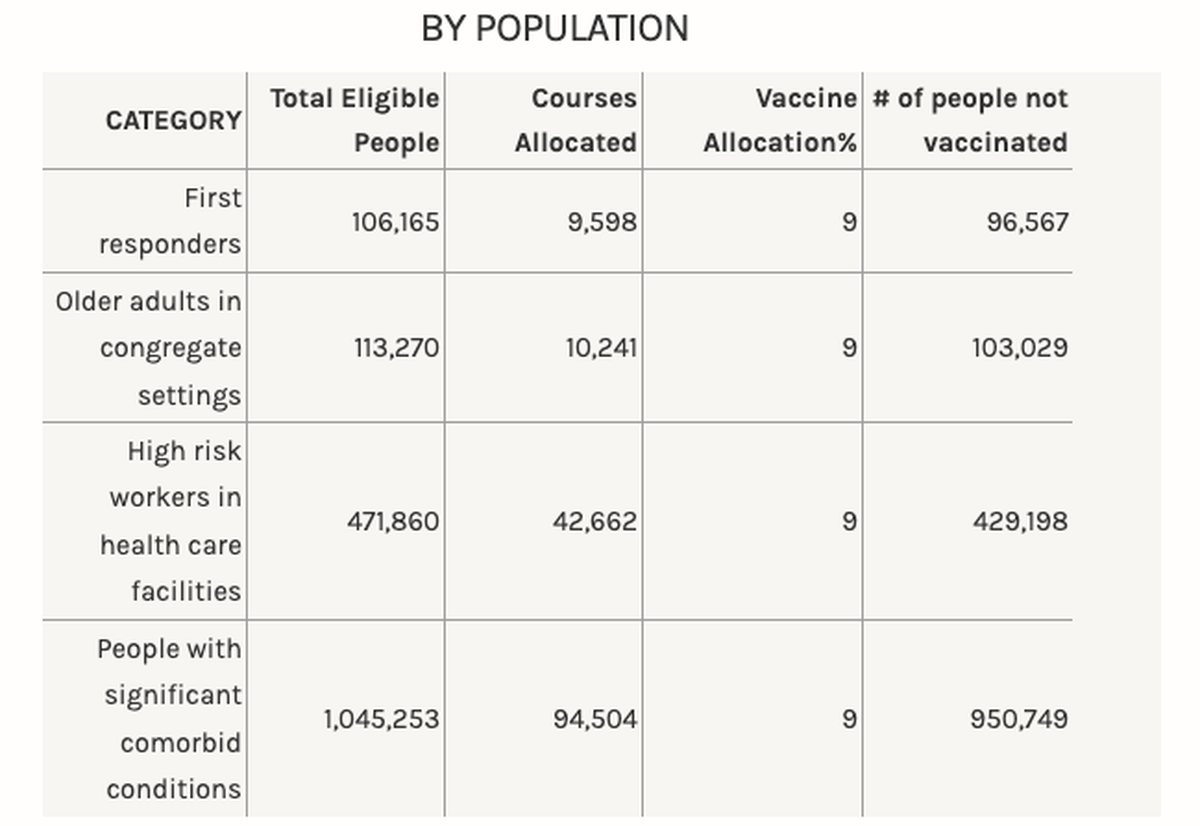
The figures continue to dwindle if users factor in later phases and the number of available vaccine doses doesn’t increase.
The Trump Administration has said it plans to “deliver 300 million doses of safe and effective vaccines with the initial doses available by January 2021” under what’s known as Operation Warp Speed. If that proves possible and the two-dose regimen was still required, that means North Carolina would have 4.7 million courses, according to the planner.
That many vaccines would cover 63% of Mecklenburg and Wake counties’ eligible population for the first three phases of vaccine distribution. Millions of North Carolinians, however, would still be unvaccinated.
North Carolina’s plan for distribution
The CDC required every state to submit a plan for vaccine distribution by Oct. 16. Similar to the Vaccine Allocation Planner, North Carolina health officials have planned for distributing the vaccine in four phases.
“At the beginning, we need to understand that there is only going to be a limited supply of those vaccines, so we’re going to have to prioritize certain folks who will be able to get access to that vaccine at first,” said Dr. Mandy Cohen, secretary of the state Department of Health and Human Services, at a news conference before the plan was announced, The News & Observer reported.
Here’s what state officials say that might look like:
- Phase 1A: Critical health care workers at high risk of exposure; essential workers in emergency management (such as firefighters and EMTs); long-term care staff
- Phase 1B: Long-term care residents; staff of congregate living settings; adults with high risk of complications from COVID-19
- Phase 2: Migrant farm workers; incarcerated people; homeless shelter residents; front-line workers at high or moderate risk of exposure; all other health care workers; teachers and school staff; adults ages 18 to 64 with one chronic condition; adults older than 65
- Phase 3: Workers in high-risk industries with increased risk of exposure; K-12 and college students
- Phase 4: Everyone else
This story was originally published October 28, 2020 at 10:38 AM with the headline "COVID-19 vaccine to be limited at first. How many may be available in each NC county?."