
NC Gov. Roy Cooper says no measures are off the table as COVID-19 cases surge
Gov. Roy Cooper said Thursday that no measure to prevent the spread of COVID-19 is off the table, as the state faced another day of record-breaking coronavirus cases.
North Carolina reported 5,637 confirmed COVID-19 cases on Thursday, over 1,000 more case than on the state’s previous worst day.
The governor said he’s deeply concerned about the numbers, adding that North Carolinians need to “take personal responsibility” for following the state’s current COVID-19 orders, like face covering requirements and restricted gatherings.
“There are a lot of people who are doing the right things,” he said. “But it’s irresponsible to ignore the rules and to create situations where people can become infected. This is why we are concentrating on enforcing the rules that we have in place.”
“But everything is on the table in the weeks to come,” Cooper added after being asked about 40 positive cases being tied to a Raleigh gym and a planned Christmas parade in Youngsville.
“I hope that people who are planning to have these large gatherings will reconsider.”
The governor was touring a medical device manufacturer in Pittsboro that has shifted its production to making personal protective equipment in response to COVID-19.
Gilero, a Morrisville, N.C.-based maker of medical devices, had just opened a manufacturing facility in a vacant hosiery mill in Pittsboro when the pandemic began to spread rapidly across the U.S.
Ted Mosler, Gilero’s CEO, said the company quickly shifted its design and manufacturing work to make face shields and self-contained negative pressure units for hospitals in the early weeks of April.
“Everybody wanted to know, ‘How can I help?’” Mosler said of the company’s response. “So we started by making 3-D printed face shields.”
By June, Gilero had hired 40 workers and made more than 400,000 face shields for a contract with the Emergency Management Division of the N.C. Department of Public Safety.
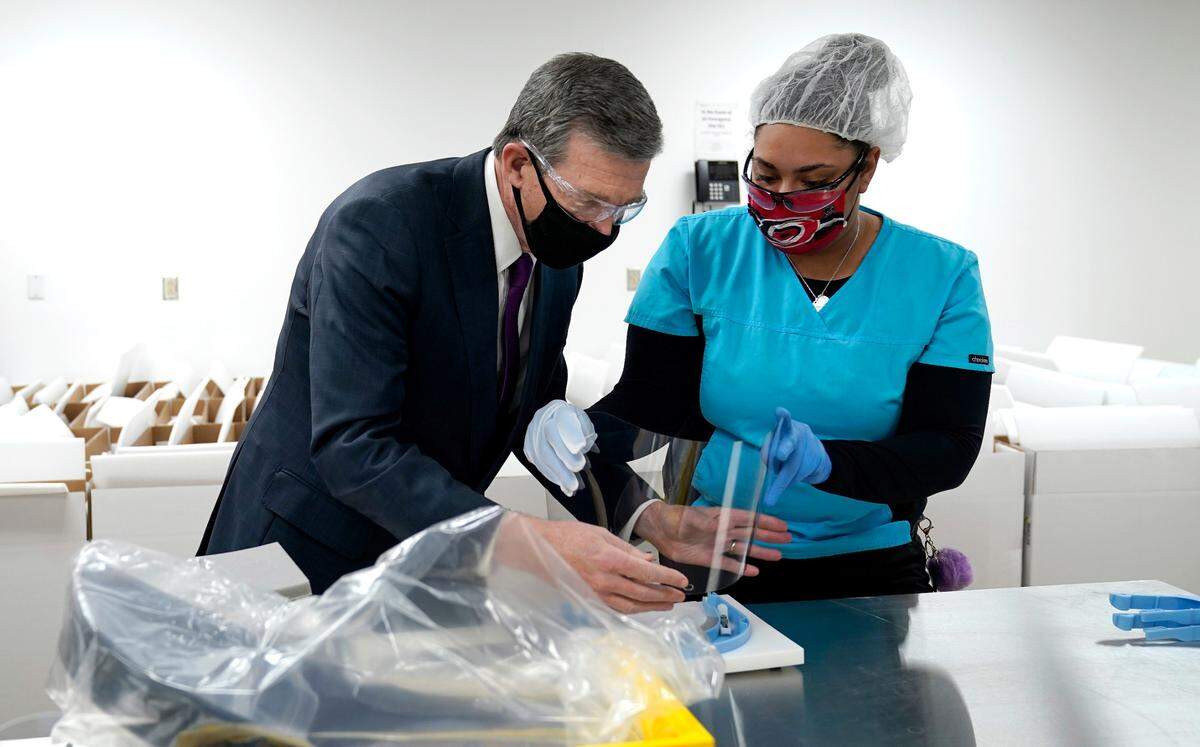
Cooper has visited several North Carolina companies in recent weeks that helped ramp up the supply of PPE in the early days of the pandemic.
It was critical that North Carolina had its own sources of PPE, he said, as every state was competing for a limited supply.
“We were slowed with our testing because we needed the PPE to conduct tests on people,” Cooper said of the early days of the pandemic. “It really has helped to significantly ease the burden of PPE supply, which is going to continue to be necessary even through the time that we are trying to get these vaccines out.”
The pandemic could continue to be a source of new jobs from Gilero.
The company is also manufacturing a new form of nasal swabs thanks to a contract with the National Institutes of Health. Mosler said the company expects to land funding from the federal government that could significantly increase its capacity to make the swabs, which could be used in at-home testing kits.
“We expect to scale that in a big way,” Mosler told the governor. “We probably will hire 100 more people.”
Mosler added that many of the workers they have hired in recent months have been laid off restaurant and hotel workers as well as students who were sent home from closed colleges.
On his tour of the facility, Cooper was shown a prototype of a negative pressure unit Gilero is making for hospitals and how its workers assembled face shields by hand.
Getting help from one of the workers, Cooper assembled his own face mask and tried it on — joking that he looked like he could coach a football team during a pandemic.
Cooper sounded a hopeful note on Thursday about the potential roll out of vaccines in North Carolina. But he said the state needs more assistance from the federal government to do a good job of it.
He said it is “extremely important” that Congress allocate more money for local and state governments as well as small businesses and individuals before the end of the year.
“With these vaccines coming, we don’t want the federal government to just believe that they can come and drop off all of these vaccines and just tell the states to do it,” he said. “We are responsible for it, but we’re going to need additional help from the federal government with financial assistance to get the job done.”
This story was produced with financial support from a coalition of partners led by Innovate Raleigh as part of an independent journalism fellowship program. The N&O maintains full editorial control of the work. Learn more; go to bit.ly/newsinnovate
This story was originally published December 3, 2020 at 3:14 PM.