
Gov. Roy Cooper receives first dose of COVID-19 vaccine on first day he is eligible
Gov. Roy Cooper came to WakeMed prepared to receive his first dose of the Pfiizer-BioNTech COVID-19 vaccine Wednesday, including wearing a short-sleeved shirt under his blazer.
“I had to make sure I found my short-sleeved shirt this morning,” he joked.
Wednesday marked the first day that Cooper and other elected officials were eligible for a vaccine as part of North Carolina’s Group 3. The governor announced Tuesday that expanding supply and the authorization of the Johnson & Johnson vaccine meant that front-line essential workers would be eligible a week earlier than originally announced, joining teachers and child care workers in being able to sign up for a shot.
“I wanted to come and get my shot today to show essential workers how much I appreciate them and to encourage them to get a spot for their shot, as well,” Cooper said. “They’ve been out on the front lines working every day as well, and we look forward to more and more people getting vaccinated.
“We know this is the way out of this pandemic.”
Cooper was vaccinated a year to the day after he stood behind a podium at the N.C. Emergency Operations Center and announced that the state had its first lab-confirmed case of COVID-19.
Cooper walked into WakeMed’s Andrews Conference Center shortly before noon on Wednesday, stopping briefly at a bank of check-in stations to verify his birthday. Then, joined by WakeMed CEO Donald Gintzig, he walked into a conference room that had been repurposed to hold nine vaccination points.
Gintzig praised the work of N.C. Department of Health and Human Services Secretary Mandy Cohen. Gintzig acknowledged that Cohen had received some criticism for the state’s vaccine management system, but said, “In the long run, sometimes you’ve got to go slow to go fast.”
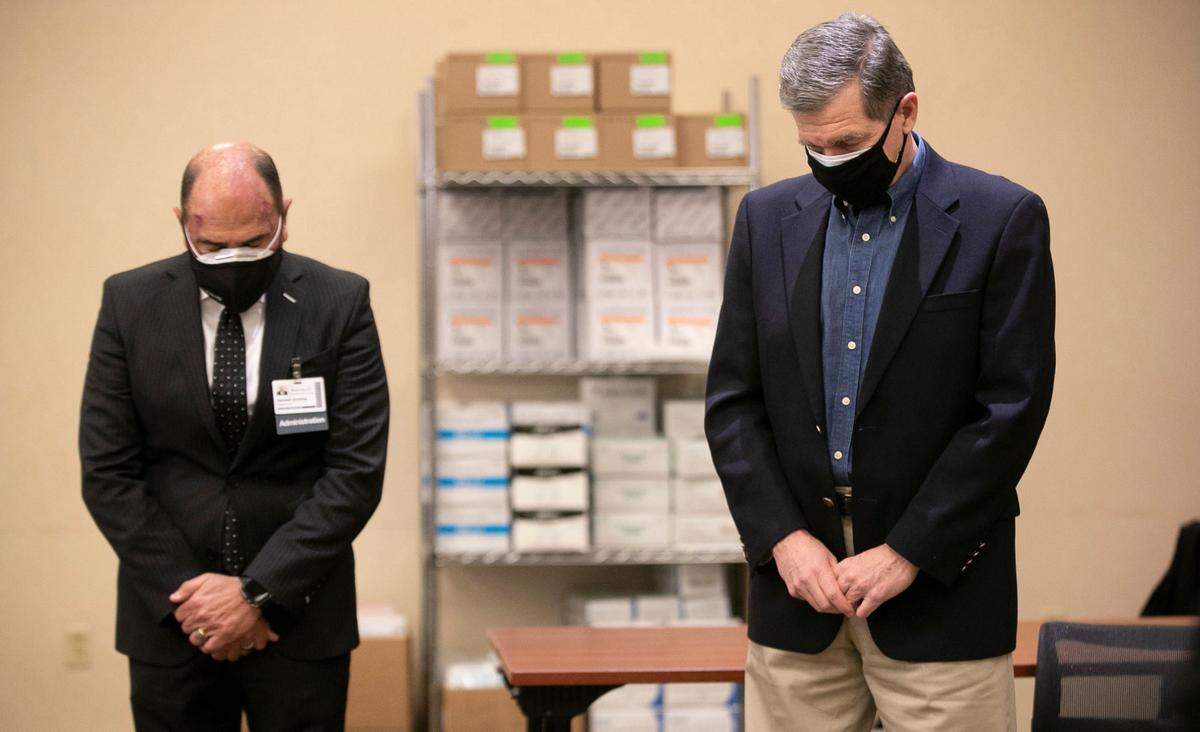
At exactly noon, Cooper and everyone else in the room paused for a moment of silence to commemorate those who have suffered and died from COVID-19. North Carolina has recorded more than 865,000 cases, and 11,363 North Carolinians have died with COVID-19, according to data reported Wednesday.
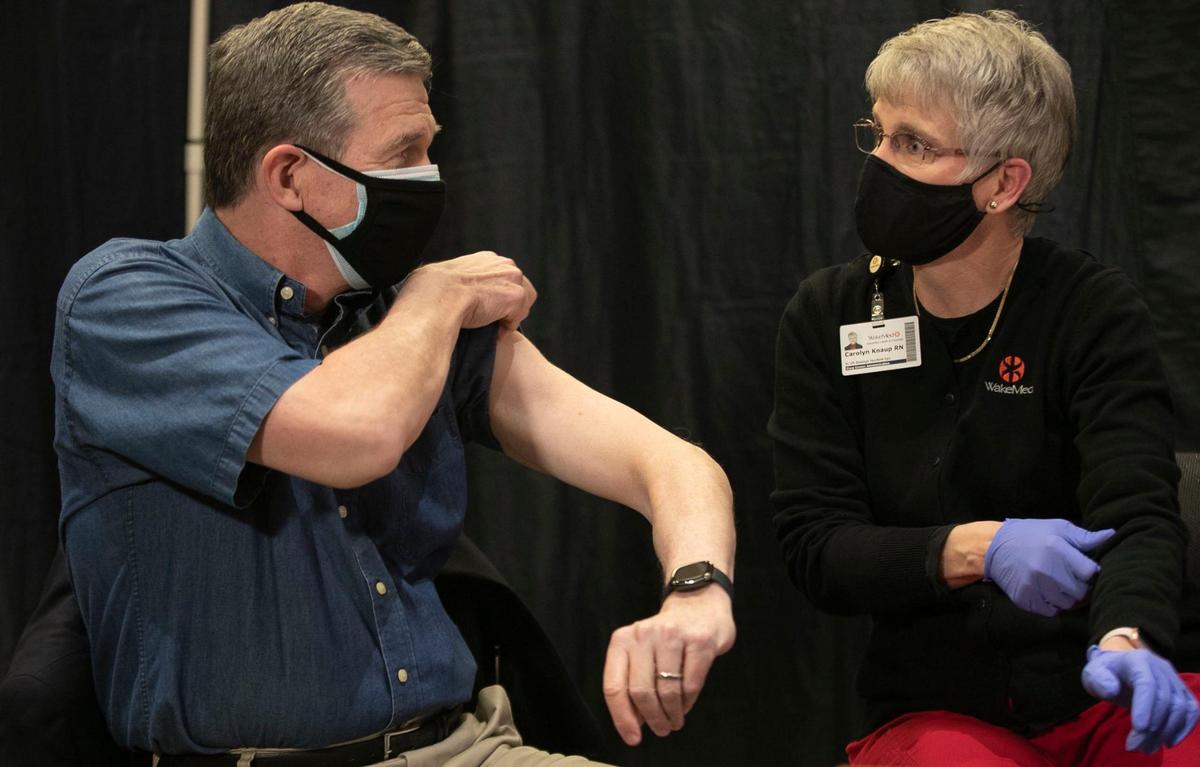
At 12:01, Cooper was pointed to station two, in a corner of the room. Carolyn Knaup, a WakeMed nurse, asked the governor a series of screening questions and then which arm he would like to have the shot in.
“Either one,” Cooper said before gesturing to his left. “Since you’re over there, then this is fine.”
Then Cooper removed his black blazer and rolled up the left sleeve of a blue short-sleeved shirt.
As Cooper held up his sleeve, Knaup told him that their children had attended school together at York Elementary. While Knaup told him that her oldest son now flies a plane for the U.S. Coast Guard, she swabbed Cooper’s arm and injected the vaccine.
After the shot was administered, Cooper was handed a card showing that he’d received the first dose. Then Knaup handed him a sticker that said “I got my dose of hope.”
Before walking away, Cooper said, “It’s an honor for me to be here with all of these people who’ve been working so hard getting this vaccine. ... We’ve still got a lot to go, but you’ve done so much and you’re helping our numbers and you’re saving lives.”
Cooper wore the sticker on his left lapel while answering questions a short time later.
North Carolina, Cooper said, is starting to receive more vaccine doses and has developed a system for quickly putting shots into arms. But even with those doses and with cases falling swiftly after a post-holiday peak, Cooper said he plans to keep safety measures in place.
Tuesday, Govs. Greg Abbott of Texas and Tate Reeves of Mississippi, both Republicans, lifted their states’ mask mandates.
“Even though we’re getting more people vaccinated, it is not time to relax our mask mandate. It is not time to relax being responsible about trying to prevent the spread of COVID,” Cooper said.
Early last month, DHHS reported there had only been four flu deaths this season compared to 186 last year. DHHS also said that there has been a 98.2% reduction in Medicaid claims for Tamiflu in the state.
Wednesday, Cooper pointed to the drop in flu cases as evidence of how contagious the coronavirus is, with the state recording tens of thousands of new cases even as masks and distancing beat back other diseases.
After leading North Carolina through a full year of the pandemic, Cooper said that it has worsened existing challenges around behavioral health, children’s nutrition, education, internet access and substance use disorder. The governor said he hopes to work with the General Assembly to address the state’s needs.
“We have to tackle all of these issues in a significant way,” Cooper said, “because this pandemic has set us back in all of these areas.”
This story was originally published March 3, 2021 at 2:56 PM.