
NC researchers say keeping masks on will prevent thousands of additional COVID cases
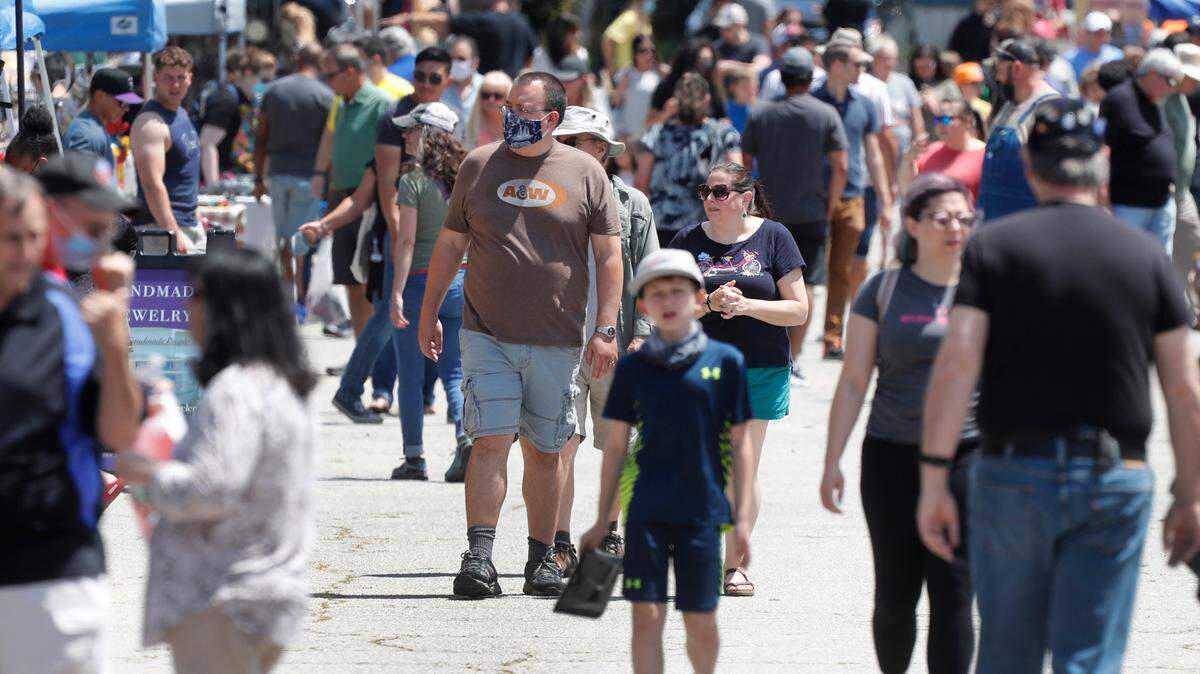
The government may no longer require North Carolinians to wear masks in public, but putting them on could help prevent thousands of coronavirus cases and deaths by the end of the year, according to researchers at three of the state’s universities.
The researchers have created a computer model that predicts coronavirus cases, hospitalizations and deaths under various scenarios. The variables include vaccination rates and effectiveness of the vaccines, as well as adherence to measures meant to prevent spread of the virus, such as closing schools and workplaces and wearing masks.
According to the model, abandoning mask wearing and other prevention measures will result in a rise in coronavirus cases in coming months.
For example, Wake County, where 50% of the population has been fully vaccinated, would see 19.5% fewer infections and 18% fewer deaths by Dec. 21 if people continued to wear masks and work from home than if they did not.
Statewide, under the same scenario, there would be more than 430,000 fewer infections during that time if people wear masks and social distance than if they didn’t, according to the model. That would translate into more than 1,150 fewer deaths in the state by the end of the year.
COVID-19 hasn’t gone away
The likely outcome is somewhere between the two extremes of totally embracing or completely abandoning preventive measures, said Julie Swann, who heads the industrial and systems engineering department at N.C. State University and played a lead role in the modeling work. The bottom line, she says, is that the coronavirus hasn’t gone away.
“We are seeing a lot of discussion, in headlines and elsewhere, that suggests the pandemic has run its course in the United States,” Swann said in a written statement. “We think that may be misleading, and feel that sharing these findings now could help reduce the number of people affected by COVID-19 over the next seven months in North Carolina, and in states with similar vaccination rates.”
The computer model was developed about a decade ago and has been adapted and applied to the coronavirus throughout the pandemic, Swann said.
Dr. David Wohl, an infectious disease specialist at UNC in Chapel Hill, was not involved with the model but says its forecasts are plausible. Even with 50% of the population vaccinated against COVID-19, masking and other preventive measures are still needed to save lives, Wohl said.
“Fifty percent is great, but we really need much more than that to prevent the kind of surge that is being predicted in this model,” he said.
The model takes into account variants of the coronavirus that are more contagious and make up a majority of new cases in the United States. The three vaccines available in the U.S. have proven effective against the variants so far, but those who aren’t vaccinated are more susceptible to getting sick, Wohl said.
“A highly infectious virus could run quickly through a susceptible population, and the viruses we’re seeing emerge are evolving to become more infectious,” he said. “What we’re seeing in other parts of the world with huge surges among unvaccinated people is because the virus is different and more aggressive.”
Vaccines lead to end of mask mandate
The number of new coronavirus infections and people hospitalized with COVID-19 in North Carolina have declined dramatically since their peaks in January. On Friday, the state Department of Health and Human Services reported 613 people hospitalized with COVID-19 statewide, down from nearly 4,000 in mid-January. The number of lab-confirmed cases reported by the state was more than six times higher in January than in May.
The availability of vaccines to the public starting this winter has a lot to do with the decline and Gov. Roy Cooper’s decision to drop the state’s mask mandate in most circumstances in mid May. As of Friday, 50% of adults in North Carolina and 39% of the entire population are fully vaccinated against COVID-19.
But vaccination rates vary, with Blacks and Hispanics less likely to be vaccinated than whites and vaccination rates lower in rural areas than urban ones, according to DHHS. Places with relatively low vaccination rates will see greater increases in coronavirus cases, Swann said.
“As more and more people remove their masks and with Memorial Day celebrations and Fourth of July celebrations and vacations and getting together with friends and grandparents and college students going home, we’re going to spark all of these little fires,” Swann said in an interview. “And the places with the most kindling and dry wood are going to be the places with more susceptible people. And I think that these are in rural areas more than they are in the cities.”
Swann helped lead a modeling effort that included researchers at NCSU, UNC-Chapel Hill, East Carolina University and Georgia Tech. An earlier paper based on the model was published Tuesday on JAMA Network Open. It involved many of the same researchers and came to the same conclusion, that masking and other measures are important while the population is still getting vaccinated.
“As soon as you start relaxing mask wearing and physical distancing with any percent of the population vaccinated, you see an increase in cases,” Mehul Patel, a UNC School of Medicine researcher and the study’s lead author, said in a press release.
NCSU has created an interactive website that lets people see the model’s predictions under various scenarios. It will be updated with the latest data in a week or two, Swann said.
The model shows the projected number of true coronavirus infections, rather the number of lab-confirmed cases reported by the state. Nationwide, the Centers for Disease Control and Prevention estimates that for every one COVID-19 case confirmed by a lab test nearly 3 others are not reported.
Swann said researchers cite the true infections number because it will be used to determine when enough people have been infected or vaccinated to achieve “herd immunity.”
This story was originally published June 4, 2021 at 1:27 PM.
