
‘We’re back in the red zone,’ Mandy Cohen says in her parting COVID update for NC
North Carolina Gov. Roy Cooper urged caution Tuesday going into the holiday season, as COVID-19 numbers have risen in recent weeks.
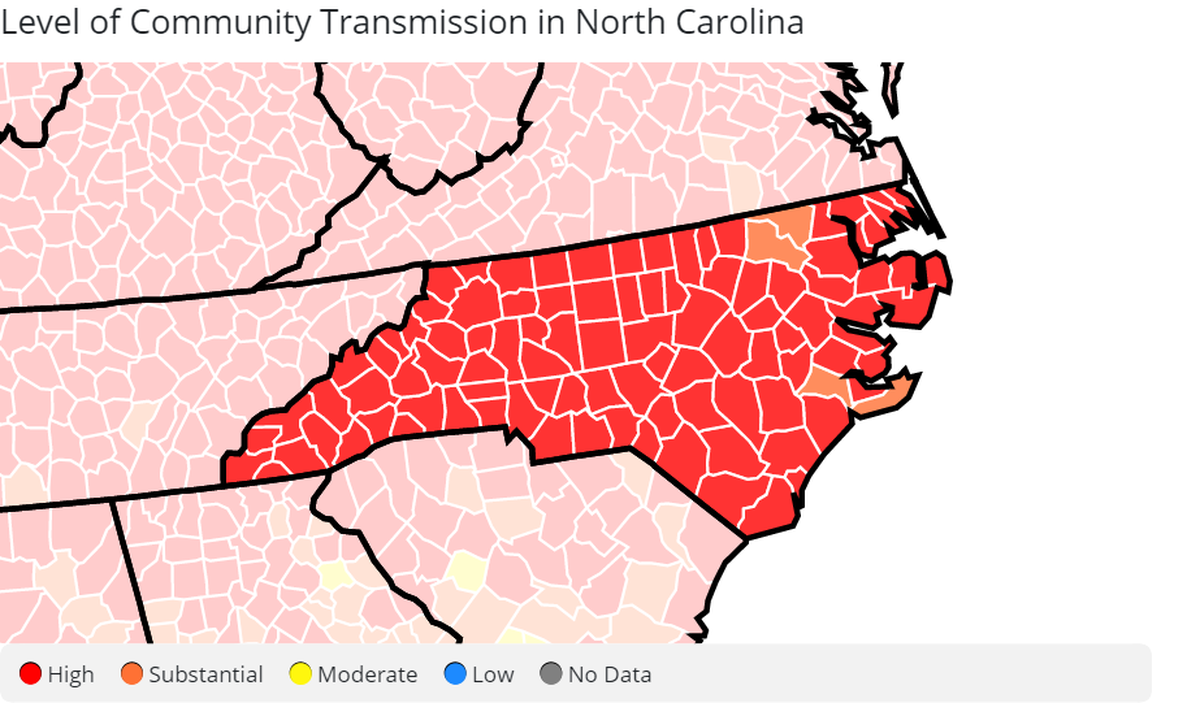
Dr. Mandy Cohen, secretary of the N.C. Department of Health and Human Services, said that community transmission of the virus has increased. The Centers for Disease Control and Prevention has designated all counties in North Carolina, excluding just four in the eastern part of the state, with the most severe level of transmission.
“We’re back in the red zone,” Cohen said at what will likely be her last news conference with Cooper on the state’s coronavirus response prior to her resignation at the end of the year.
The COVID-19 briefing came exactly a year after the first vaccine doses were administered in North Carolina. Vaccinations are now widely available and free for those ages 5 and older.
Cooper encouraged people to get vaccinated against the virus, including third-dose boosters of the vaccines from Pfizer and Moderna or a second-dose booster of Johnson & Johnson’s vaccine.
“As we gather again in December, we should get vaccinated to protect ourselves, our loved ones and others around us from severe COVID,” Cooper said.
Anyone in North Carolina 16 or older is eligible for boosters from each vaccine manufacturer. It is recommended to get the booster from either Pfizer or Moderna six months after the second dose. For the J&J vaccine, the wait is two months after the first dose.
Nearly 2 million in North Carolina have received booster shots as of Tuesday.
Omicron and vaccines
There is concern among public health experts that the highly mutated omicron variant, which was first found in North Carolina last week, may be able to evade immunity induced by either vaccination or natural infection.
But early data from Pfizer suggests that a third dose of the company’s vaccine provides significantly better protection against omicron.
Experts believe those with only protection gained from natural infection are at greater risk from the new variant.
Delta remains the dominant variant, making up nearly all new cases in North Carolina.
COVID numbers increasing
Cooper’s news conference comes as new cases, hospitalizations and ICU patients have increased since Thanksgiving, The News & Observer reported.
Cohen said at the press conference that new cases are mostly among children and young adults, who are less vaccinated than older populations.
Hospitalizations due to the virus, at 1,575, are at their highest since October as the state was coming down from its summer surge of the delta variant.
Among those hospitalized, 439 are in intensive care units, also the highest since October.
Public health experts expect cases to continue to increase throughout the holiday season as many will gather in-person over the next few weeks.
During last year’s holiday season, North Carolina saw the worst of COVID-19 as January was the deadliest of the pandemic. However, vaccines, which remain the best way to prevent COVID-19, were not widely available a year ago.
“We have the tools to beat back this pandemic,” said Cohen, emphasizing the need for boosters and more testing going into the holiday season. People can safely gather if they are boosted, tested and wear masks, Cohen said.
Cooper and Cohen said anyone gathering in-person throughout the holidays should get tested beforehand, as well as before and after traveling.
“Everyone should be wearing a mask when in public indoor places. Protect yourself and your family and friends. Vaccinate, test and mask,” she said.
Cohen’s last press conference
As of Tuesday, 69% of all adults in North Carolina are fully vaccinated. Among those eligible, ages 5 and up, 62% have received their shots.
Those unvaccinated are at the greatest risk of serious illness from COVID-19.
As of data from Dec. 1, those unvaccinated in North Carolina are more than five times as likely to contract COVID-19 and are more than 25 times as likely to die from the disease, compared to those vaccinated.
Cooper said Tuesday that vaccinations, rather than mandates, would be the state’s priority.
“Right now, the vaccines are where we need to concentrate, where we need to use our influence over this process, is to push those vaccinations,” Cooper said.
“We will continue to look at the data and get recommendations from the health experts, but I don’t expect any statewide mandates at this point,” he said.
While statewide restrictions were all lifted at the end of July, some local governments still have mask mandates based on CDC criteria in their county.
After legislation passed this fall, school boards must vote monthly on whether to keep or lift mask mandates in school buildings. The largest school system in the state, Wake County, has a mask mandate in place for all teachers, staff, students and visitors.
Cohen said that the vaccination rate in North Carolina for children ages 5 to 11 is very low, but that it is premature to talk about vaccine mandates for K-12 students.
She said she wants parents to know that she got her kids vaccinated the first weekend it was available, and it has brought her peace of mind that her children are protected. She urged parents to talk to their pediatrician and “do it because they want to protect their kids, because these vaccines do just that.”
Cohen, DHHS secretary for the past five years, told reporters when she announced her departure two weeks ago that she does not plan to run for any public office and was “looking at a range of opportunities” after taking some time off to spend with family.
“Certainly the last two years have been quite a marathon, and I’m so proud of all the work that we’ve been able to accomplish,” Cohen said then.
This story was originally published December 14, 2021 at 3:41 PM.
.jpg)