
B-17 Flying Fortress designed to haul bombs now carries a patriotic message
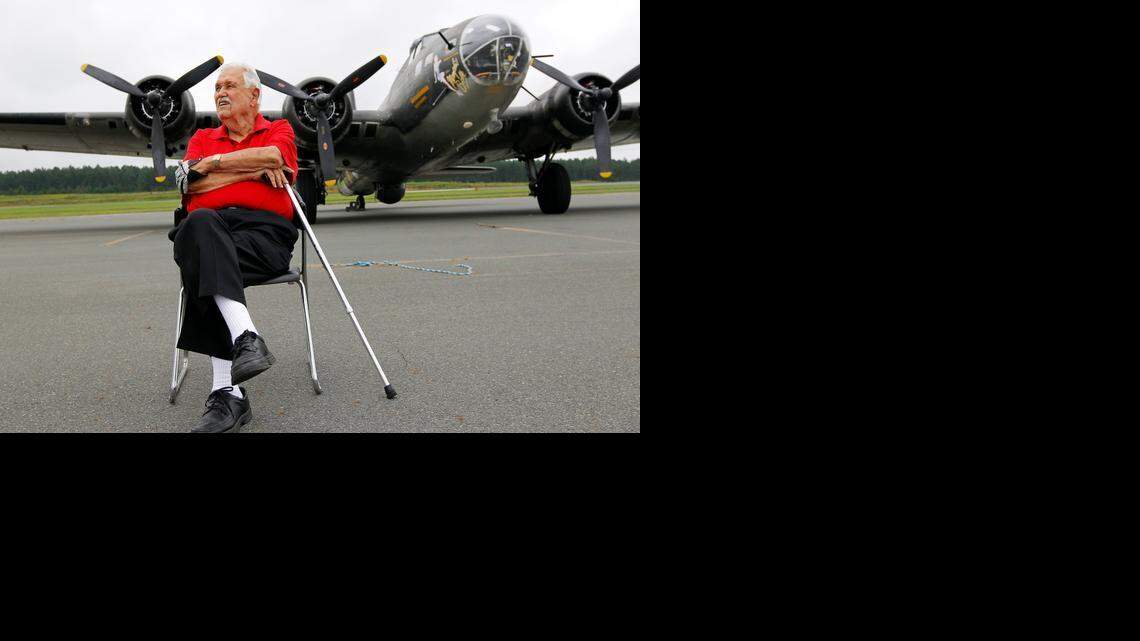
The old plane sat alone on the runway, an eery shape, a muscular ghost from a time nearly three-quarters of a century ago, when some of America’s most promising young men were testing a new strategy of war.
In 1942, a plane like this one – a B-17 bomber, the Flying Fortress – might have been idling at an airfield in England, its four engines and its 10-man crew warming up for the day ahead.
On Monday, this aircraft, which was built in 1945 but never saw combat, was serving as a symbol of the bravery, determination and ingenuity that American troops employed in planes like this during the war. It’s been painted to look like the storied Memphis Belle, one of the first B-17s to complete the 25 combat missions it needed before it could return home.
The Liberty Foundation, an Oklahoma-based nonprofit, uses the plane to educate the public about the air war and to honor the veterans who fought it.
Depending on the mission, a B-17 might have been one of dozens, or hundreds, of planes assigned to a bombing raid over a target in Germany. That was the 8th Air Force’s plan: Avoid a repeat of the trench fighting of World War I by crippling the enemy’s ability to fund and supply a war by carpet-bombing its economic engines and materiel manufacturing. For the sake of accuracy, the Mighty 8th flew in the daytime, when the crews could best see their targets.
That meant the planes could also be seen by the well-armed enemy forces who, if they couldn’t eyeball the actual aircraft from 25,000 feet below or spot them on radar, could guess their trajectory by the telltale vapor trails they left in that high, frigid air.
This was extraordinarily dangerous work. Though B-17s proved to be tough, reliable aircraft whose pilots could return them to their airfields with hunks out of their tail pieces and gaping holes in their fuselages, their crews often came back battered too, or not at all. From 1942 to the end of the war, nearly 250,000 American troops had flown in B-17s, and 46,500 of them were killed or wounded, according to histories of the plane.
A chance to fly again
The growling B-17 on the runway of the Raleigh Executive Jetport on Monday morning played the part of the Memphis Belle in the 1990 movie made about the original aircraft and crew, which included Asheville’s own Robert Morgan, a 23-year-old captain when he served as its pilot.
On Monday, the intended crew had a luxury that combat crews in World War II rarely enjoyed. They could not go airborne under the morning’s heavy skies.
They would have liked to. If the clouds had lifted, Bob Hill and Stuart Goldstein, volunteer pilot and co-pilot with the Liberty Foundation, would have taken 95-year-old Oscar Alford Smith up in the air and back in time.
Smith rode to the airport, just outside Sanford, from Burlington with his daughter, granddaughter and nephew for a chance to fly in a Fortress again.
Smith was trained as a pilot during the war. He volunteered for the job because, he said, “I didn’t want to be in the ground troops.”
After he finished his training, he thought he would be given a plane, a crew and a thrilling assignment in Europe. Instead, he was stationed in Idaho, where he trained others to fly. He racked up more than 5,000 hours in the B-24, 200 hours in the B-29 and 100 in the B-17.
“Great aircraft,” he said Monday before climbing aboard. He negotiated the cramped cabin, tiptoed over the ball turret, balanced on the narrow catwalk and took a seat in the cockpit, where he asked Goldstein if his recollection of the engine-starting sequence was correct.
It was.
Jon Eades, the plane’s crew chief, said that as the plane travels around the country, he is amazed at the way it brings veterans’ memories to the surface. They may never have told their families about their war experiences and may think they have forgotten themselves.
But when they feel the plane’s aluminum skin, hear its engines rumble and smell the smoke, he said, “They just start talking. The memories come pouring out.”
This story was originally published September 15, 2014 at 8:00 PM with the headline "B-17 Flying Fortress designed to haul bombs now carries a patriotic message."